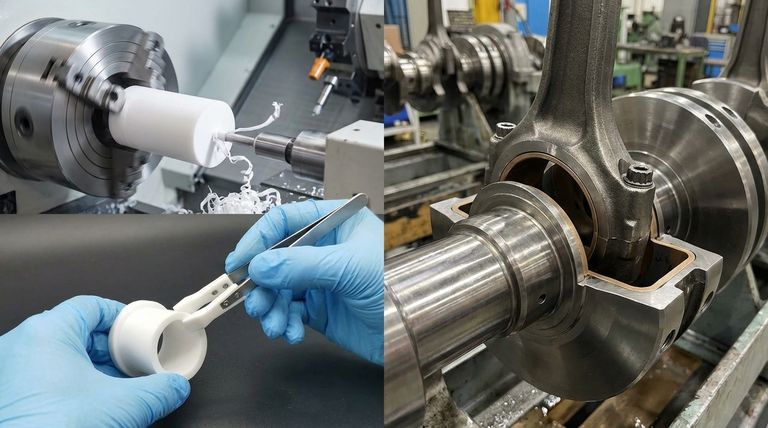
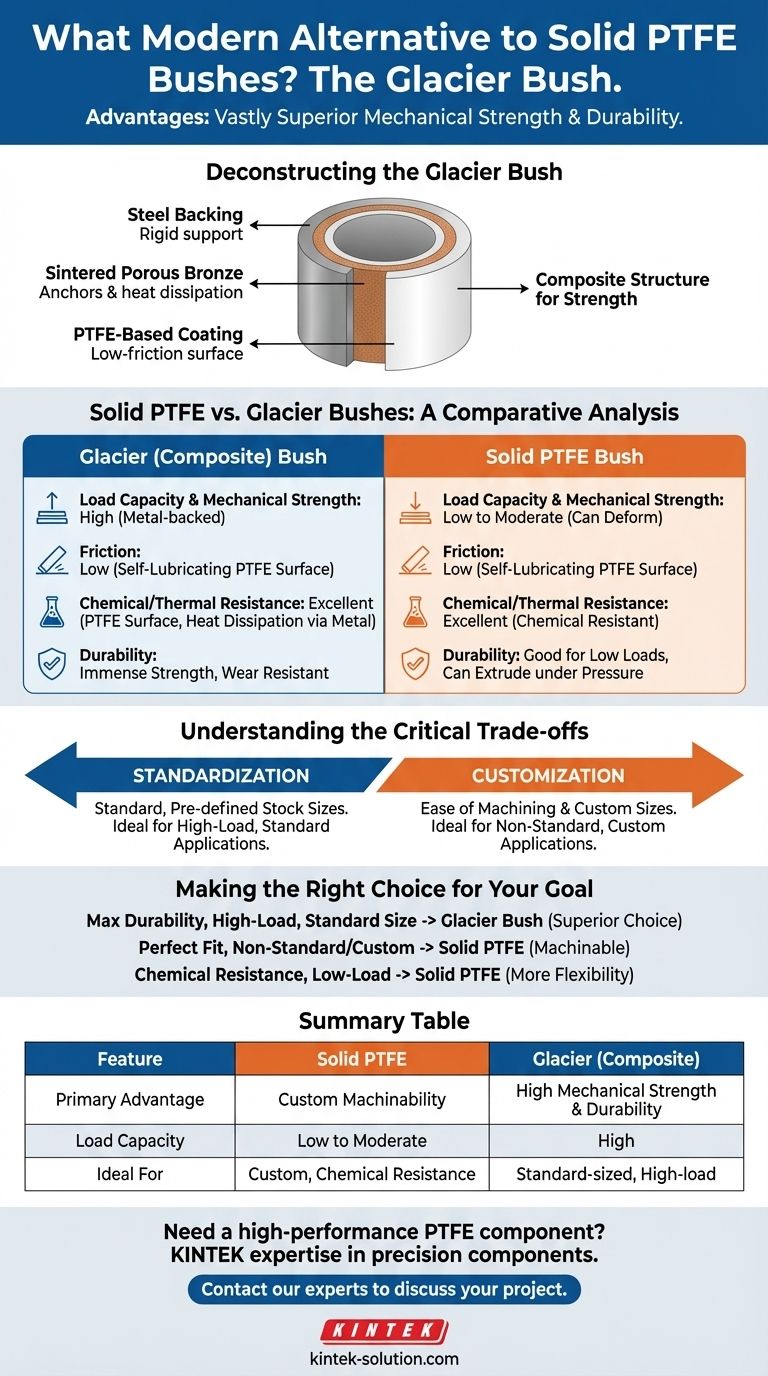
The modern alternative mentioned is a Glacier bush. This is a composite component consisting of a thin steel backing, a sintered bronze substrate, and a very thin surface layer of PTFE. Its primary advantage over a solid PTFE bush is vastly superior mechanical strength and durability, allowing it to be used in high-load applications.
The core decision between a solid PTFE bush and a Glacier-type bush is a trade-off. You must choose between the superior strength and durability of a standardized Glacier bush and the custom machinability of a solid PTFE bush for non-standard applications.
Deconstructing the Glacier Bush
A Glacier bush isn't a solid piece of plastic; it's a layered, engineered component designed to combine the best properties of metal and PTFE.
A Composite for Strength
The construction is key to its performance. It starts with a strong steel backing that provides rigid structural support.
Bonded to that is a layer of sintered porous bronze. This intermediate layer helps anchor the final surface and aids in heat dissipation.
The final, innermost layer is a thin PTFE-based coating that provides the extremely low-friction sliding surface.
The Advantage of Durability
This composite structure gives the Glacier bush immense strength and wear resistance compared to a solid polymer bush.
This durability makes it suitable for demanding, high-load applications where solid PTFE would fail, such as in crankshaft main bushes within an engine.
Solid PTFE vs. Glacier Bushes
While both utilize the low-friction properties of PTFE, their ideal use cases are fundamentally different due to their construction.
Load Capacity and Mechanical Strength
The steel and bronze layers give Glacier bushes a significantly higher load capacity.
Solid PTFE, while excellent for low friction, can deform or extrude under high pressure and is not suitable for high-load mechanical applications. Carbon-filled PTFE variants offer improved strength but still do not match a metal-backed bush.
Friction and Self-Lubrication
Both options provide an exceptionally low coefficient of friction because the contact surface is PTFE.
They are both considered self-lubricating, making them ideal for applications where regular maintenance is difficult or where lubricants could cause contamination.
Chemical and Thermal Resistance
The PTFE surface on both types provides excellent resistance to chemicals and a wide range of operating temperatures.
The metal backing of a Glacier bush can also help conduct heat away from the bearing surface more effectively than a solid polymer bush.
Understanding the Critical Trade-offs
Choosing the wrong type of bush for your application can lead to premature failure. The decision hinges almost entirely on one key factor: standardization versus customization.
The Customization Constraint
The primary limitation of Glacier bushes is that they are typically manufactured in standard, pre-defined stock sizes.
If your application involves a non-standard shaft or housing diameter, such as custom fork stanchions, you will likely be unable to find a Glacier bush that fits.
The Machinability Factor
Conversely, the key advantage of solid PTFE is its ease of machining and customization.
You can machine a solid PTFE billet into any custom size or shape required for a specific, non-standard application. This flexibility is its greatest strength.
Application Environment
Solid PTFE is the ideal choice for environments where chemical corrosion is the main concern and loads are low to moderate.
Glacier bushes excel in environments defined by high mechanical loads and abrasive wear, where a standard size can be used.
Making the Right Choice for Your Goal
To select the correct material, you must first define your primary engineering constraint.
- If your primary focus is maximum durability in a high-load, standard-sized application: The metal-backed Glacier bush is the superior choice.
- If your primary focus is creating a perfect fit for a non-standard or custom component: Solid PTFE is your only practical option due to its machinability.
- If your primary focus is chemical resistance in a low-load environment: Either option will perform well, but solid PTFE offers more design flexibility.
Ultimately, your decision is guided by balancing the need for custom fabrication against the demand for high mechanical strength.
Summary Table:
| Feature | Solid PTFE Bush | Glacier (Composite) Bush |
|---|---|---|
| Primary Advantage | Custom machinability for non-standard sizes | High mechanical strength & durability |
| Load Capacity | Low to moderate | High |
| Ideal For | Custom applications, chemical resistance | Standard-sized, high-load applications |
Need a high-performance PTFE component for your application?
Whether your priority is the extreme durability of a metal-backed composite bush for a high-load industrial application or the custom machinability of solid PTFE for a specialized medical or laboratory device, KINTEK has the expertise.
We manufacture precision PTFE components (including seals, liners, labware, and custom bushes) for the semiconductor, medical, laboratory, and industrial sectors. From prototypes to high-volume orders, we deliver the right solution for your specific strength, chemical resistance, and customization needs.
Contact our experts today to discuss your project requirements and get a quote.
Visual Guide
Related Products
- Custom PTFE Constant Pressure Separatory Funnel Corrosion Resistant Low Background Labware for PFA Flasks
- Customizable PTFE Rods for Advanced Industrial Applications
- Custom PTFE Sleeves and Hollow Rods for Advanced Applications
- Custom Graphite Filled PTFE Rods for Advanced Industrial Applications
- PTFE PFA Vacuum Filtration System Corrosion Resistant Customizable Shatterproof Laboratory Device
People Also Ask
- What customization options are available for PTFE materials? Tailor Performance for Your Application
- Why is specialized eluent selection critical for SEC of fluoropolymers, and how do PTFE/PFA labware components support this?
- What fundamental molecular characteristics give fluoropolymer labware, such as PTFE and PFA containers, their exceptional chemical inertness and high temperature resistance?
- How do the surface energy and nonpolarity of PTFE and PFA labware benefit high-purity trace analysis and sample preparation? Reduce sample loss and contamination.
- What industries use custom PTFE parts and for what purposes? Solve Critical Challenges with High-Performance Materials