At their core, PTFE V-Rings are specified for industries that cannot afford seal failure, including chemical processing, food and beverage, pharmaceuticals, and automotive. Their adoption is driven by PTFE’s unique ability to withstand aggressive chemicals, extreme temperatures, and dynamic friction where lesser materials would quickly degrade.
The question isn't just which industries use PTFE V-Rings, but why they have become the default choice for critical sealing applications. The answer lies in PTFE's unmatched combination of chemical inertness, temperature resilience, and low friction.
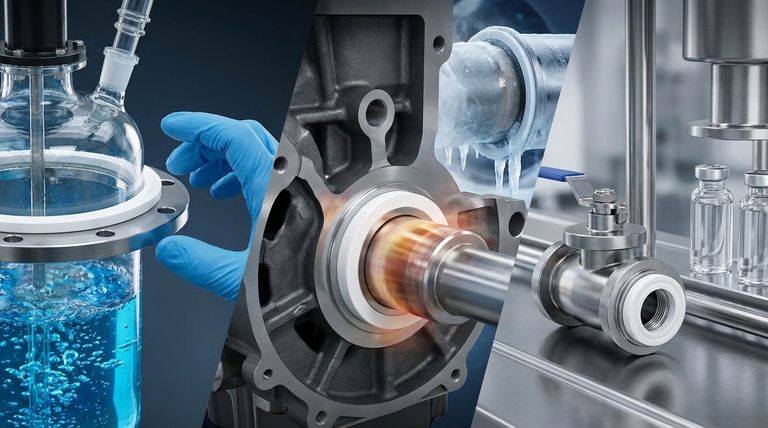
Why PTFE is the Material of Choice for Demanding Seals
The value of a PTFE V-Ring is not in the component itself, but in the properties of the material it is made from. Understanding these properties is key to understanding its industrial applications.
Unmatched Chemical Resistance
PTFE is virtually inert to almost all industrial chemicals, acids, and solvents. This makes it an essential material for equipment that handles corrosive substances.
Seals made from other materials would corrode and fail, leading to dangerous leaks and costly downtime.
Extreme Temperature Tolerance
PTFE maintains its integrity and sealing capability across an exceptionally wide temperature range. It can perform reliably in cryogenic conditions and in high-heat environments where many plastics and elastomers would become brittle or melt.
This thermal stability is critical for processes in aerospace, automotive engines, and industrial manufacturing.
Exceptionally Low Friction
PTFE has one of the lowest coefficients of friction of any solid material, often compared to wet ice on wet ice. This "non-stick" property is vital for dynamic seals in moving parts like pumps and pistons.
This reduces wear on machinery, lowers energy consumption, and prevents the "stick-slip" phenomenon that can cause jerky movement and premature failure.
Purity and Non-Toxicity
Virgin PTFE is inherently pure, non-toxic, and can comply with strict regulatory standards, including those from the FDA. It does not impart taste, color, or contaminants.
This makes it the only viable choice for many applications in food processing, beverage production, and pharmaceutical manufacturing where product purity is non-negotiable.
Key Industry Applications in Detail
These fundamental properties directly translate into mission-critical applications across several major sectors.
Chemical Processing and Manufacturing
In this industry, V-rings are used to seal pumps, valves, and mixers that handle highly corrosive substances. The chemical inertness of PTFE prevents seal degradation and ensures process safety.
Food, Beverage, and Pharmaceuticals
Here, hygiene is paramount. PTFE V-rings are used in processing and packaging equipment because they are non-toxic, do not contaminate the product, and can withstand aggressive clean-in-place (CIP) chemicals and high-temperature sterilization.
Automotive and Aerospace
In automotive engines and transmissions, PTFE V-rings seal fluids under high-temperature and high-wear conditions. In aerospace, they are used in hydraulic systems and fuel lines where reliability across extreme temperature shifts is essential.
Oil and Gas Exploration
PTFE seals are critical in high-pressure, high-temperature (HPHT) downhole tools and surface equipment. They must resist aggressive chemicals and maintain a seal under immense mechanical stress, preventing catastrophic failures.
Understanding the Trade-offs
No material is perfect, and being an effective advisor means acknowledging limitations. Objectivity requires understanding where PTFE might not be the right choice without modification.
Low Mechanical Strength
Unfilled, or "virgin," PTFE is a relatively soft material. Under high mechanical loads, it can be prone to deformation, a phenomenon known as creep or cold flow.
Wear Resistance
While its low friction reduces wear, pure PTFE itself can wear down in high-speed, dynamic applications without reinforcement.
The Role of Fillers
To counteract these weaknesses, PTFE is often blended with fillers like carbon, glass fiber, or bronze. These fillers dramatically improve mechanical strength, wear resistance, and dimensional stability, making the V-rings suitable for much more demanding dynamic and high-pressure applications.
Making the Right Choice for Your Application
The selection of a PTFE V-ring is not a one-size-fits-all decision. It must be aligned with the specific demands of the operating environment.
- If your primary focus is sealing against aggressive chemicals: Virgin PTFE is often the best choice due to its superior chemical inertness.
- If your primary focus is ensuring purity in food or pharma: You must specify virgin, FDA-compliant PTFE to avoid any possibility of contamination.
- If your primary focus is a high-wear, dynamic application: A filled PTFE compound (e.g., carbon or glass-filled) is necessary to provide the required mechanical strength and durability.
- If your primary focus is a high-pressure, high-temperature environment: A specialized, filled PTFE V-ring is required to resist creep and maintain seal integrity under extreme stress.
Understanding the core properties of PTFE allows you to select the precise sealing solution that ensures reliability, safety, and performance.
Summary Table:
| Industry | Primary Application | Key PTFE Benefit |
|---|---|---|
| Chemical Processing | Sealing pumps, valves, and mixers | Unmatched chemical resistance |
| Food, Beverage & Pharma | Processing and packaging equipment | Purity, non-toxicity, FDA compliance |
| Automotive & Aerospace | Engine seals, hydraulic systems | Extreme temperature tolerance |
| Oil & Gas | High-pressure, high-temperature tools | Chemical and thermal stability |
Need a reliable PTFE sealing solution for your critical application? At KINTEK, we specialize in manufacturing high-performance PTFE components—including custom V-Rings, seals, liners, and labware—for semiconductor, medical, laboratory, and industrial sectors. Whether you require virgin PTFE for chemical resistance or filled compounds for dynamic wear, our precision production and custom fabrication (from prototypes to high-volume orders) ensure your seals perform under extreme conditions. Contact us today to discuss your specific requirements!
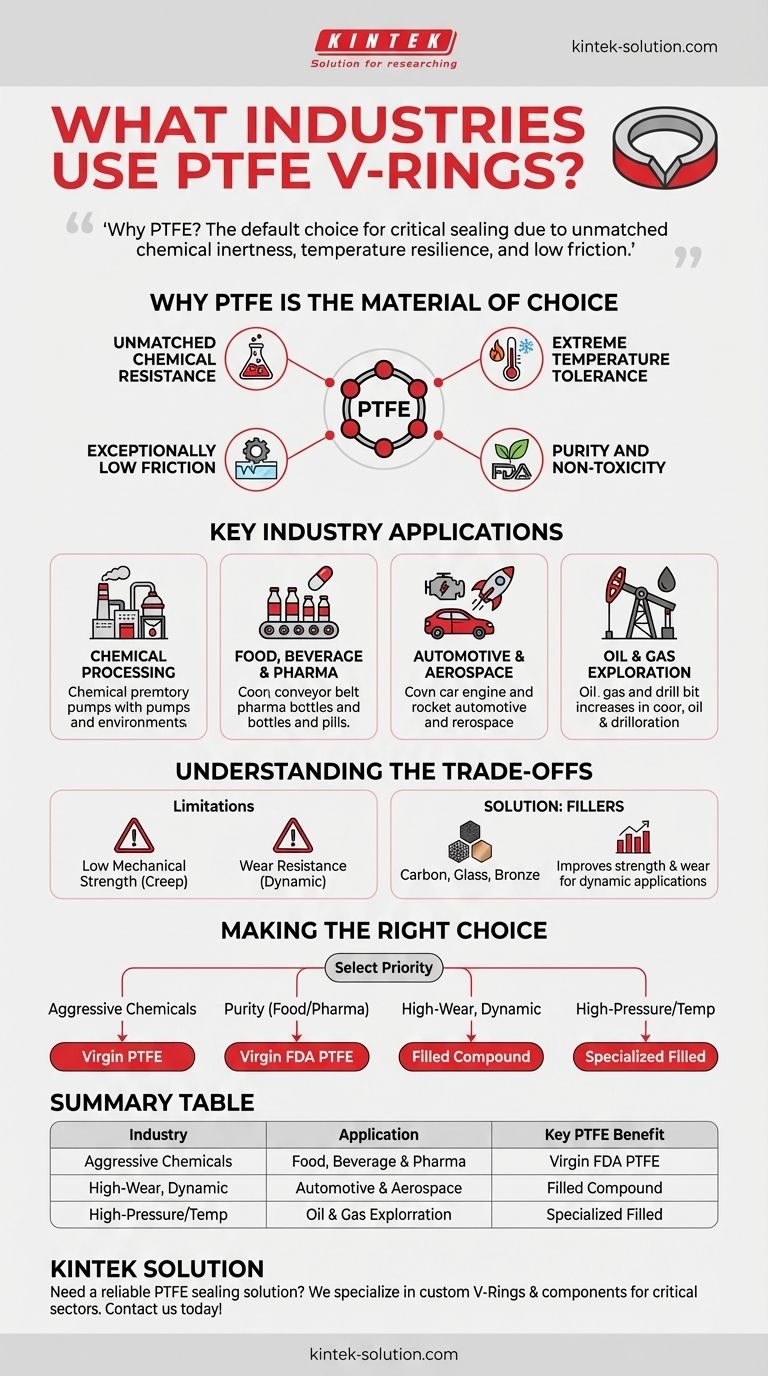
Visual Guide
Related Products
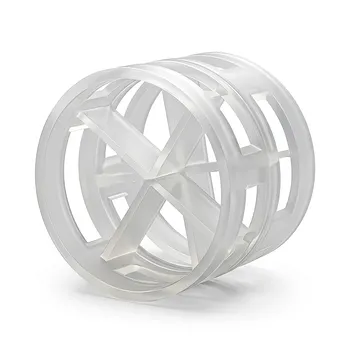
- High Purity PFA PTFE Raschig Rings for Chemical Distillation Tower Packing in Acidic and Alkaline Environments
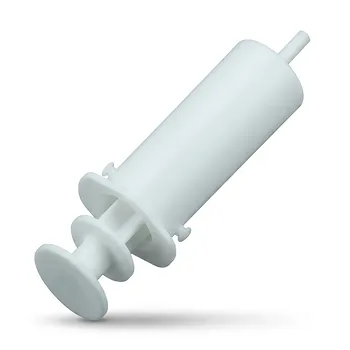
- High Purity Laboratory Grade PTFE Syringe Chemical Resistant Fluoropolymer Injector for Trace Analysis
- Customizable PTFE Rods for Advanced Industrial Applications
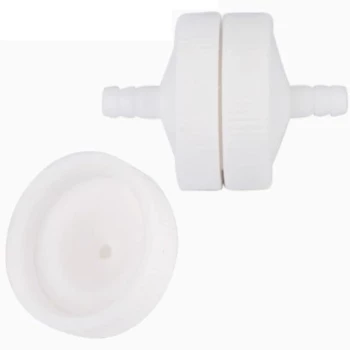
- Customizable PTFE Seals Filter Holders for Versatile Applications
- High Corrosion Resistant PTFE Faucet Polytetrafluoroethylene Valve for Chemical Storage Drums and Fluid Transfer Systems Customizable Industrial Grade
People Also Ask
- What properties make PTFE seal rings suitable for food, beverage, and pharma? Ensure Purity & Regulatory Compliance
- What are the key properties of PTFE that make it suitable for sealing rings? Unmatched Chemical & Thermal Resistance
- How does temperature affect the performance and design of PTFE seal rings? Optimize for -200°C to +260°C environments.
- How do PTFE seal rings perform in the high-pressure and corrosive environments of the oil and gas sector? - Guide
- How do fillers such as glass fiber, carbon, bronze, and graphite enhance the performance of PTFE seal rings? Key Benefits