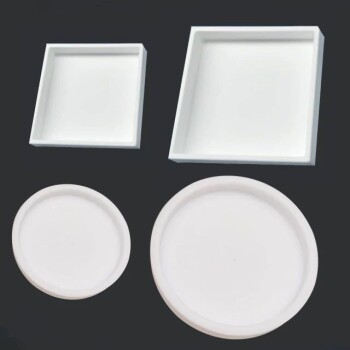
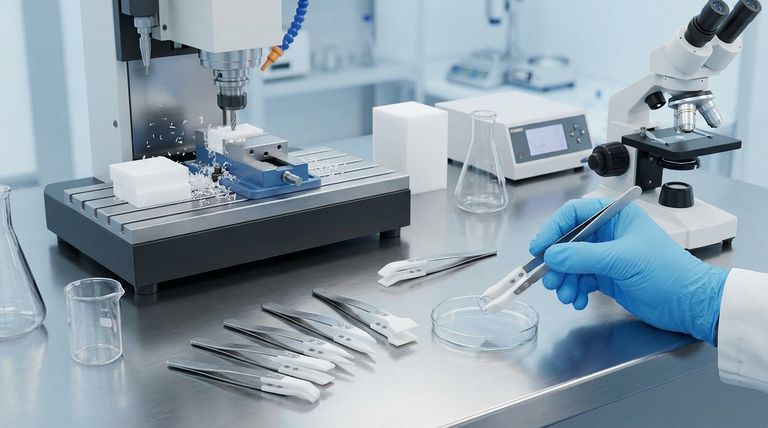
The unique properties of PTFE that make it highly suitable for CNC machining are its exceptional chemical inertness, wide thermal stability, and an extremely low coefficient of friction. These characteristics make it a go-to material for parts that must operate in harsh environments or require smooth, non-stick surfaces, such as seals, bearings, and electrical insulators.
While PTFE's core properties make it incredibly valuable for finished components, its inherent softness and tendency to expand with heat present unique challenges. Successful machining depends entirely on understanding and managing these material behaviors.
The Core Properties Driving PTFE's Value
Polytetrafluoroethylene (PTFE), commonly known by the brand name Teflon, is a fluoropolymer with a distinct combination of traits that make it a frequent choice for machined parts in demanding applications.
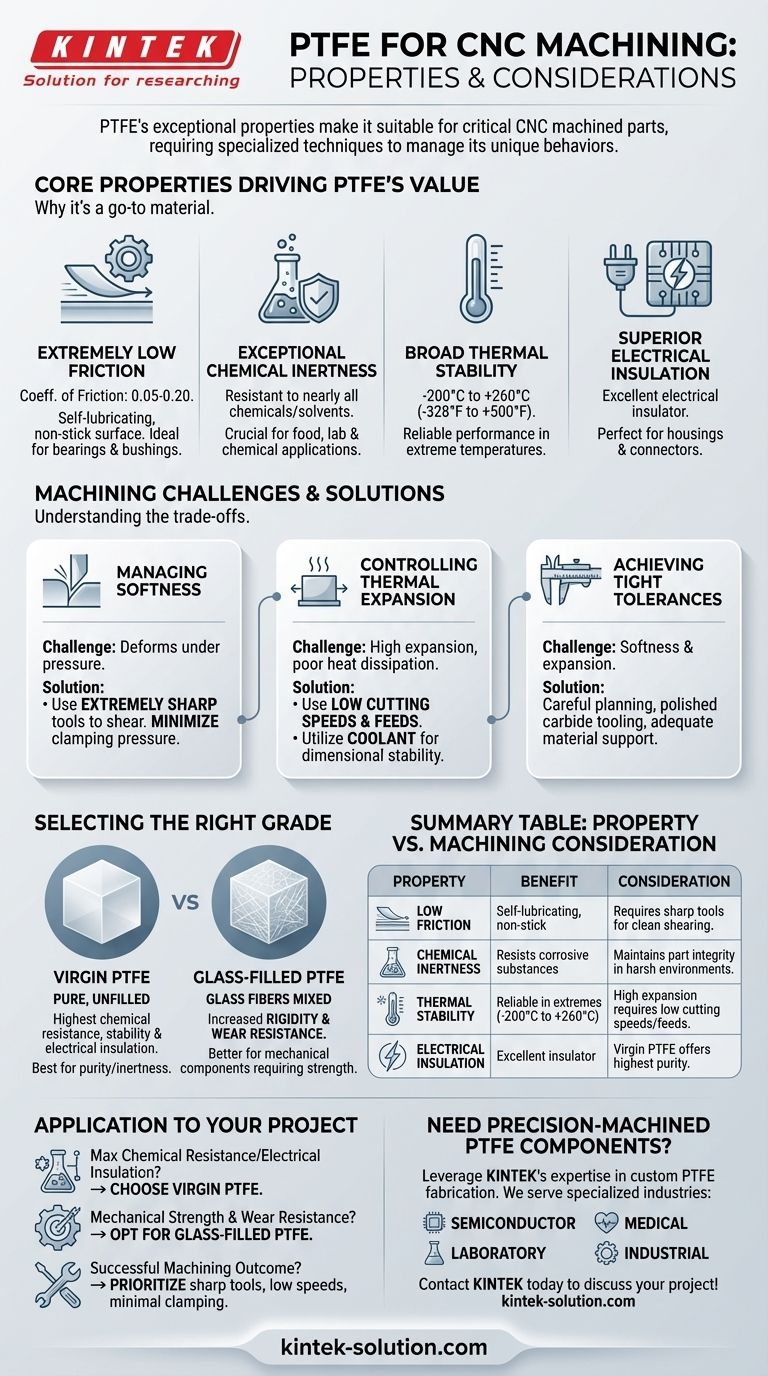
Extremely Low Friction
PTFE has one of the lowest coefficients of friction of any solid material, typically between 0.05 and 0.20.
This creates a self-lubricating, non-stick surface ideal for components like bearings and bushings where smooth movement and low wear are critical.
Exceptional Chemical Inertness
This material is highly resistant to nearly all chemicals and solvents.
This property makes it indispensable for components used in food processing, laboratory instrumentation, and chemical manufacturing where exposure to corrosive substances is constant.
Broad Thermal Stability
PTFE maintains its integrity across an exceptionally wide range of temperatures, from -200°C to +260°C (-328°F to +500°F).
This allows machined PTFE parts to perform reliably in applications involving extreme cold or high heat without degrading.
Superior Electrical Insulation
PTFE is an excellent electrical insulator, making it a perfect material for manufacturing electrical housings, connectors, and other components where blocking electrical current is necessary.
Understanding the Trade-offs: Machining Challenges
The very properties that make PTFE desirable also introduce specific challenges during the CNC machining process. An operator's success hinges on mitigating these factors.
Managing Material Softness
PTFE is a soft material that can easily deform under pressure.
This requires using extremely sharp tools to shear the material cleanly rather than push it. It also means clamping pressure must be minimized to avoid distorting the workpiece during machining.
Controlling Thermal Expansion
The material has a high rate of thermal expansion and does not dissipate heat well.
Friction from cutting tools can generate heat, causing the part to expand and throwing off final dimensions. This necessitates using low cutting speeds and feeds and often requires coolant to maintain dimensional stability.
Achieving Tight Tolerances
The combination of softness and thermal expansion makes holding tight tolerances a significant challenge.
Success requires careful planning, appropriate tooling (such as polished carbide tools), and providing adequate support for the material to prevent tool chatter or vibration.
Selecting the Right Grade of PTFE
Not all PTFE is the same. The grade you choose directly impacts the final part's performance characteristics.
Virgin PTFE
This is pure, unfilled PTFE. It offers the highest chemical resistance, stability, and electrical insulation properties.
It is the ideal choice when purity and inertness are the primary requirements for the application.
Glass-Filled PTFE
This grade includes glass fibers mixed into the PTFE resin.
The glass provides increased rigidity and wear resistance, making it better suited for mechanical components that require higher strength and durability than virgin PTFE can offer.
How to Apply This to Your Project
Your specific goal will determine which material properties and machining considerations are most important.
- If your primary focus is maximum chemical resistance or electrical insulation: Choose virgin PTFE for its purity and superior inertness.
- If your primary focus is mechanical strength and wear resistance: Opt for glass-filled PTFE to gain the necessary rigidity and durability for your component.
- If your primary focus is achieving a successful machining outcome: Prioritize using exceptionally sharp tools, low cutting speeds, and minimal clamping force to manage the material's softness and thermal expansion.
Ultimately, mastering PTFE machining is about adapting your process to respect the material's unique combination of strengths and sensitivities.
Summary Table:
| Property | Benefit for Machined Parts | Key Consideration for Machining |
|---|---|---|
| Low Friction (0.05-0.20) | Self-lubricating, non-stick surfaces for bearings, seals. | Minimizes wear but requires sharp tools for clean shearing. |
| Chemical Inertness | Resists corrosive substances; ideal for labs, chemical processing. | Maintains part integrity in harsh environments. |
| Thermal Stability (-200°C to +260°C) | Reliable performance in extreme temperatures. | High thermal expansion requires low cutting speeds/feeds. |
| Electrical Insulation | Excellent for electrical housings and connectors. | Virgin PTFE offers the highest purity for critical applications. |
Need Precision-Machined PTFE Components?
Leverage KINTEK's expertise in custom PTFE fabrication. We understand the unique challenges of machining PTFE and its variants, like glass-filled grades for enhanced strength. Our precision production ensures your components—from seals and liners to complex labware—meet exact specifications, from prototypes to high-volume orders.
We serve specialized industries where material performance is critical:
- Semiconductor
- Medical
- Laboratory
- Industrial
Contact KINTEB today to discuss your project and get a quote for reliable, high-performance PTFE parts!
Visual Guide
Related Products
- Custom PTFE Filtration System Acid Resistant High Purity Semiconductor Grade Chemical Processing Filter
- High Corrosion Resistant PTFE Faucet Polytetrafluoroethylene Valve for Chemical Storage Drums and Fluid Transfer Systems Customizable Industrial Grade
- PTFE PFA Vacuum Filtration System Corrosion Resistant Customizable Shatterproof Laboratory Device
- PTFE Corrosion Resistant Filter with PFA Valve Connections and Integrated Sieve Plate
- High Temperature Chemical Resistant 50ml PTFE Syringe Customized Teflon Injector with Threaded Seal for Trace Analysis
People Also Ask
- What makes PTFE filtration systems advantageous for industrial and scientific use? Unmatched Chemical & Thermal Stability
- What sizes and pore options are available for PTFE filters? Choose the Right Filter for Your Application
- What steps are involved in selecting the proper PTFE filter? A 4-Step Guide to Optimal Filtration
- What temperature resistance do PTFE filters offer? Unmatched Thermal Stability from -200°C to +260°C
- How does the hydrophobicity of PTFE filters benefit their use? Ensure Uninterrupted Gas Flow and Solvent Filtration