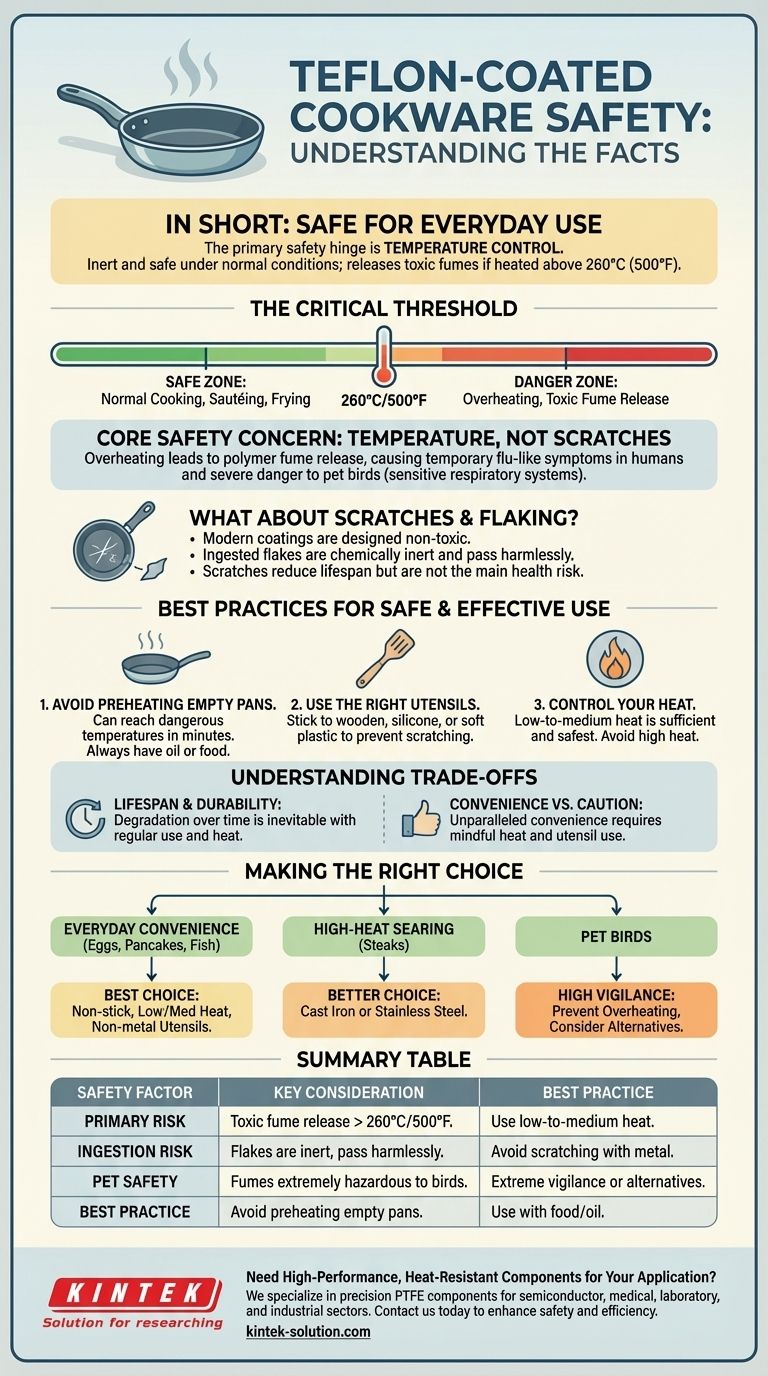
In short, Teflon-coated cookware is considered safe for everyday cooking. The primary safety concern is not the coating itself under normal conditions, but rather the potential for it to release harmful fumes if it is overheated to extreme temperatures. As long as you use the cookware within its intended temperature range, it poses no significant health risk.
The central takeaway is this: The safety of Teflon cookware hinges entirely on temperature control. The material is inert and safe during normal use, but it can break down and release toxic fumes if heated above 260°C (500°F).
The Core Safety Concern: Temperature, Not Scratches
The debate around Teflon safety can be simplified by focusing on the one factor that truly matters: heat. Most other concerns are secondary to this fundamental principle.
The Critical Temperature Threshold
Teflon's non-stick coating is stable and non-reactive at typical cooking temperatures. However, its chemical structure begins to deteriorate when it surpasses approximately 260°C (500°F).
This temperature is significantly higher than the boiling point of water (100°C / 212°F) and the typical temperatures used for most frying and sautéing.
The Risk of Toxic Fumes
When Teflon is overheated, the deteriorating coating can release polymer fumes. Inhaling these fumes can lead to temporary flu-like symptoms in humans.
This risk is particularly acute for pet birds, whose respiratory systems are extremely sensitive. The fumes from an overheated non-stick pan can be fatal to them, which underscores the importance of proper temperature management.
What About Scratches and Flaking?
While scratches from metal utensils will damage the non-stick surface and shorten the pan's lifespan, they are not the primary health concern.
Modern non-stick coatings are designed to be non-toxic. If a small flake of the coating is accidentally ingested, it is expected to pass harmlessly through the digestive system as the material is chemically inert.
Best Practices for Safe and Effective Use
Properly caring for your non-stick cookware not only extends its life but is also the key to ensuring its safety.
Avoid Preheating Empty Pans
An empty pan can reach the critical temperature threshold of 260°C (500°F) in just a few minutes on a high burner. Always have oil, butter, or food in the pan before you turn on the heat.
Use the Right Utensils
To prevent scratching and preserve the coating, always use wooden, silicone, or soft plastic utensils. Avoid metal spatulas, forks, or knives, as they will abrade the non-stick surface.
Control Your Heat
Most non-stick cooking is best done on low to medium heat. High heat is rarely necessary and is the fastest way to approach the temperature danger zone, risking damage to your pan and the release of fumes.
Understanding the Trade-offs
While safe and convenient, non-stick cookware comes with certain considerations that set it apart from other materials.
Lifespan and Durability
Unlike cast iron or stainless steel, a Teflon coating will inevitably degrade over time. Regular use, heat exposure, and utensil abrasion all contribute to this gradual breakdown.
Convenience vs. Caution
The unparalleled convenience of a non-stick surface requires a more cautious approach to cooking. You must be mindful of the heat you use and the utensils you choose to maintain both the pan's performance and its safety profile.
Making the Right Choice for Your Goal
To use Teflon cookware safely, align your cooking method with the material's strengths and weaknesses.
- If your primary focus is everyday convenience: Non-stick cookware is an excellent choice for eggs, pancakes, and delicate fish, provided you use low-to-medium heat and non-metal utensils.
- If your primary focus is high-heat searing: A cast iron or stainless steel pan is a superior and safer tool for tasks like searing steaks, as these materials are designed to handle extreme temperatures.
- If you own pet birds: You must be exceptionally vigilant about preventing overheating, or consider using alternative cookware materials to eliminate the risk of toxic fumes entirely.
By understanding how to manage heat and care for the surface, you can confidently leverage the benefits of non-stick cookware without compromising safety.
Summary Table:
| Safety Factor | Key Consideration |
|---|---|
| Primary Risk | Toxic fume release when overheated above 260°C (500°F). |
| Ingestion Risk | Ingested flakes are chemically inert and pass harmlessly. |
| Pet Safety | Fumes are extremely hazardous to birds; requires high vigilance. |
| Best Practice | Use low-to-medium heat and avoid preheating empty pans. |
Need High-Performance, Heat-Resistant Components for Your Application?
At KINTEK, we specialize in manufacturing precision PTFE components (like seals, liners, and labware) for the semiconductor, medical, laboratory, and industrial sectors. Our expertise in custom fabrication—from prototypes to high-volume orders—ensures you get durable, reliable parts designed to perform safely under specific thermal conditions.
Contact us today to discuss your project requirements and discover how our precision PTFE solutions can enhance the safety and efficiency of your operations.
Visual Guide
Related Products
- Custom Large Diameter PTFE Petri Dishes High Purity Corrosion Resistant 210mm Non Stick Labware
- Custom PTFE Petri Dish 90mm Diameter Corrosion Resistant Low Background High Purity Labware
- Custom PTFE Petri Dish 120mm Diameter Corrosion Resistant Low Background High Purity Labware
- Custom PTFE Petri Dishes Corrosion Resistant High Purity Low Background Labware
- Custom Polytetrafluoroethylene PTFE Petri Dishes 60mm Corrosion Resistant Low Background Labware
People Also Ask
- Why are PTFE or PFA Petri dishes preferred for membrane casting? Ensure Damage-Free Recovery & Chemical Purity
- What are the benefits of Teflon's non-stick properties in industrial settings? Boost Uptime & Cut Costs
- Why is it dangerous to overheat Teflon cookware? Avoid Toxic Fumes & Protect Your Family
- Does Teflon release harmful gases when heated? Understanding Safe Cooking Temperatures
- How is Teflon used in cookware? Leveraging Non-Stick Properties for Superior Cooking