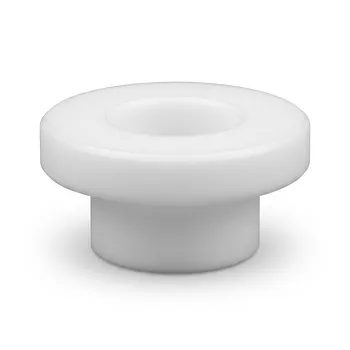
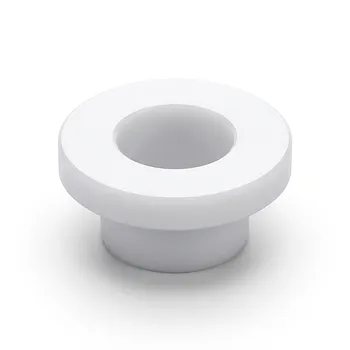
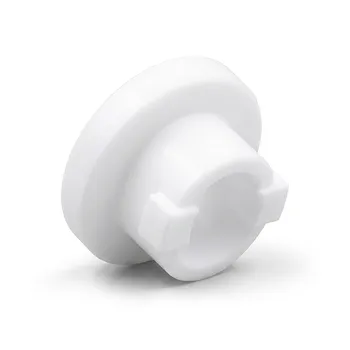
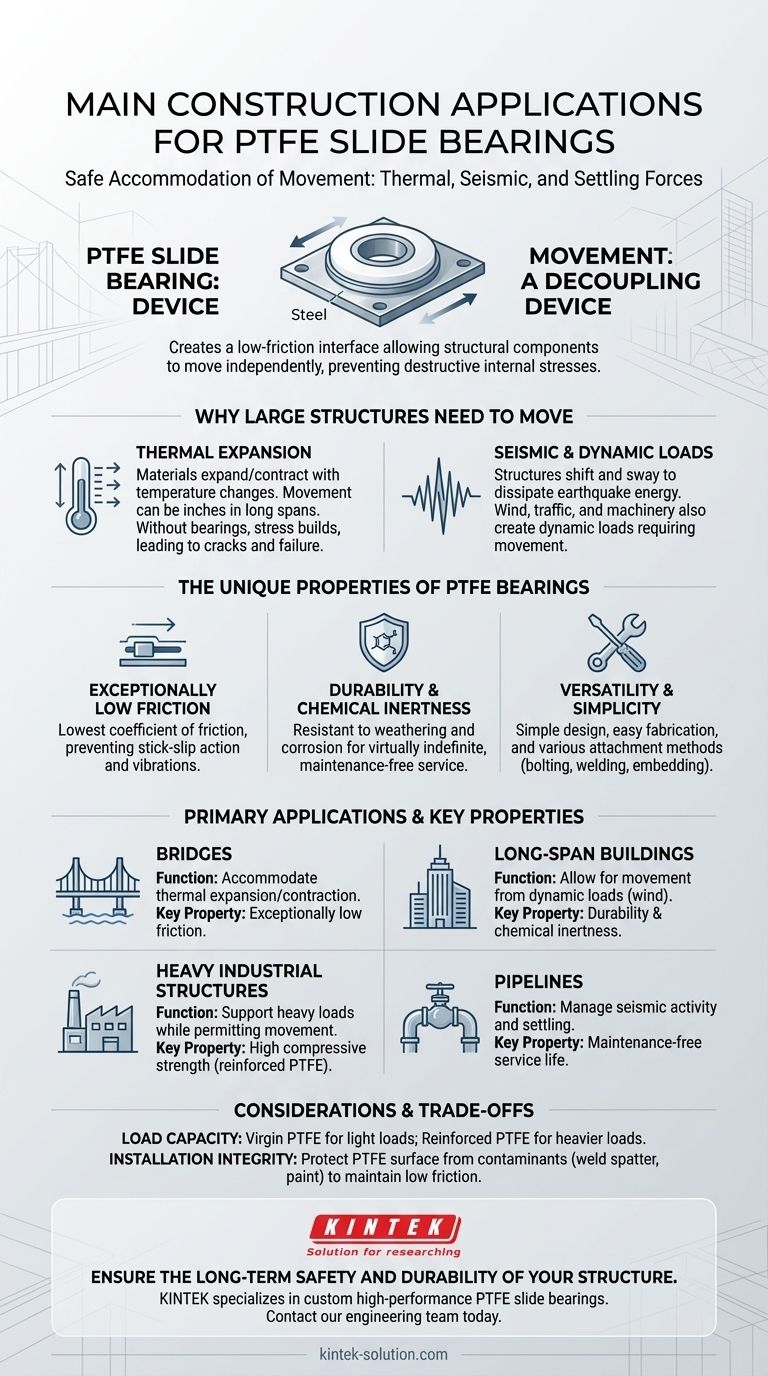
The primary construction applications for PTFE slide bearings are in bridges, long-span commercial buildings, heavy industrial structures, and pipelines. These components are engineered to safely accommodate movement caused by thermal expansion and contraction, seismic activity, and the settling of structural elements over time.
A PTFE slide bearing is fundamentally a decoupling device. It creates a low-friction interface that allows massive structural components to move independently, preventing the buildup of destructive internal stresses.

Why Large Structures Need to Move
Large-scale constructions are not static. They are constantly subjected to forces that cause them to expand, contract, and shift. A properly designed structure must accommodate this movement to maintain its integrity.
The Force of Thermal Expansion
As ambient temperatures change, construction materials like steel and concrete expand and contract. Over the long span of a bridge or a large roof, this movement can measure several inches.
Without a bearing to absorb this motion, immense stress would build up in columns, foundations, and beams, leading to cracks and potential failure.
Seismic and Dynamic Loads
In seismically active regions, structures must be able to shift and sway to dissipate the energy from an earthquake. Slide bearings provide a controlled plane of movement.
Similarly, forces from wind, traffic vibrations, or heavy machinery create dynamic loads that require structural elements to move without resistance.
The Unique Properties of PTFE Bearings
Polytetrafluoroethylene (PTFE) is uniquely suited for this role due to a combination of physical and chemical properties that make it an ideal bearing material.
Exceptionally Low Friction
PTFE has one of the lowest coefficients of friction of any solid material. This allows heavy structural elements to slide smoothly against each other.
This key property prevents stick-slip action, a jerky motion of sticking and releasing that can introduce damaging vibrations into a structure.
Durability and Chemical Inertness
PTFE is chemically inert and highly resistant to weathering and corrosion. This means the bearing will not degrade over time, even in harsh environments.
This durability leads to a virtually indefinite, maintenance-free service life, a critical advantage for inaccessible components inside a large structure.
Versatility and Simplicity
PTFE bearings are simple in design, making them cost-efficient to fabricate and install.
They can be attached through various methods, including bolting, welding, or embedding in mortar, allowing for flexible integration into steel and concrete constructions.
Understanding the Trade-offs and Considerations
While highly effective, the proper specification and installation of PTFE bearings are critical for their performance and longevity.
Load Capacity and Material Choice
Standard, or virgin PTFE, is ideal for lighter loads where minimal friction and chemical resistance are the primary requirements.
For heavier loads, such as those in major bridge supports, reinforced PTFE (often filled with glass fiber or other materials) is used. This increases compressive strength and wear resistance but may slightly alter the friction coefficient.
Installation Integrity is Paramount
The effectiveness of the bearing depends entirely on the integrity of the PTFE surface.
During construction, the surface must be meticulously protected from weld spatter, paint, and metal debris. Any contamination can compromise the low-friction interface and impede movement.
Making the Right Choice for Your Project
Selecting the appropriate bearing solution depends on the specific forces your structure must manage.
- If your primary focus is thermal expansion in long spans: A standard PTFE slide bearing offers the most cost-effective and reliable solution for predictable, slow-moving loads.
- If your primary focus is seismic performance or very heavy loads: Specify a reinforced PTFE bearing designed to handle high compressive forces and dynamic movement.
- If your primary focus is long-term durability and zero maintenance: The chemical inertness of PTFE makes it superior to mechanical or elastomeric alternatives, especially in corrosive or inaccessible locations.
Ultimately, incorporating PTFE slide bearings is a foundational strategy for ensuring the long-term safety and durability of any large-scale structure.
Summary Table:
| Application | Primary Function | Key PTFE Property Utilized |
|---|---|---|
| Bridges | Accommodate thermal expansion/contraction | Exceptionally low friction |
| Long-Span Buildings | Allow for movement from dynamic loads (wind, etc.) | Durability & chemical inertness |
| Heavy Industrial Structures | Support heavy loads while permitting movement | High compressive strength (reinforced PTFE) |
| Pipelines | Manage seismic activity and settling | Maintenance-free service life |
Ensure the Long-Term Safety and Durability of Your Structure
For construction projects in the semiconductor, medical, laboratory, and industrial sectors, the precision and reliability of your PTFE components are non-negotiable. KINTEK specializes in the custom fabrication of high-performance PTFE slide bearings, seals, liners, and labware.
We partner with you from prototype to high-volume production, ensuring every component meets the exacting demands for load capacity, low friction, and indefinite service life.
Contact our engineering team today to discuss your project's specific requirements and receive a quote.
Visual Guide
Related Products
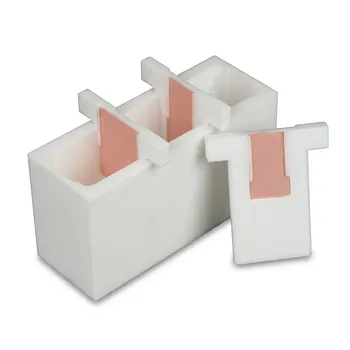
- White PTFE Electrolytic Cell with Movable Slider and Insulated Lid for Fluorine Corrosion Resistance
- Customizable PTFE Rods for Advanced Industrial Applications
- Custom Graphite Filled PTFE Rods for Advanced Industrial Applications
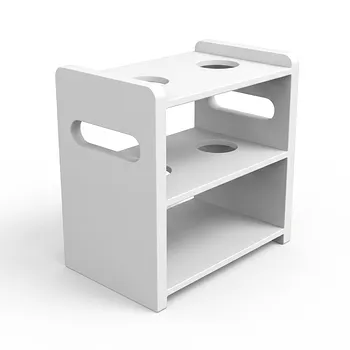
- Customizable PTFE Heat Insulation Plate High Temperature Corrosion Resistant Laboratory Support Layered Multi Tier Stand
- Custom PTFE Sleeves and Hollow Rods for Advanced Applications
People Also Ask
- What makes PTFE an ideal construction material for custom electrochemical cells and electronic analytical instrumentation housings? Discover superior chemical resistance and electrical insulation
- How do custom PTFE electrochemical cells improve the accuracy of stability testing for alkaline catalysts compared to glass cells?
- How does the hydrophobicity of PTFE benefit electrochemical measurements? Enhance Stability and Precision in Your Lab
- How are electrolytic cells utilized in the Hall-Héroult process? Optimizing Purity and Energy Efficiency
- What are the primary components required for the construction of a standard electrolytic cell? Essential Hardware Guide