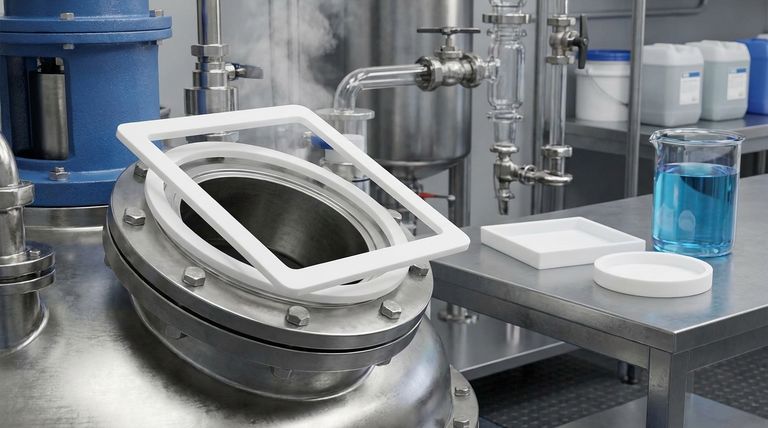
In the most demanding industrial environments, PTFE gaskets stand out for their unique combination of properties. Their primary advantages are exceptional chemical resistance against nearly all acids, bases, and solvents; a remarkably wide operational temperature range from cryogenic levels up to 260°C (500°F); and excellent flexibility, which allows them to create a reliable seal on imperfect surfaces.
The core value of a PTFE gasket is not a single feature, but its ability to provide a durable, non-reactive, and stable seal in extreme chemical and thermal conditions where most other materials would degrade and fail.
The Core Pillars of PTFE Performance
To understand why PTFE is specified for critical applications, we must look at the fundamental properties that give it these advantages. Each contributes to its reputation as a premier sealing solution.
Unmatched Chemical Inertness
Polytetrafluoroethylene (PTFE) is one of the most non-reactive materials known. It is virtually immune to attack from aggressive acids, solvents, and bases.
This chemical inertness prevents gasket corrosion and ensures the purity of the media being processed, making it indispensable in pharmaceutical, food and beverage, and chemical manufacturing.
Extreme Thermal Stability
PTFE gaskets maintain their integrity and sealing capability across an exceptionally broad temperature spectrum, typically from -200°C to +260°C (-328°F to +500°F).
This allows them to be used reliably in applications involving cryogenics, steam, or high-temperature processing without becoming brittle or degrading.
Superior Sealing and Adaptability
PTFE is an inherently flexible and conformable material. This softness allows it to compress easily and fill minor imperfections on flange surfaces.
The result is a highly effective, leak-proof seal that is more forgiving of surface irregularities than a rigid metal gasket.
Unique Surface Properties
The material has an extremely low coefficient of friction, giving it a characteristic non-stick quality. This prevents process media from adhering to the gasket surface.
This non-wetting property simplifies cleaning, reduces material buildup, and is beneficial in applications with sliding or rotating parts.
Excellent Insulating Capabilities
Virgin PTFE is a superb electrical insulator, making it a valuable choice for isolating flanges and preventing galvanic corrosion between dissimilar metals.
It also serves as an effective thermal insulator, which can be a secondary benefit in managing heat transfer at connection points.
Understanding a Key Consideration: Creep
While its advantages are significant, it is critical to understand the primary trade-off of standard, or "virgin," PTFE to ensure its proper application.
The Challenge of Cold Flow
PTFE's softness can also be a limitation. Under sustained compressive load, especially at elevated temperatures, the material can exhibit "creep" or "cold flow."
This is a slow, permanent deformation where the gasket material is squeezed out from between the flanges, potentially leading to a loss of bolt torque and seal integrity over time.
Mitigating Creep with Filled PTFE
This issue is often addressed by using filled PTFE gaskets. Reinforcing materials like glass fiber, carbon, or silica are added to the PTFE matrix.
These fillers significantly improve the gasket's mechanical strength and resistance to creep, making them suitable for higher pressure and temperature applications while retaining most of PTFE's chemical resistance.
Making the Right Choice for Your Application
Selecting the correct gasket material depends entirely on the specific demands of your system.
- If your primary focus is aggressive chemical processing: PTFE's unparalleled inertness is its defining advantage for preventing corrosion and contamination.
- If your primary focus is a wide temperature range: Its stability from cryogenic lows to high heat makes it a uniquely reliable choice for thermal cycling.
- If your primary focus is purity (food, pharma): FDA-compliant grades of PTFE provide a non-toxic, non-contaminating seal that protects product integrity.
- If your primary focus is high-pressure service: Specify a filled PTFE gasket to gain the necessary mechanical strength and resistance to cold flow.
Understanding these core properties and trade-offs empowers you to select the precise material for a safe and reliable seal.
Summary Table:
| Key Advantage | Benefit Summary |
|---|---|
| Chemical Inertness | Resists nearly all acids, bases, and solvents, preventing corrosion and contamination. |
| Thermal Stability | Performs reliably from cryogenic temperatures (-200°C) up to 260°C (500°F). |
| Sealing Adaptability | Flexible material conforms to imperfect surfaces for a reliable, leak-proof seal. |
| Non-Stick Surface | Low friction prevents media adhesion, simplifying cleaning and reducing buildup. |
| Electrical Insulation | Excellent insulator helps prevent galvanic corrosion between dissimilar metals. |
Need a PTFE Gasket Solution for Your Demanding Application?
At KINTEK, we specialize in manufacturing high-performance PTFE components, including custom gaskets, seals, liners, and labware. Our expertise ensures you get a sealing solution that delivers:
- Reliable Performance: Precise fabrication for superior chemical resistance and thermal stability in extreme conditions.
- Custom Fit: We offer custom fabrication from prototypes to high-volume orders to meet your exact specifications.
- Industry Expertise: We serve the semiconductor, medical, laboratory, and industrial sectors, understanding the critical need for purity and durability.
Let us help you achieve a safe, reliable, and long-lasting seal. Contact our experts today to discuss your specific requirements and get a quote!
Visual Guide

Related Products
- Customizable High Temperature Resistant Anti Static PTFE Insulating Gaskets Flame Retardant Corrosion Proof Industrial Seals
- Custom PTFE Insulating Gaskets Corrosion Resistant Teflon Seals Tailored Engineering Plastic Components
- Custom PTFE Insulating Gaskets and Corrosion Resistant Fluoropolymer Seals for Industrial Electrical Applications
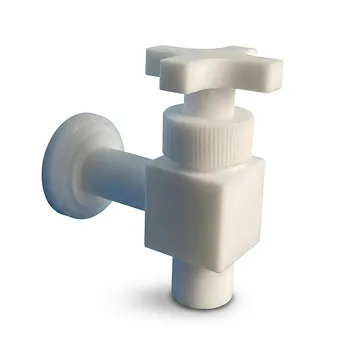
- High Corrosion Resistant PTFE Faucet Polytetrafluoroethylene Valve for Chemical Storage Drums and Fluid Transfer Systems Customizable Industrial Grade
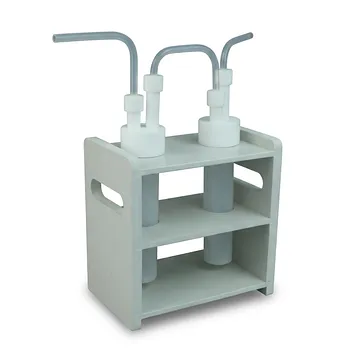
- Custom PTFE Acid Resistant Support Rack Multi Hole PFA Hydrogen Absorption System Bracket
People Also Ask
- Why is PTFE an ideal material choice for sealing gaskets, valves, and fluid transfer tubing exposed to extremely aggressive chemicals? Discover Its Superior Chemical Resistance and Reliability
- How is PTFE utilized in seals and gaskets? Leverage Its Chemical & Temperature Resistance
- What are the key properties of PTFE that make it suitable for seals and gaskets? Unlock Superior Sealing Performance
- Why are PTFE gaskets used in the petrochemical industry? For Superior Chemical & Thermal Resistance
- What manufacturing methods are used to produce PTFE gaskets? Choose the Right Process for a Perfect Seal