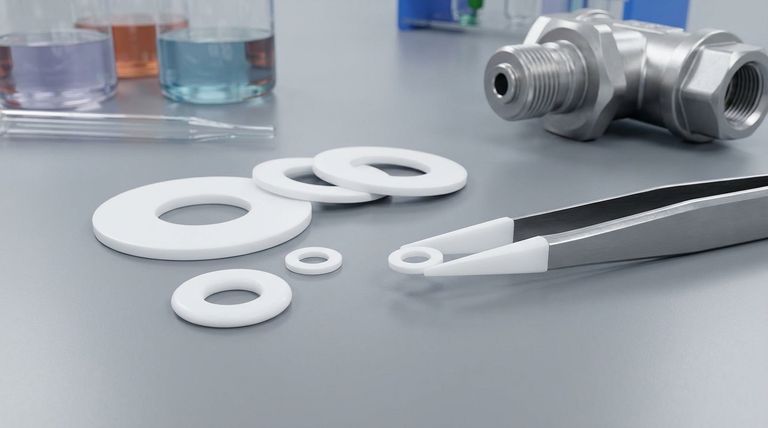
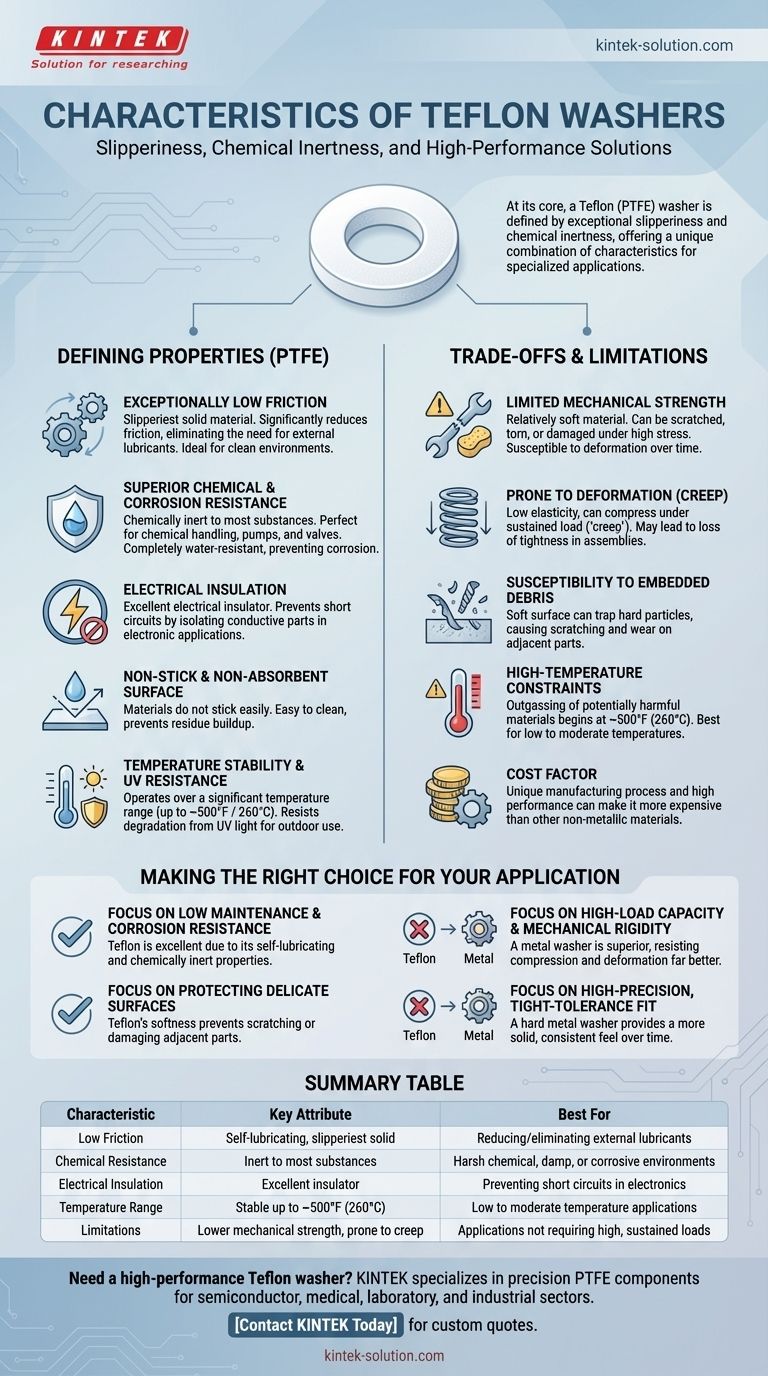
At its core, a Teflon washer is defined by its exceptional slipperiness and chemical inertness. These flat discs, made from Polytetrafluoroethylene (PTFE), provide a unique combination of characteristics, including an extremely low coefficient of friction, outstanding resistance to chemicals and corrosion, and effective electrical insulation. They are a go-to component for applications where self-lubrication and resilience to harsh environments are critical.
The primary value of a Teflon washer is its self-lubricating, low-friction surface that resists nearly all chemicals. However, this comes at the cost of lower mechanical strength and a tendency to deform under sustained pressure compared to metal alternatives.
The Defining Properties of Teflon (PTFE) Washers
Exceptionally Low Friction
Teflon is one of the slipperiest solid materials known. This property means Teflon washers create very little resistance between moving parts.
This natural slipperiness significantly reduces or eliminates the need for external lubricants. This makes them ideal for field use or clean environments where grease and oil are undesirable.
Superior Chemical & Corrosion Resistance
PTFE is chemically inert, meaning it does not react with most substances. This makes Teflon washers perfect for use in chemical handling systems, pumps, and valves.
They are also completely water-resistant, which prevents the corrosion that can plague metal washers in damp or outdoor applications.
Electrical Insulation
Teflon is an excellent electrical insulator. This property makes it a valuable component in electronic and electrical applications where it can prevent short circuits by isolating conductive parts.
Non-Stick & Non-Absorbent Surface
Materials do not easily stick to Teflon's surface. This, combined with its non-absorbent nature, makes it easy to clean and reliable in applications where residue buildup is a concern.
Temperature Stability
While best known for low-temperature applications, Teflon can operate over a significant range. However, it does have important limitations at higher temperatures.
UV Resistance
Teflon washers resist degradation from ultraviolet (UV) light, making them suitable for outdoor applications where they may be exposed to sunlight.
Understanding the Trade-offs and Limitations
No material is perfect. The unique advantages of Teflon come with specific drawbacks that are critical to understand.
Limited Mechanical Strength
Teflon is a relatively soft material. The washers can be easily scratched, torn, or damaged during installation or under high stress. Over time, they can deform and lose their original round shape.
Prone to Deformation (Creep)
Teflon has very little elasticity and can be compressed under a sustained load. This "creep" can lead to a loss of tightness in an assembly, causing issues like side-to-side blade movement in a folding knife.
Susceptibility to Embedded Debris
Because the material is soft, hard particles like metal shavings can become embedded in the washer's surface. This debris is difficult to remove and can cause scratching and premature wear on adjacent metal parts.
High-Temperature Constraints
At temperatures around 500°F (260°C), Teflon begins to outgas materials that can be harmful. For this reason, it is generally considered ideal for low and moderate-temperature use cases.
Cost Factor
Due to its unique manufacturing process and high performance, Teflon can be more expensive than many other non-metallic materials used for washers.
Making the Right Choice for Your Application
Choosing between Teflon and another material, such as phosphor bronze, depends entirely on the demands of your specific project.
- If your primary focus is low maintenance and corrosion resistance: Teflon is an excellent choice due to its self-lubricating and chemically inert properties.
- If your primary focus is high-load capacity and mechanical rigidity: A metal washer is the superior option as it resists compression and deformation far better than Teflon.
- If your primary focus is protecting delicate surfaces: Teflon's softness will prevent it from scratching or damaging adjacent parts, unlike a harder metal washer.
- If your primary focus is a high-precision, tight-tolerance fit: A hard metal washer will provide a more solid and consistent feel over time, whereas Teflon may compress and loosen.
Ultimately, selecting a Teflon washer is a deliberate choice for its unique combination of slickness and resilience in environments where other materials would fail.
Summary Table:
| Characteristic | Key Attribute | Best For |
|---|---|---|
| Low Friction | Self-lubricating, slipperiest solid | Reducing/eliminating external lubricants |
| Chemical Resistance | Inert to most substances | Harsh chemical, damp, or corrosive environments |
| Electrical Insulation | Excellent insulator | Preventing short circuits in electronics |
| Temperature Range | Stable up to ~500°F (260°C) | Low to moderate temperature applications |
| Limitations | Lower mechanical strength, prone to creep | Applications not requiring high, sustained loads |
Need a high-performance Teflon washer for your application?
KINTEK specializes in manufacturing precision PTFE components, including custom washers, seals, and liners. We serve the semiconductor, medical, laboratory, and industrial sectors, providing solutions from prototypes to high-volume orders.
Our expertise ensures you get a component with the exact characteristics your project demands—superior slipperiness, unmatched chemical resistance, and reliable insulation.
Contact KINTEK today to discuss your specific requirements and get a quote!
Visual Guide
Related Products
- Customizable PTFE Scrapers and Shovels for Demanding Applications
- Custom Machined Molded PTFE Teflon Parts Manufacturer for Laboratory ITO FTO Conductive Glass Cleaning Flower Basket
- Custom PTFE Teflon Parts Manufacturer Conductive Glass Substrate Cleaning Rack
- Custom PTFE Teflon Balls for Advanced Industrial Applications
- High Purity PTFE Square Membrane Cutter Equipartition Device for Trace Analysis and Disease Control Centers Clean Non Stick No Leaching
People Also Ask
- Why are PTFE shovels considered cost-effective? Maximize ROI with Superior Durability
- What are the key properties that make PTFE shovels ideal for laboratory use? Ensure Sample Integrity with Chemically Inert Tools
- How does the durability of PTFE shovels compare to plastic shovels? Discover the Superior Choice for Harsh Conditions
- What are some specific applications of PTFE shovels in the laboratory? Ensure Sample Purity and Safety
- What are the advantages of PTFE shovels in terms of chemical resistance? Unmatched Inertness for Handling Corrosives