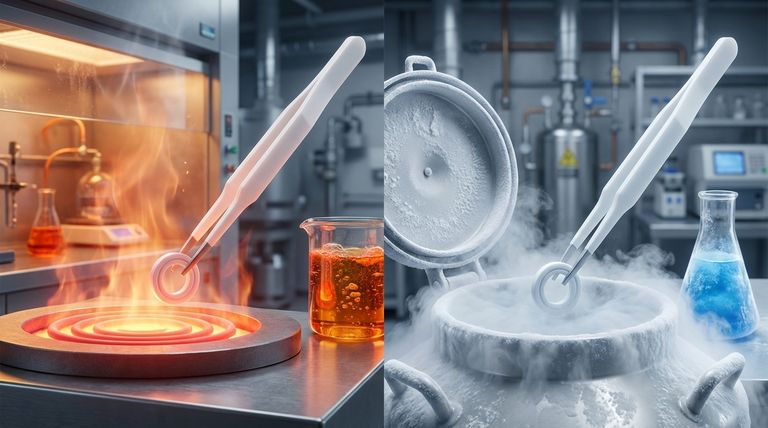
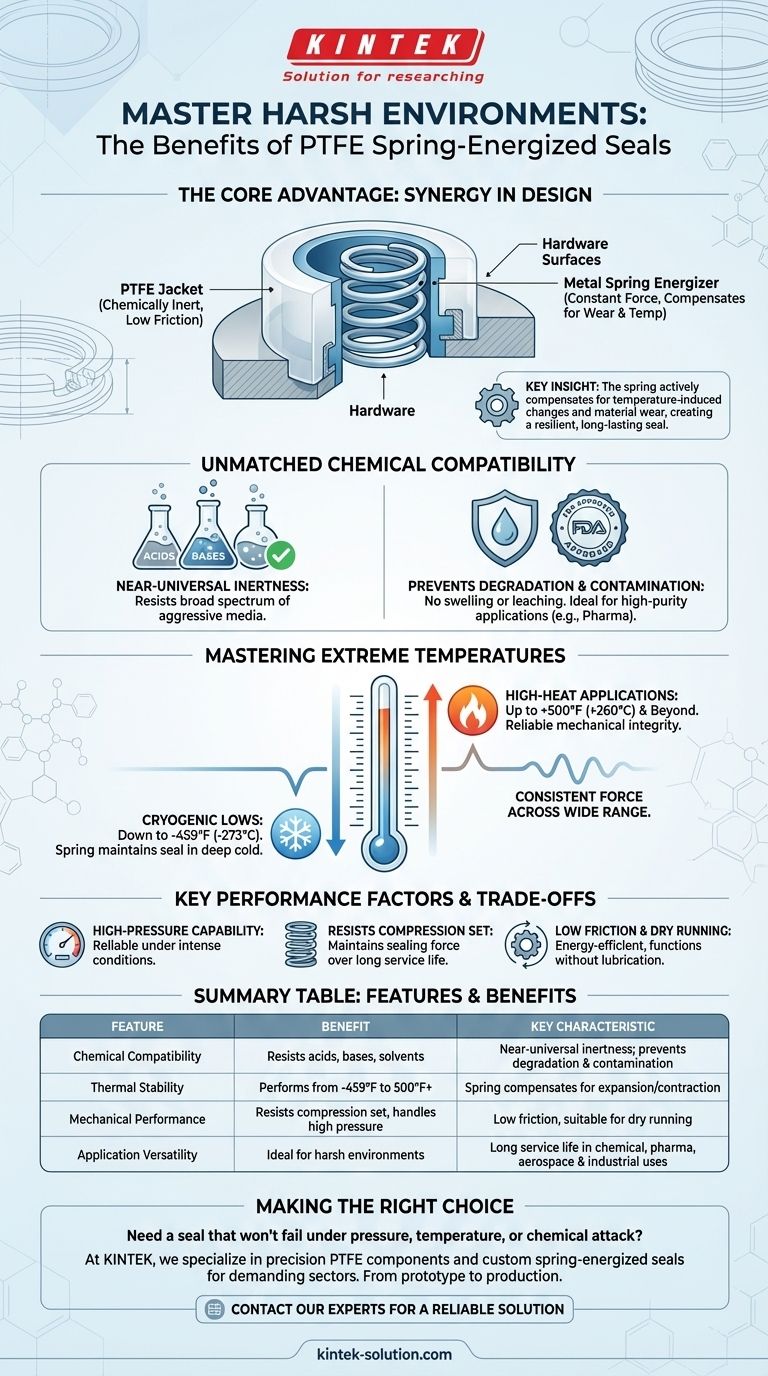
At their core, PTFE spring-energized seals provide exceptional chemical compatibility and thermal stability due to their unique two-part construction. The Polytetrafluoroethylene (PTFE) jacket is nearly universally inert, resisting degradation from aggressive chemicals like acids and solvents, while the internal spring ensures the seal maintains a constant force against hardware across an extremely wide temperature range, from cryogenic lows below -250°F to high-heat applications above 500°F.
The fundamental advantage is not just the material properties of PTFE, but how the internal spring actively compensates for temperature-induced dimensional changes and material wear. This creates a resilient, long-lasting seal in environments where traditional elastomeric seals would quickly degrade and fail.
How the Design Achieves Unmatched Resilience
The performance of these seals is a direct result of the synergy between their two primary components: the polymer jacket and the metal spring energizer.
The Role of the PTFE Jacket
PTFE is a high-performance fluoropolymer renowned for its chemical inertness. This property means it does not react with the vast majority of industrial fluids.
This material provides an extremely low coefficient of friction, allowing it to operate in dynamic applications with minimal wear and heat generation, even without lubrication.
The Function of the Internal Spring
The spring provides the initial seating force when the seal is installed. More importantly, it delivers a constant, live force throughout the seal's life.
This stored energy ensures the seal lips remain in contact with the mating surfaces, compensating for wear, pressure fluctuations, and the expansion or contraction of the seal jacket due to extreme temperature changes.
Unpacking Chemical Compatibility
The primary reason to specify a PTFE seal is often its ability to survive exposure to aggressive media that would destroy other materials.
Near-Universal Inertness
The PTFE jacket is resistant to a broad spectrum of chemicals, including potent acids, bases, solvents, and corrosive fluids.
This makes them a default choice for demanding industries like chemical processing and pharmaceutical manufacturing, where seal integrity is directly tied to safety and product purity.
Preventing Degradation and Contamination
Unlike rubber-based seals, PTFE does not swell, harden, or degrade when exposed to harsh chemicals.
This stability is critical in high-purity applications. Because the material is inert, it will not leach contaminants into the process media, a key reason many grades are FDA-approved.
Mastering Extreme Temperatures
Many sealing materials lose their mechanical properties at temperature extremes, becoming either brittle or overly soft. PTFE spring-energized seals are engineered to overcome this.
Performance in High-Heat Environments
These seals reliably function in continuous service at temperatures exceeding 500°F (260°C).
At these elevated temperatures, the seal maintains its mechanical integrity and the spring continues to provide consistent force, preventing leaks that would occur as hardware expands.
Reliability in Cryogenic Conditions
On the other end of the spectrum, PTFE seals perform exceptionally well in cryogenic conditions, with some configurations rated for temperatures as low as -459°F.
While other materials become brittle and crack in deep cold, the spring energizer ensures the stiffened PTFE jacket maintains a tight seal against the contracting hardware.
Understanding the Trade-offs and Key Factors
While chemical and thermal resistance are the headline benefits, other performance characteristics are equally critical in specifying these seals.
High-Pressure Capability
The spring's constant radial force allows these seals to perform reliably under high-pressure conditions where other seals might be extruded or dislodged.
Resisting Compression Set
Elastomeric seals can permanently deform under prolonged compression, a phenomenon known as compression set. PTFE seals are highly resistant to this, ensuring they continue to provide a sealing force over very long service periods.
Low Friction and Dry Running
The low-friction nature of PTFE is a significant advantage, reducing energy consumption in rotating equipment and allowing the seal to function effectively even in dry or poorly lubricated conditions.
The Importance of Configuration
The primary "trade-off" is not in performance but in complexity. The specific grade of PTFE, the spring material (e.g., stainless steel, Elgiloy), and the spring geometry must be carefully matched to the application's pressure, temperature, and media to achieve optimal results.
Making the Right Choice for Your Goal
Specifying a PTFE spring-energized seal is a decision for applications where reliability in harsh conditions is paramount.
- If your primary focus is aggressive chemical processing: These seals provide unmatched resistance to degradation, ensuring long service life and process purity.
- If your primary focus is aerospace or cryogenic applications: Their stability across extreme temperature ranges, from high heat to deep cold, prevents leaks where other materials would fail.
- If your primary focus is high-purity manufacturing (e.g., pharmaceutical): The inertness of PTFE prevents contamination, and many grades are FDA-approved for these sterile environments.
- If your primary focus is long-life or high-pressure systems: The spring's constant force resists compression set and ensures a reliable seal under demanding physical conditions.
Ultimately, selecting a PTFE spring-energized seal is a strategic engineering decision for applications where failure is not an option.
Summary Table:
| Feature | Benefit | Key Characteristic |
|---|---|---|
| Chemical Compatibility | Resists acids, bases, solvents | Near-universal inertness; prevents degradation & contamination |
| Thermal Stability | Performs from -459°F to 500°F+ | Spring compensates for expansion/contraction |
| Mechanical Performance | Resists compression set, handles high pressure | Low friction, suitable for dry running |
| Application Versatility | Ideal for harsh environments | Long service life in chemical, pharmaceutical, aerospace & industrial uses |
Need a seal that won't fail under pressure, temperature, or chemical attack?
At KINTEK, we specialize in manufacturing precision PTFE components, including custom spring-energized seals, for the semiconductor, medical, laboratory, and industrial sectors. Our expertise ensures your seals are perfectly configured for your specific media, temperature, and pressure requirements—from prototype to high-volume production.
Contact our experts today to discuss your application and receive a solution built for reliability.
Visual Guide
Related Products
- Customizable PTFE Seals Filter Holders for Versatile Applications
- Customizable High Temperature Resistant Anti Static PTFE Insulating Gaskets Flame Retardant Corrosion Proof Industrial Seals
- Custom PTFE Insulating Gaskets and Corrosion Resistant Fluoropolymer Seals for Industrial Electrical Applications
- Custom PTFE Sealing Tapes for Industrial and High Tech Applications
- Custom PTFE Insulating Gaskets Corrosion Resistant Teflon Seals Tailored Engineering Plastic Components
People Also Ask
- How are custom PTFE parts used in the automotive sector? Enhance Vehicle Performance & Durability
- What are the drawbacks of PTFE seals? Key Limitations and Design Considerations
- What is the shelf life of PTFE seals? Achieve Long-Term Reliability with Chemically Inert Seals
- What are the benefits of PTFE seals in terms of prototyping and production? Accelerate R&D and Ensure Elite Performance
- What are the benefits of using PTFE seals in demanding industries? Solve Extreme Sealing Challenges