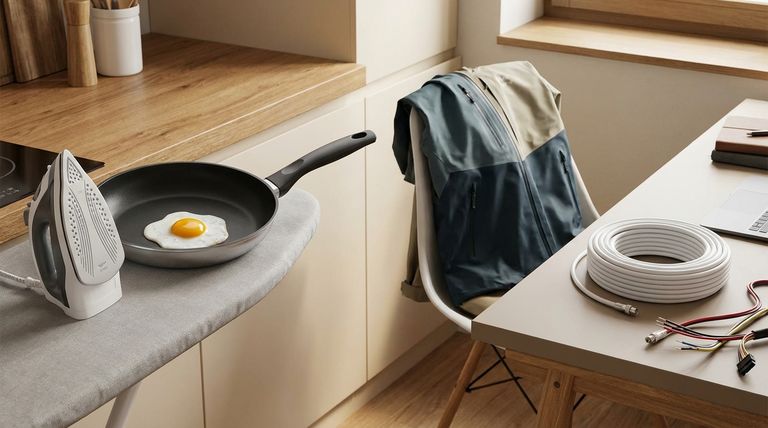
Beyond its famous role in non-stick cookware, Polytetrafluoroethylene (PTFE) is a surprisingly common material found in a wide range of consumer products. You can find it in personal care appliances like clothing irons and hair straighteners, in performance outerwear as a weatherproofing layer, and even as an additive in high-performance lubricants for bicycles.
The versatility of PTFE in consumer goods is not due to a single feature, but a rare combination of three core properties: it is extremely non-stick (low friction), chemically inert, and an excellent electrical insulator. Understanding these traits explains why the same material can be used to cook an egg, waterproof a jacket, and insulate a computer cable.
The Core Properties Driving PTFE's Versatility
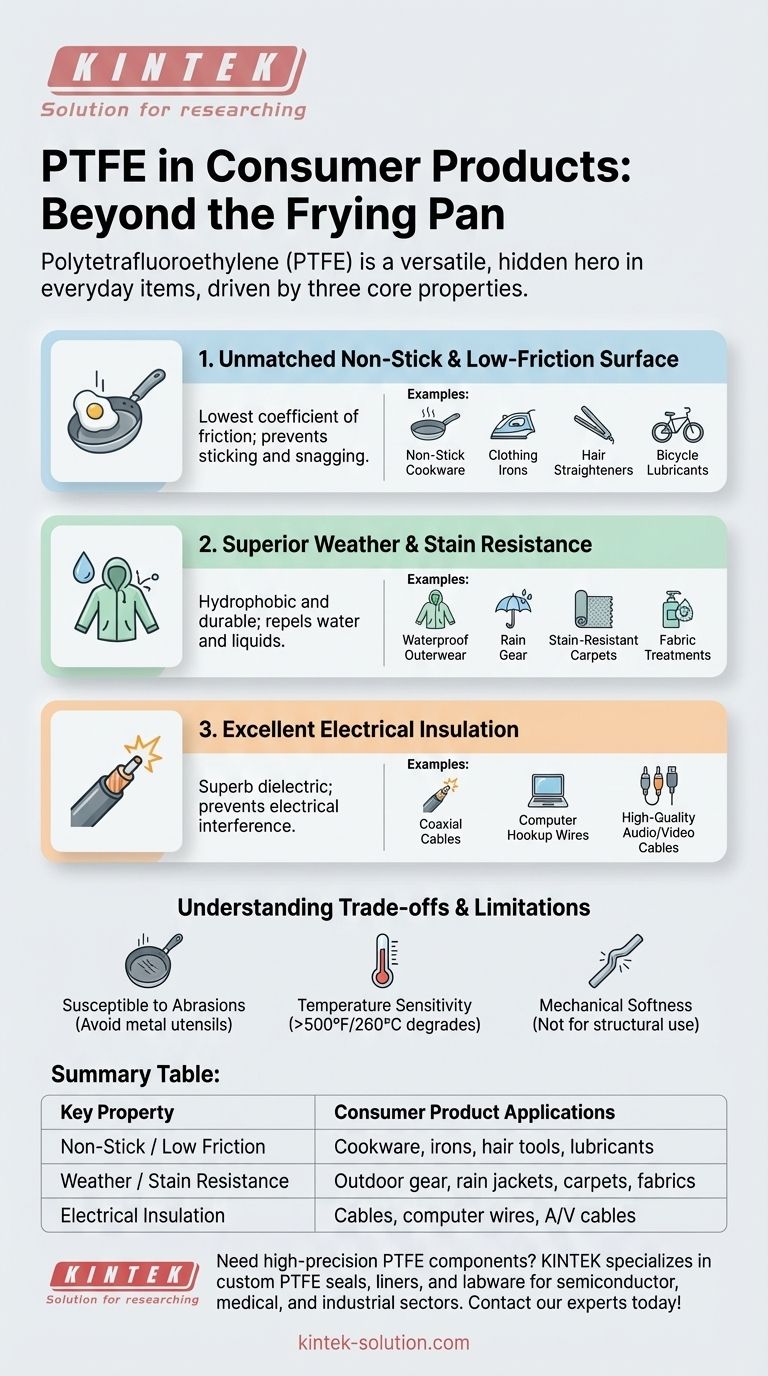
PTFE's wide adoption stems from a unique set of characteristics that are difficult to find in any other single material. Different industries leverage different properties to solve specific engineering challenges.
Unmatched Non-Stick and Low-Friction Surface
PTFE has one of the lowest coefficients of friction of any known solid. This means other materials, from food to fabric, slide across its surface with extreme ease.
This property is the reason for its use in non-stick cookware, baking sheets, and the soleplates of clothing irons. It is also why many hair styling tools, like straighteners and curling wands, are coated with PTFE to prevent hair from snagging and sticking.
Beyond coatings, this slipperiness makes PTFE an excellent additive for lubricants and greases, reducing friction in moving parts like bicycle chains and other machinery.
Superior Weather and Stain Resistance
PTFE is hydrophobic, meaning it actively repels water. This quality, combined with its durability, makes it a key component in high-performance textiles.
It is frequently used as a membrane or coating for outdoor rain gear and weatherproof apparel. This same principle applies to its use in stain-resistant treatments for carpets and fabrics, where it creates a barrier that prevents liquids from soaking in.
Excellent Electrical Insulation
PTFE is a superb dielectric, meaning it does not conduct electricity. This makes it an ideal material for insulating sensitive electrical components, especially where high frequencies are involved.
In consumer electronics, you will find PTFE used as insulation for high-quality coaxial cables (like those for internet or cable TV) and internal computer hookup wires. Its presence ensures signal integrity by preventing electrical interference.
Understanding the Trade-offs and Limitations
While highly effective, PTFE is not a perfect material for every situation. Its limitations are just as important to understand as its strengths.
Susceptibility to Abrasions
The non-stick coating on cookware is relatively soft. Using metal utensils or abrasive scouring pads can easily scratch and damage the PTFE layer, diminishing its non-stick performance over time.
Temperature Sensitivity
Although PTFE has a high melting point, it can begin to degrade at temperatures above 500°F (260°C). Overheating a pan, for instance, can cause the coating to release fumes, which is why proper use is critical for both performance and safety.
Mechanical Softness
In its pure form, PTFE is not exceptionally strong or rigid. For mechanical applications like bearings or seals, it is often reinforced with other materials like glass or carbon to improve its strength and wear resistance. This is why you don't see it used for structural components.
How to Recognize PTFE in Your Products
By understanding its core functions, you can easily identify where this versatile material is likely being used in the products you own.
- If your primary focus is the kitchen or home appliances: Look for any product labeled "non-stick," from frying pans to irons, as this almost always indicates a PTFE coating.
- If your primary focus is clothing or textiles: High-performance "waterproof," "weatherproof," or "stain-resistant" labels often signify the use of a PTFE membrane or surface treatment.
- If your primary focus is electronics: The white, waxy-feeling plastic used to insulate high-quality cables for audio, video, or data is frequently made of PTFE.
PTFE's unique combination of properties makes it a hidden yet essential material that enhances the performance of countless everyday products.
Summary Table:
| Key Property | Consumer Product Applications |
|---|---|
| Non-Stick / Low Friction | Non-stick cookware, baking sheets, clothing irons, hair straighteners, lubricants |
| Weather / Stain Resistance | Waterproof outdoor gear, rain jackets, stain-resistant carpets and fabrics |
| Electrical Insulation | Coaxial cables, computer wires, audio/video cables |
Need high-precision PTFE components for your products? KINTEK specializes in manufacturing custom PTFE seals, liners, and labware for the semiconductor, medical, laboratory, and industrial sectors. From prototypes to high-volume orders, we deliver the durability and performance your applications demand. Contact our experts today to discuss your project requirements!
Visual Guide
Related Products
- Custom PTFE Filtration System Acid Resistant High Purity Semiconductor Grade Chemical Processing Filter
- High Corrosion Resistant PTFE Faucet Polytetrafluoroethylene Valve for Chemical Storage Drums and Fluid Transfer Systems Customizable Industrial Grade
- PTFE PFA Vacuum Filtration System Corrosion Resistant Customizable Shatterproof Laboratory Device
- PTFE Corrosion Resistant Filter with PFA Valve Connections and Integrated Sieve Plate
- High Temperature Chemical Resistant 50ml PTFE Syringe Customized Teflon Injector with Threaded Seal for Trace Analysis
People Also Ask
- What makes PTFE filtration systems advantageous for industrial and scientific use? Unmatched Chemical & Thermal Stability
- What steps are involved in selecting the proper PTFE filter? A 4-Step Guide to Optimal Filtration
- What sizes and pore options are available for PTFE filters? Choose the Right Filter for Your Application
- How does the hydrophobicity of PTFE filters benefit their use? Ensure Uninterrupted Gas Flow and Solvent Filtration
- What temperature resistance do PTFE filters offer? Unmatched Thermal Stability from -200°C to +260°C