Beyond simply preventing seal extrusion, PTFE and PEEK backup rings provide a significant upgrade in performance through their low friction, high chemical resistance, and ability to operate reliably at high continuous temperatures. These properties make them essential components in chemically aggressive and high-performance industrial applications.
The core decision between PTFE and PEEK is not about which is better, but which is right for the specific challenge. PTFE offers the ultimate in chemical and thermal resistance, while PEEK delivers unparalleled mechanical strength and wear resistance for extreme pressure environments.
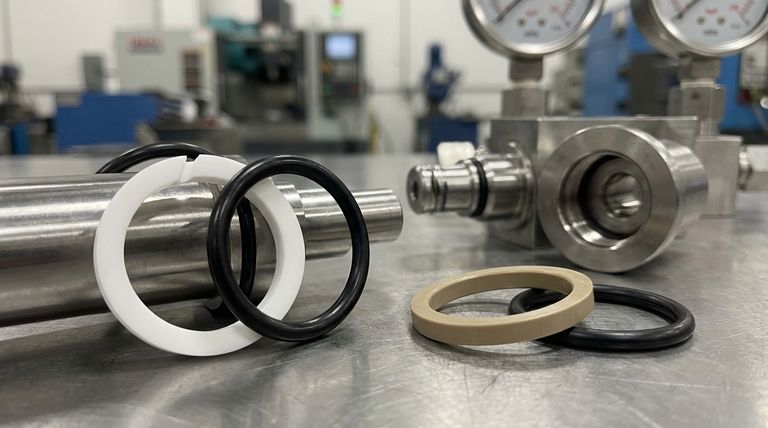
The Core Function: A Foundation of Extrusion Resistance
Why Backup Rings are Necessary
In any high-pressure hydraulic or pneumatic system, soft elastomer seals like O-rings are at risk of being forced into the small clearance gap between moving parts. This process, known as extrusion, quickly leads to seal damage and system failure.
Backup rings are rigid, precisely-machined rings installed next to the O-ring to physically block this extrusion gap. This allows the system to operate at much higher pressures and temperatures than it could with an O-ring alone.
The Material Advantage
Materials like PTFE (Polytetrafluoroethylene) and PEEK (Polyetheretherketone) are ideal for this role because they are dimensionally stable and have excellent compressive strength. They will not deform or flow under the immense forces that cause an elastomer to fail.
Deep Dive: When to Choose PTFE
PTFE is often the material of choice when environmental conditions are the primary challenge. Its unique properties make it exceptionally versatile.
Unmatched Chemical Inertness
PTFE is famously resistant to nearly all industrial chemicals, acids, and alkalis. This makes it the default choice for equipment in chemical processing, pipelines, and valves where seals are exposed to highly corrosive media.
The Lowest Coefficient of Friction
With one of the lowest friction coefficients of any solid material, PTFE is perfect for dynamic applications requiring smooth movement and minimal wear. This reduces operational energy and heat buildup in components like piston rings and dynamic seals.
Exceptional Thermal Range
PTFE maintains its integrity and properties across an incredibly wide temperature spectrum, performing reliably in environments from extreme cryogenic lows to high heat.
Design Flexibility: The Scarf Cut
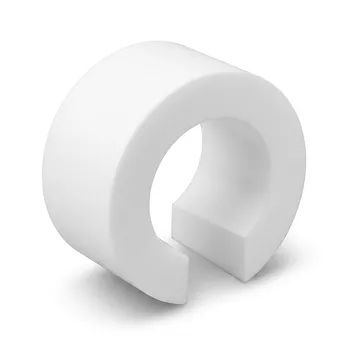
PTFE backup rings are often manufactured in a "split" or "scarf cut" design. This allows the ring to be slightly expanded and snapped into a groove without requiring a complete disassembly of the equipment, simplifying installation and maintenance.
Deep Dive: When to Choose PEEK
PEEK excels where mechanical stress is the dominant factor. It is specified for applications where strength and durability are non-negotiable.
Extreme Strength and Rigidity
PEEK possesses exceptionally high tensile strength and rigidity. This allows it to withstand ultra-high pressures without distortion, making it essential for high-performance hydraulic systems and high-pressure valves.
Superior Wear Resistance
In applications with high-intensity, continuous cycles, PEEK's mechanical toughness and wear resistance ensure long-term performance. It is built for durability in demanding aerospace, automotive, and industrial machinery.
Understanding the Critical Trade-offs
Neither material is a universal solution. Understanding their limitations is key to proper selection and avoiding premature failure.
The PTFE Compromise: Mechanical Strength
While chemically and thermally robust, PTFE is a softer material than PEEK. In applications with extremely high pressures combined with large extrusion gaps, PEEK's superior rigidity provides a greater margin of safety against mechanical failure.
The PEEK Limitation: Chemical Resistance
PEEK has excellent chemical resistance to many fluids, but it is not as universally inert as PTFE. Certain aggressive acids and chemicals can degrade PEEK over time, making PTFE the safer choice in the most corrosive environments.
Making the Right Choice for Your Application
Your final decision should be guided by the single greatest demand your system will place on the component.
- If your primary focus is exposure to aggressive chemicals or a very wide temperature range: Choose PTFE for its unparalleled chemical inertness and thermal stability.
- If your primary focus is withstanding ultra-high pressures and ensuring long-term mechanical durability: Select PEEK for its superior strength, rigidity, and wear resistance.
- If your primary focus is ease of maintenance on existing equipment: Consider a split (scarf cut) PTFE backup ring to simplify installation and reduce downtime.
Choosing the right advanced material transforms a simple backup ring from a supporting part into a critical component for maximizing system reliability.
Summary Table:
| Material | Key Strengths | Ideal For |
|---|---|---|
| PTFE | Superior chemical inertness, lowest friction, wide thermal range | Chemically aggressive environments, dynamic seals, cryogenics to high heat |
| PEEK | Extreme mechanical strength, high rigidity, superior wear resistance | Ultra-high pressure systems, high-cycle applications, demanding machinery |
Optimize Your System's Performance with the Right Backup Ring
Choosing between PTFE and PEEK is critical for the reliability and longevity of your equipment in demanding environments. The right material selection can prevent costly downtime and seal failure.
KINTEK specializes in manufacturing precision PTFE and PEEK components—including seals, liners, and custom backup rings—for the semiconductor, medical, laboratory, and industrial sectors. We offer custom fabrication from prototypes to high-volume orders, ensuring a perfect fit and superior performance for your specific application.
Let our expertise guide you to the optimal solution. Contact KINTEB today to discuss your requirements and receive a quote.
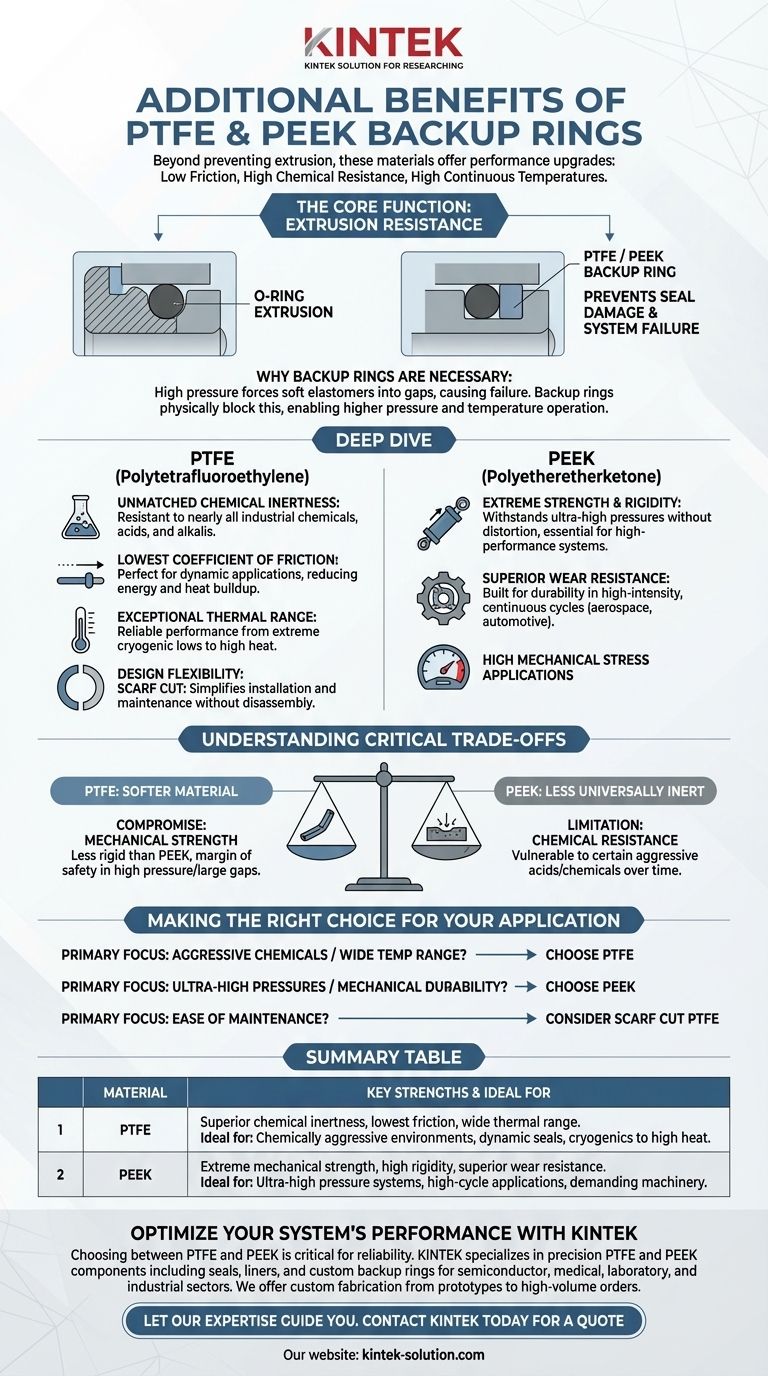
Visual Guide
Related Products
- Custom PTFE Acid Resistant Support Rack for PFA Hydrogen Absorption Systems Multi Hole Configurations
- Custom PTFE Corrosion Resistant White Syringe with Threaded Luer Connector Compatibility
- High Purity Virgin PTFE Syringe 20ml Chemical Resistant Liquid Handling for Syringe Pumps and PFA Tubing Integration
- Customizable PTFE Heat Insulation Plate High Temperature Corrosion Resistant Laboratory Support Layered Multi Tier Stand
- Custom PTFE Acid Resistant Support Rack Multi Hole PFA Hydrogen Absorption System Bracket
People Also Ask
- What are the benefits of integrating PTFE into piping support systems? Reduce Friction, Corrosion & Maintenance
- What structural and chemical features make PTFE and PFA laboratory equipment exceptionally resistant to harsh chemical attack and high temperatures? Discover the molecular shield of fluorine.
- What unique material properties make fluorinated polymers like PTFE and PFA essential for high-performance laboratory equipment and chemical containment? Key advantages explained
- How does high fluorination in perfluorinated polymers improve chemical resistance and thermal stability of lab apparatus? Discover the science behind PTFE and PFA's superior performance.
- What material considerations are critical for laboratory apparatus when performing cage-opening reactions on fluorinated silsesquioxanes using strong superacids? Choose PTFE/PFA for inertness and purity