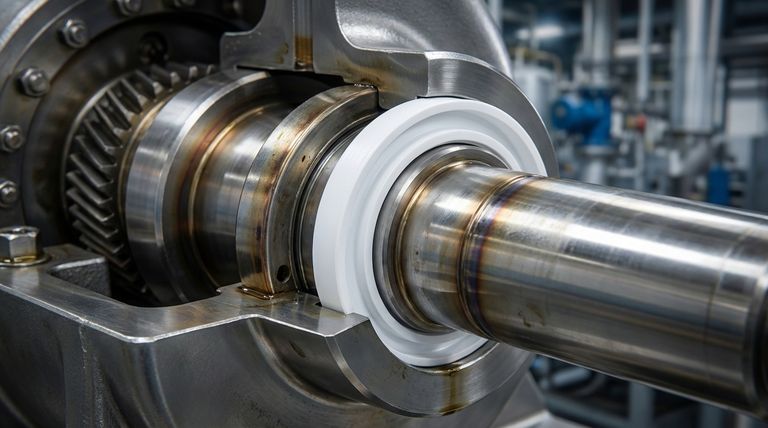
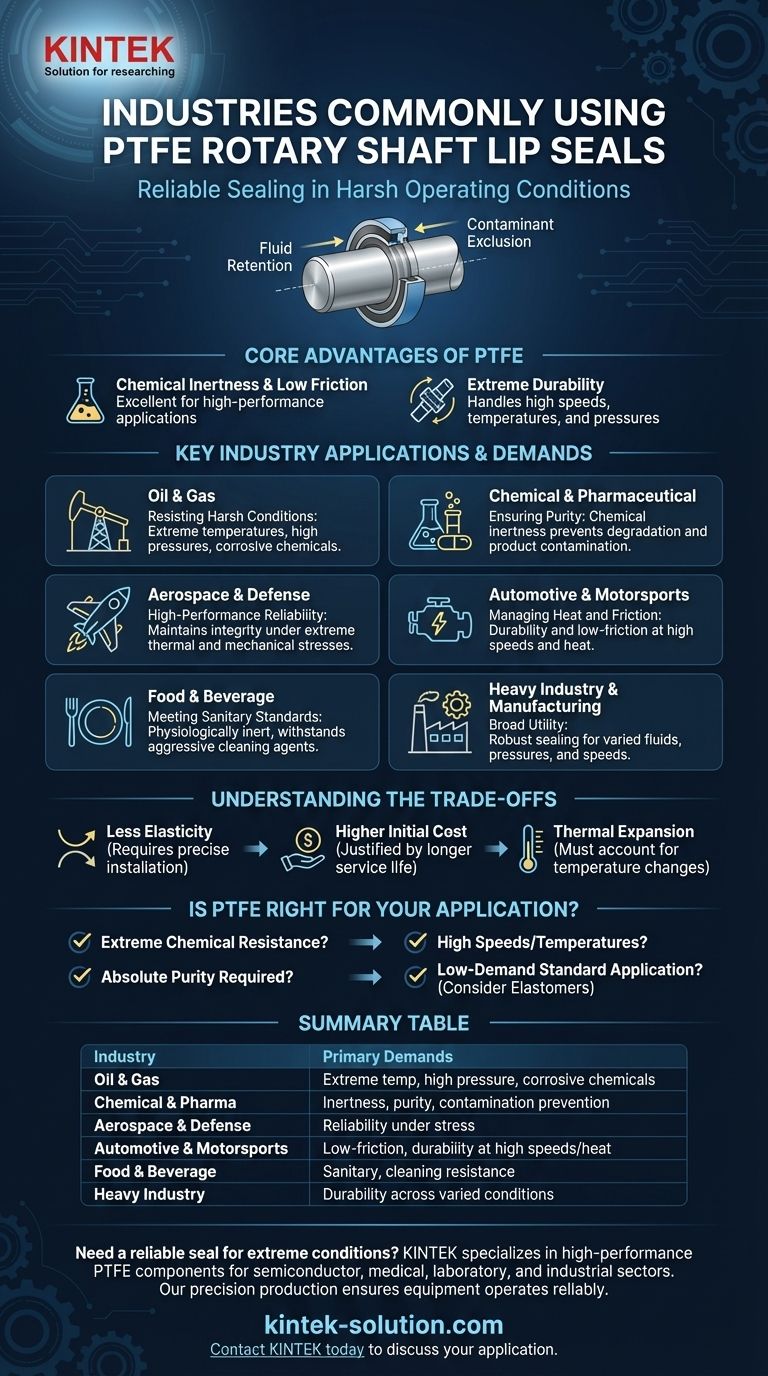
To be direct, PTFE rotary shaft lip seals are predominantly used in the automotive, oil and gas, chemical processing, aerospace, and food and beverage industries. Their selection is driven by an exceptional ability to perform reliably in harsh operating conditions where traditional seals would quickly fail due to extreme temperatures, high pressures, or aggressive chemicals.
The core reason these industries rely on PTFE seals is not simply for sealing a rotating shaft, but for guaranteeing that seal's integrity under conditions that would degrade, dissolve, or destroy conventional rubber-based alternatives.
Why PTFE Seals are Essential in Demanding Environments
To understand the widespread use of PTFE seals, we must first look at the material itself and the fundamental problem it solves.
Understanding the Core Material: PTFE
PTFE (Polytetrafluoroethylene) is a synthetic fluoropolymer renowned for its unique properties. It is exceptionally resistant to a wide range of chemicals and possesses an extremely low coefficient of friction.
This combination of chemical inertness and slipperiness makes it an ideal material for high-performance sealing applications.
The Function of a Rotary Shaft Seal
At its most basic, a rotary shaft seal is designed to do two things: prevent a fluid (like oil or a chemical) from leaking out and stop contaminants (like dirt and water) from getting in.
PTFE lip seals accomplish this in rotating equipment, especially under demanding conditions that exceed the capabilities of standard materials.
Key Industry Applications and Their Demands
The choice of a PTFE seal is always a direct response to a specific, challenging operational demand. Different industries leverage its unique properties to solve critical problems.
Oil & Gas: Resisting Harsh Conditions
In the oil and gas sector, equipment like pumps, compressors, valves, and drilling tools operate under immense stress.
These applications demand seals that can withstand extreme temperatures, high pressures, and corrosive chemicals, all of which are defining characteristics of PTFE's performance profile.
Chemical & Pharmaceutical Processing: Ensuring Purity
Equipment such as mixers, reactors, and pumps in chemical and pharmaceutical manufacturing handle highly aggressive or sensitive substances.
The primary requirement here is chemical inertness. PTFE seals do not react with the process media, preventing both seal degradation and product contamination.
Aerospace & Defense: High-Performance Reliability
Aerospace systems, particularly aircraft engines, operate across a vast range of temperatures and at very high rotational speeds.
Reliability is non-negotiable. PTFE's ability to maintain its integrity and low-friction properties under these extreme thermal and mechanical stresses makes it a critical component.
Automotive & Motorsports: Managing Heat and Friction
Within high-performance automotive applications like engines, transmissions, and differentials, high rotational speeds generate significant friction and heat.
PTFE seals excel in these environments, offering durability and low-friction operation where standard elastomeric seals would quickly wear out or overheat.
Food & Beverage: Meeting Strict Sanitary Standards
Sanitary processing equipment in the food, dairy, and beverage industries requires absolute cleanliness and resistance to frequent, harsh cleaning cycles.
PTFE is ideal because it is physiologically inert and can withstand aggressive cleaning agents, ensuring hygienic standards are met without compromising the seal's integrity.
Heavy Industry & Manufacturing: Broad Utility
General manufacturing and heavy industry use equipment like screw compressors, blowers, and various machine tools that require durable and reliable sealing solutions.
PTFE provides a robust seal that can handle a wide variety of fluids, pressures, and speeds found throughout industrial plants.
Understanding the Trade-offs
While highly effective, PTFE seals are a specialized solution. Their selection involves acknowledging certain trade-offs compared to more common elastomeric (rubber) seals.
Less Elasticity than Rubber
PTFE is a relatively rigid plastic, not a flexible elastomer. This means it is less forgiving of shaft imperfections or minor installation misalignments.
Proper surface finish and careful installation are critical to achieving a reliable seal.
Higher Initial Cost
As a high-performance material, PTFE and the manufacturing processes for these seals result in a higher upfront cost compared to standard rubber seals.
This cost is justified by significantly longer service life, reduced downtime, and the ability to operate in conditions where no other material would suffice.
Thermal Expansion Considerations
PTFE has a higher coefficient of thermal expansion than the metals it typically seals against.
This characteristic must be accounted for in the design of the seal and the surrounding hardware to ensure a consistent and effective seal is maintained across the full operating temperature range.
How to Determine if PTFE Seals Are Right for Your Application
Choosing the correct seal comes down to matching the material's capabilities to the specific demands of your operating environment.
- If your primary focus is extreme chemical resistance: PTFE is the superior choice for handling aggressive media where elastomers would chemically degrade.
- If you are managing high speeds or high temperatures: The low-friction and thermally stable properties of PTFE make it ideal for applications that would burn or wear out rubber seals.
- If your application requires absolute purity (food, pharma): PTFE's inertness and compliance with sanitary standards prevent any risk of product contamination from the seal material.
- If you are working with a standard, low-demand application: A traditional elastomeric seal may be a more cost-effective solution if extreme conditions are not present.
Ultimately, selecting a PTFE rotary shaft seal is a decision to prioritize long-term reliability in the face of challenging operational demands.
Summary Table:
| Industry | Primary Demand Met by PTFE Seal |
|---|---|
| Oil & Gas | Extreme temperatures, high pressures, corrosive chemicals |
| Chemical & Pharmaceutical | Chemical inertness, product purity, contamination prevention |
| Aerospace & Defense | Reliability under extreme thermal and mechanical stress |
| Automotive & Motorsports | Low-friction operation, durability at high speeds and heat |
| Food & Beverage | Sanitary standards, resistance to aggressive cleaning agents |
| Heavy Industry | Durability across a wide variety of fluids, pressures, and speeds |
Need a reliable seal for extreme conditions? KINTEK specializes in manufacturing high-performance, custom PTFE components—including seals, liners, and labware—for the semiconductor, medical, laboratory, and industrial sectors. Our precision production ensures your equipment operates reliably under harsh conditions, from prototypes to high-volume orders. Contact KINTEK today to discuss your specific application and get a solution tailored to your demands.
Visual Guide
Related Products
- Custom PTFE Sealing Tapes for Industrial and High Tech Applications
- Custom PTFE Insulating Gaskets and Corrosion Resistant Fluoropolymer Seals for Industrial Electrical Applications
- Customizable PTFE Seals Filter Holders for Versatile Applications
- Custom PTFE Sealing Caps and Corrosion Resistant Low Background Teflon Adapters
- Customizable High Temperature Resistant Anti Static PTFE Insulating Gaskets Flame Retardant Corrosion Proof Industrial Seals
People Also Ask
- How are custom PTFE parts used in the automotive sector? Enhance Vehicle Performance & Durability
- Why is PTFE's temperature stability important for sealing applications? Ensure Leak-Proof Performance from -200°C to 260°C
- Why is PTFE popular in the oil and gas industry? Withstand Extreme Heat, Pressure & Corrosion
- What is PTFE and why is it used for seals? The Ultimate Guide to High-Performance Sealing
- What are the key benefits of using PTFE for seals? Unlock Superior Performance in Extreme Conditions