At their core, PTFE Teflon washers benefit industrial machinery by providing a uniquely low-friction, chemically inert, and temperature-resistant interface between components. This dramatically reduces wear and tear on moving parts, eliminates the need for external lubrication in many cases, and ensures operational reliability in harsh environments.
The true value of a PTFE washer isn't just its function as a spacer or seal; it's an engineering solution that enables machinery to run more efficiently, last longer, and operate with significantly less maintenance.
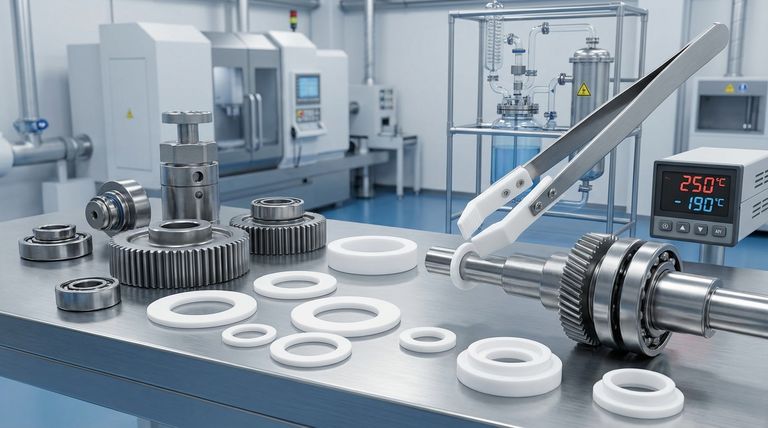
The Core Properties Defining PTFE Performance
To understand the benefits, we must first look at the inherent properties of Polytetrafluoroethylene (PTFE), the material commonly known as Teflon. These characteristics are what make it such a versatile problem-solver in industrial applications.
Unmatched Low-Friction Surface
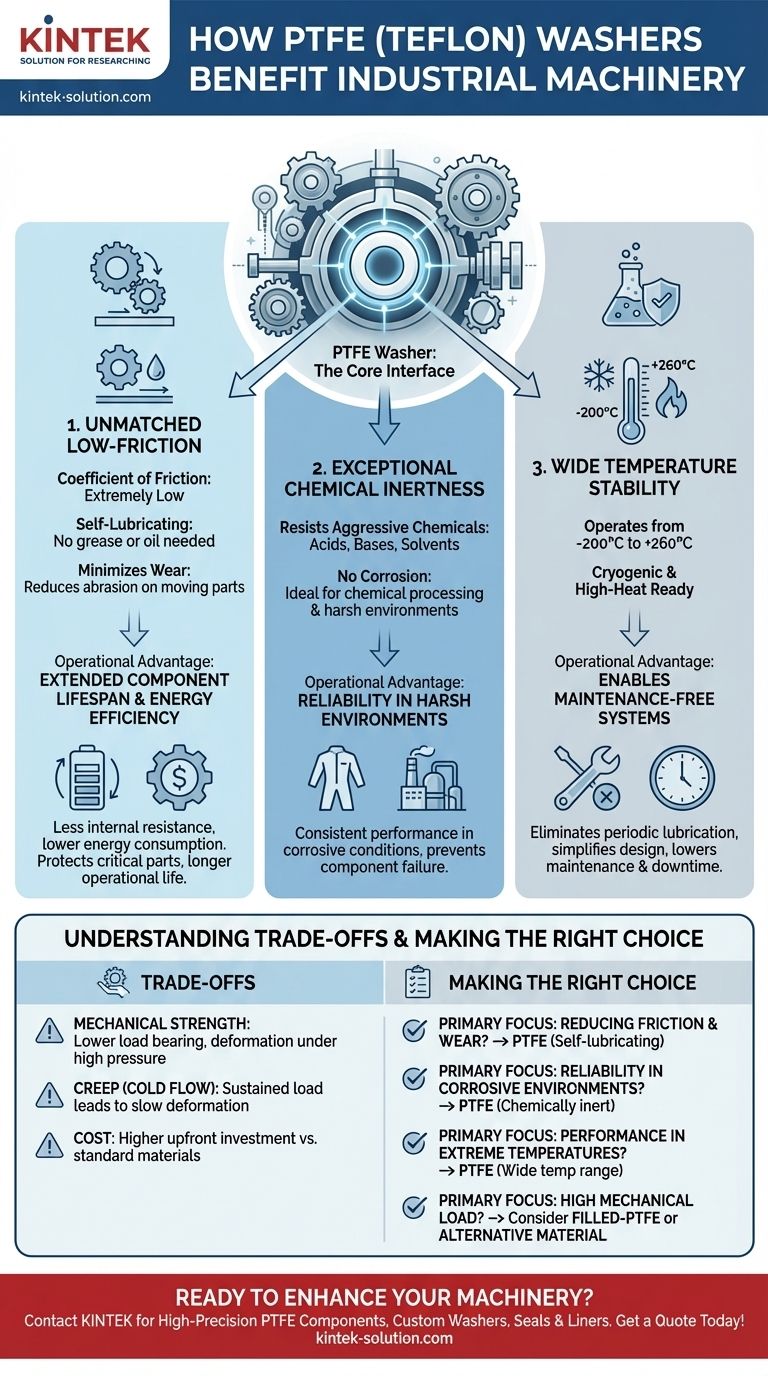
PTFE has one of the lowest coefficients of friction of any solid material. This property is intrinsic, meaning it does not require grease or oil.
This self-lubricating nature is the primary reason it minimizes wear between moving parts, such as in gears, bearings, and pump housings.
Exceptional Chemical Inertness
PTFE is virtually inert and does not react with the vast majority of industrial chemicals, including aggressive acids, bases, and solvents.
This makes PTFE washers an ideal choice for equipment in chemical processing plants, laboratories, and any environment where corrosion is a primary cause of component failure.
Wide Temperature Stability
These washers maintain their integrity and performance across an exceptionally broad temperature range, typically from -200°C to +260°C (-328°F to +500°F).
This allows them to be used reliably in applications involving cryogenic liquids as well as high-temperature processing.
Superior Electrical Insulation
PTFE is an excellent electrical insulator, making it a critical component in electrical and electronic assemblies where it prevents short circuits and isolates components.
Resistance to Moisture and UV
The material is non-absorbent, meaning it does not swell or degrade when exposed to moisture. It also exhibits strong resistance to degradation from UV radiation, making it suitable for outdoor applications.
Translating Properties into Operational Advantages
These fundamental material properties deliver tangible, real-world benefits that impact a machine's entire lifecycle, from performance to maintenance and overall cost of ownership.
Extending Component Lifespan
By drastically reducing friction, PTFE washers act as a protective barrier. They limit the contact stress and abrasive wear that would otherwise degrade critical moving parts, leading to a longer operational life for the entire assembly.
Enabling Maintenance-Free Systems
Because PTFE is self-lubricating, engineers can design systems that do not require periodic greasing. This simplifies machinery design, reduces potential points of failure, and lowers long-term maintenance costs and downtime.
Boosting Energy Efficiency
Machinery operating with less internal resistance consumes less energy. By lowering friction, PTFE washers allow motors and actuators to work more efficiently, resulting in direct energy savings and a lower environmental impact.
Ensuring Reliability in Harsh Environments
The combination of chemical and temperature resistance ensures that a PTFE washer will not degrade, deform, or fail when exposed to corrosive substances or extreme temperatures. This provides a reliable seal and consistent performance where other materials would quickly fail.
Understanding the Trade-offs
While PTFE offers exceptional performance, it is not a universal solution. An objective analysis requires acknowledging its limitations.
Mechanical Strength and Load Bearing
PTFE is a relatively soft material compared to metals or other engineered polymers. In high-load applications, a standard PTFE washer can be crushed or deformed. It is best suited for low-to-moderate pressure environments.
Susceptibility to "Creep"
Under a sustained compressive load, PTFE can be subject to "creep" or "cold flow," where the material slowly deforms over time. This can be a critical consideration in high-precision assemblies or sealing applications where consistent fastener tension is required.
Cost Considerations
High-quality PTFE is often more expensive upfront than common materials like nylon, rubber, or steel. The investment must be justified by the long-term benefits of reduced maintenance, increased lifespan, and enhanced reliability.
Making the Right Choice for Your Goal
Selecting the right material is about matching its properties to your primary engineering challenge.
- If your primary focus is reducing friction and wear: PTFE is an ideal choice for creating self-lubricating, low-wear interfaces in bearings, sliders, and other dynamic components.
- If your primary focus is reliability in corrosive environments: PTFE's chemical inertness makes it the default choice for sealing and spacing in chemical pumps, valves, and processing equipment.
- If your primary focus is performance in extreme temperatures: The wide stable temperature range of PTFE makes it one of the few viable options for both cryogenic and high-heat applications.
- If your primary focus is high mechanical load: Consider a filled-PTFE composite or an alternative material, as standard PTFE may deform under significant pressure.
Ultimately, specifying a PTFE washer is a decision to prioritize long-term performance and reliability over initial component cost.
Summary Table:
| Property | Benefit for Machinery |
|---|---|
| Low Friction | Reduces wear, enables self-lubrication, boosts energy efficiency |
| Chemical Inertness | Resists corrosion from acids, bases, and solvents |
| High Temp Stability | Performs reliably from -200°C to +260°C |
| Electrical Insulation | Prevents short circuits in electrical assemblies |
Ready to enhance your machinery's performance and reliability?
At KINTEK, we specialize in manufacturing high-precision PTFE components, including custom washers, seals, and liners, for the semiconductor, medical, laboratory, and industrial sectors. Our expertise in custom fabrication—from prototypes to high-volume orders—ensures you get the exact solution to reduce maintenance, extend component life, and operate reliably in harsh conditions.
Contact our engineering team today to discuss your specific application and receive a quote for PTFE components tailored to your needs.
Visual Guide
Related Products
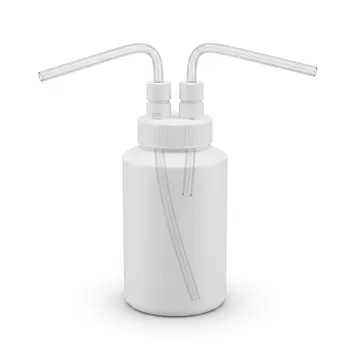
- Custom PTFE Gas Washing Bottle Corrosion Resistant Chemical Absorption Vessel with Quarter Inch Tubing Connections
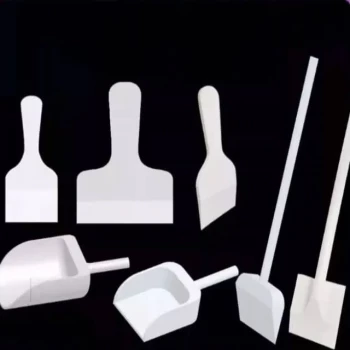
- Customizable PTFE Scrapers and Shovels for Demanding Applications
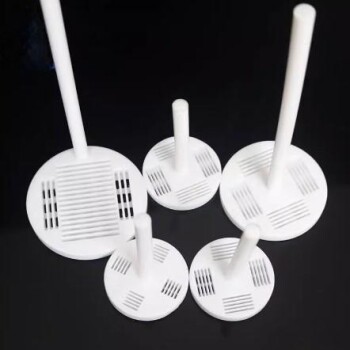
- Custom Machined Molded PTFE Teflon Parts Manufacturer for Laboratory ITO FTO Conductive Glass Cleaning Flower Basket
- PTFE PFA Vacuum Filtration System Corrosion Resistant Customizable Shatterproof Laboratory Device
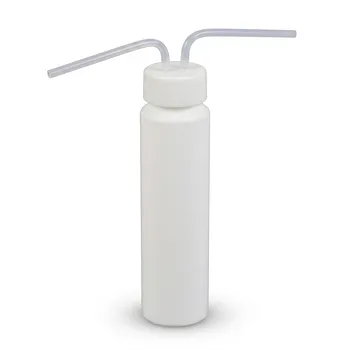
- Custom PTFE Gas Washing Bottle Corrosion Resistant Low Background Fluoropolymer Gas Absorption Vessel
People Also Ask
- Can PTFE washers be customized for specific needs? Achieve Perfect Fit and Functionality
- What are the key reasons to choose PTFE washers? Unmatched Performance in Demanding Environments
- What are PTFE washers made of? Unlocking the Power of Carbon-Fluorine Chemistry
- Why are non-stick properties important in PTFE washers? Prevent Adhesion and Ensure Reliability
- How do PTFE washers perform in extreme temperature conditions? Unmatched Stability from -200°C to 260°C