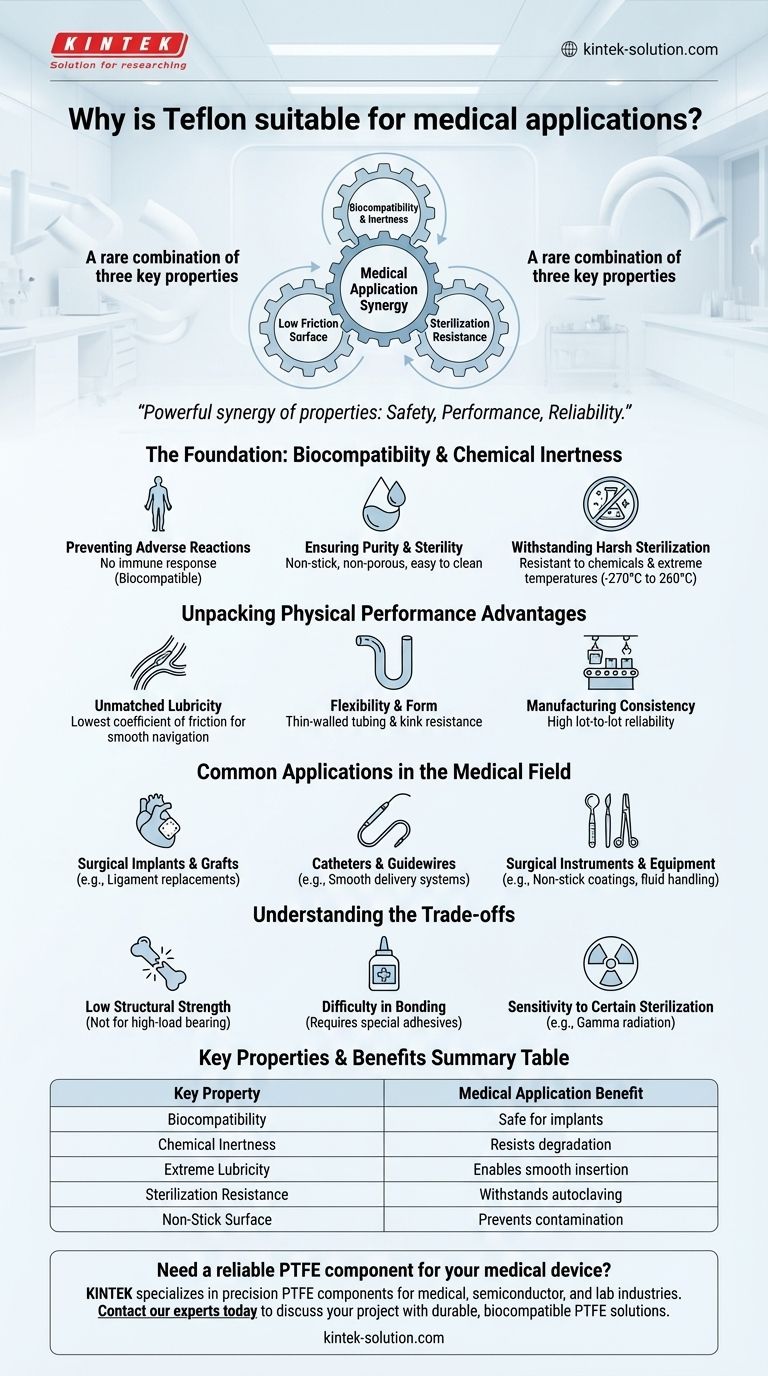
At its core, Teflon’s suitability for medical applications stems from a rare combination of three key properties. Medically known as Polytetrafluoroethylene (PTFE), the material is profoundly non-reactive with human tissue, it possesses an extremely low-friction surface, and it can withstand the harshest sterilization methods. This trio of characteristics ensures it can be used safely inside the body and in sterile environments without causing harm or degrading.
The crucial insight is that Teflon isn't chosen for a single benefit, but for the powerful synergy of its properties. Its chemical inertness provides safety, its physical lubricity enhances performance, and its resilience ensures reliability, making it a uniquely dependable material for critical medical technology.
The Foundation: Biocompatibility and Chemical Inertness
The primary reason Teflon is trusted in medicine is its profound lack of reactivity. It is one of the most inert materials known, which is the cornerstone of its safety profile for use in and around the human body.
Preventing Adverse Reactions
Teflon is biocompatible, meaning it does not provoke an immune response or react with bodily fluids and tissues. This chemical inertness makes it an ideal material for implants, grafts, and devices that reside inside the body for extended periods.
Ensuring Purity and Sterility
The material’s non-stick, non-porous surface is highly resistant to contamination. Because substances do not adhere to it, Teflon is exceptionally easy to clean and sterilize, which is a critical requirement for any reusable surgical instrument or piece of laboratory equipment.
Withstanding Harsh Sterilization
Medical components must endure rigorous sterilization processes involving aggressive chemicals or high heat. Teflon’s resistance to both chemicals and extreme temperatures (from -270°C to 260°C) ensures its structural integrity and performance are not compromised during these essential procedures.
Unpacking the Physical Performance Advantages
Beyond its chemical stability, Teflon's physical properties offer significant advantages for the design and function of medical devices. These traits directly impact device performance and patient outcomes.
Unmatched Lubricity
Teflon has one of the lowest coefficients of friction of any solid. This extreme "slipperiness" is invaluable for devices like catheters and guidewires, allowing them to navigate blood vessels and other internal passages with minimal friction and reduced risk of tissue damage.
Flexibility and Form
While durable, Teflon is also a flexible material. This allows it to be formed into the thin-walled tubing required for catheters, fluid handling systems, and drug delivery devices, where adaptability and kink resistance are essential.
Manufacturing Consistency
For medical devices, reliability is non-negotiable. Teflon can be manufactured with high lot-to-lot consistency, ensuring that every device component meets the exact specifications required for safe and effective medical use.
Common Applications in the Medical Field
The unique combination of these properties has led to Teflon's adoption across a wide range of medical applications.
Surgical Implants and Grafts
Because it is not rejected by the body, Teflon is used to create artificial body parts such as ligament replacements or patches for cardiovascular surgery. Its inert nature ensures long-term stability once implanted.
Catheters and Guidewires
The material's lubricity is the dominant feature for its use in catheters and other delivery systems. A thin Teflon coating allows these devices to be inserted and maneuvered smoothly, improving the safety and comfort of procedures.
Surgical Instruments and Equipment
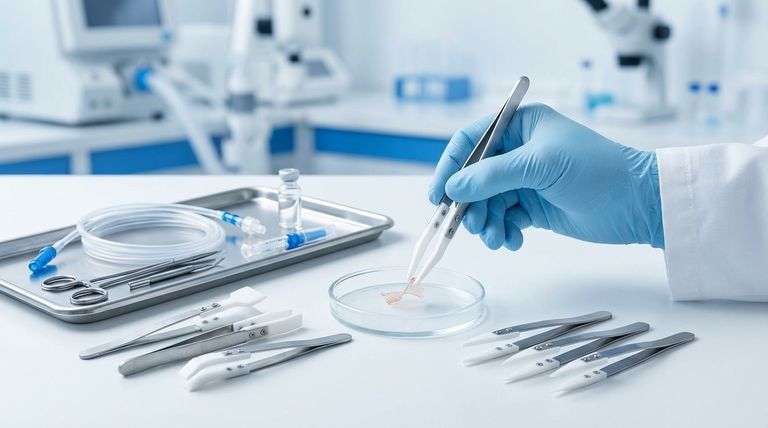
Teflon is often used as a coating on surgical tools and as a component in fluid and drug handling systems. Its non-stick surface prevents tissue adhesion during surgery and ensures that sensitive medications do not cling to equipment surfaces.
Understanding the Trade-offs
No material is perfect, and making an informed decision requires understanding Teflon's limitations. Its unique properties create specific constraints that must be considered during device design.
Low Structural Strength
While durable, pure Teflon is a relatively soft material. It is not suitable for high-load-bearing applications, such as major joint replacements, unless it is reinforced or used as a component within a stronger assembly.
Difficulty in Bonding
The same non-stick properties that make Teflon so valuable also make it very difficult to bond to other materials using conventional adhesives. This can add complexity and cost to the manufacturing process for multi-component devices.
Sensitivity to Certain Sterilization
Although highly resistant, certain methods like gamma radiation can degrade Teflon's mechanical properties over time. Engineers must carefully select the sterilization protocol that is compatible with the material to ensure long-term device integrity.
Making the Right Choice for Your Goal
To leverage Teflon effectively, you must align its specific strengths with the primary requirement of your medical application.
- If your primary focus is patient safety for implants: Teflon's biocompatibility and chemical inertness are its most critical features, preventing rejection and reaction.
- If your primary focus is device deliverability (e.g., catheters): The exceptionally low coefficient of friction is paramount for smooth, minimally invasive insertion.
- If your primary focus is equipment hygiene and reusability: Its non-stick, non-porous surface and resistance to harsh sterilization make it ideal for maintaining a sterile field.
Ultimately, understanding these distinct properties allows you to leverage Teflon's unique advantages for the specific demands of any medical device or application.
Summary Table:
| Key Property | Medical Application Benefit |
|---|---|
| Biocompatibility | Safe for long-term implants; does not react with bodily tissues or fluids. |
| Chemical Inertness | Resists degradation from harsh chemicals, ensuring device purity and longevity. |
| Extreme Lubricity | Enables smooth insertion of catheters and guidewires, minimizing patient trauma. |
| Sterilization Resistance | Withstands autoclaving and chemical sterilization without losing integrity. |
| Non-Stick Surface | Prevents contamination and allows for easy cleaning of surgical instruments. |
Need a reliable PTFE component for your medical device?
KINTEK specializes in the precision manufacturing of high-quality PTFE components—including seals, liners, and custom labware—for the medical, semiconductor, and laboratory industries. Our expertise ensures your devices benefit from Teflon's critical properties, from custom prototypes to high-volume production runs.
Contact our experts today to discuss how we can support your project with durable, biocompatible PTFE solutions.
Visual Guide
Related Products
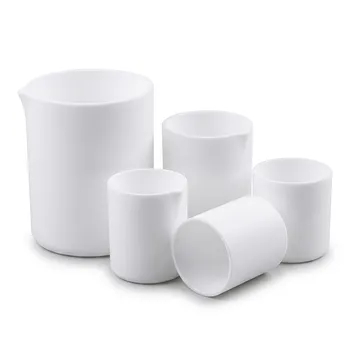
- Large Scale PTFE Beakers and Flasks for High Temperature Corrosion Resistant Laboratory Applications with Custom CNC Fabrication
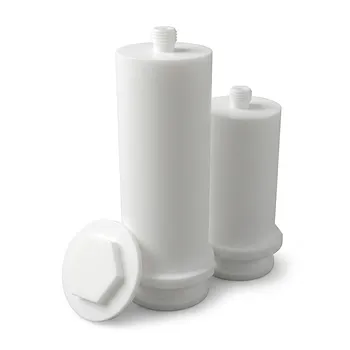
- High Temperature Chemical Resistant 50ml PTFE Syringe Customized Teflon Injector with Threaded Seal for Trace Analysis
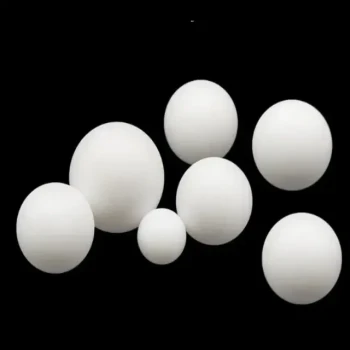
- Custom PTFE Teflon Balls for Advanced Industrial Applications
- Custom Polytetrafluoroethylene White Syringe Corrosion Resistant Teflon Plastic Injector Threaded Luer Fitting Compatible
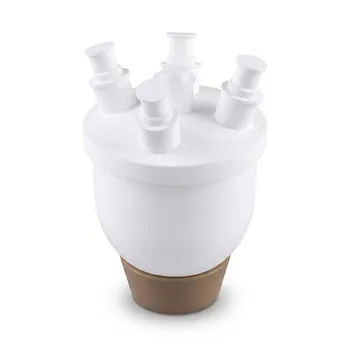
- High Performance Customizable PTFE Reaction Vessel and Corrosion Resistant Polytetrafluoroethylene Flask for Chemical Laboratory Use
People Also Ask
- Why is the material of the reaction vessel critical for tribocatalytic degradation? Boost Your Catalytic Yield!
- What is the operational temperature range for PTFE laboratoryware? Mastering Thermal Limits from -200°C to +260°C
- What are the main advantages of PTFE as a material for laboratory bottles? Superior Chemical & Thermal Resistance
- Why is PTFE used in laboratory applications? Ensure Chemical Purity and Reliability
- What are the limitations of pure PTFE in high temperature applications? Understanding the 200°C Ceiling