At its core, selecting a supplier based on their PTFE lining standards is a critical risk management decision. While many suppliers use PTFE, the rigor of their manufacturing and quality control standards directly determines the final product's performance, durability, and reliability, significantly impacting the total cost of ownership.
The real issue isn't the PTFE material itself, but the supplier's process control. Inconsistent or low standards introduce unpredictable variability, turning a component from a reliable asset into a potential point of catastrophic failure.
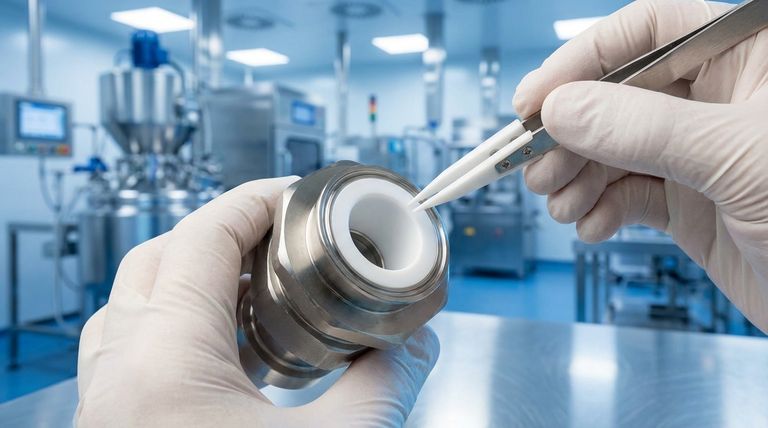
What "PTFE Lining Standards" Actually Define
The term "standards" goes far beyond simply using the correct raw material. It refers to the entire system of processes and checks a manufacturer implements to ensure quality and consistency.
The Process, Not Just the Polymer
A robust standard dictates how the PTFE is prepared, applied, and finished. This includes critical parameters that define the lining's integrity and its ability to perform under stress.
Key Elements of a High-Quality Standard
Superior suppliers codify their processes around several key metrics. These often include precise tolerances for lining thickness and uniformity, protocols for substrate surface preparation to ensure maximum adhesion, and stringent testing for porosity or pinholes that could lead to premature failure.
Material Purity and Composition
Standards also govern the quality of the PTFE itself. This ensures there are no impurities that could compromise its low-friction properties or chemical resistance, guaranteeing consistent performance from batch to batch.
The Tangible Impact of Subpar Standards
Choosing a supplier with lax or undocumented standards exposes your project to predictable and often costly failure modes. The initial cost savings are quickly erased by the consequences.
Accelerated Wear and Failure
An inconsistent lining thickness is a primary outcome of poor standards. Thinner sections will wear through rapidly, leading to a drastically reduced operational lifespan and unexpected maintenance demands.
Catastrophic Delamination
Perhaps the most significant risk is lining delamination. If a supplier's standard for surface preparation and bonding is inadequate, the PTFE lining can peel away from the base material, causing a complete and often sudden component failure.
Unpredictable Performance
Without rigorous standards, you lose predictability. One batch of components might perform perfectly, while the next fails under the exact same conditions. This variability makes it impossible to engineer a reliable system.
Understanding the Trade-offs
The decision to prioritize a supplier's standards is a classic engineering trade-off between upfront cost and long-term value.
The Cost vs. Reliability Equation
Suppliers with high standards invest heavily in process control, advanced inspection equipment, and documentation. This results in a higher initial component cost but provides a guarantee of reliability.
The Hidden Costs of Low Standards
A lower-cost component from a supplier with poor standards carries significant hidden costs. These include the expense of unplanned downtime, replacement labor, and potential damage to interconnected equipment when the component fails.
The Challenge of Verification
A key challenge is that suppliers may claim to have high standards without providing proof. True high-quality suppliers can readily provide documentation on their testing procedures, material traceability, and quality control metrics.
How to Vet a Supplier's PTFE Lining Standards
Your application's specific needs should guide your level of scrutiny when evaluating a potential supplier.
- If your primary focus is maximum reliability for a critical application: Demand detailed documentation on quality control, including specific tests for lining adhesion, thickness consistency, and porosity.
- If your primary focus is balancing performance and budget: Ask for performance data from previous projects and inquire specifically about their standards for surface preparation, as this is the most common point of failure.
- If your primary focus is a non-critical system or initial prototype: A supplier with less rigorous standards might be acceptable, but you must acknowledge and plan for a shorter component lifespan and higher potential for failure.
Ultimately, a supplier's documented standards are the most reliable predictor of a component's real-world performance and longevity.
Summary Table:
| Supplier Standard Level | Impact on Performance | Risk Level |
|---|---|---|
| High (Documented & Rigorous) | Predictable, long-lasting reliability | Low |
| Low (Lax or Undocumented) | Unpredictable wear, risk of delamination | High |
Don't let subpar PTFE lining standards compromise your critical systems. KINTEK manufactures high-performance PTFE components (seals, liners, labware) for the semiconductor, medical, laboratory, and industrial sectors. Our commitment to rigorous, documented standards ensures your components deliver maximum reliability, longevity, and value. Let's discuss your project's specific requirements—contact our experts today for a consultation on custom fabrication from prototypes to high-volume orders.
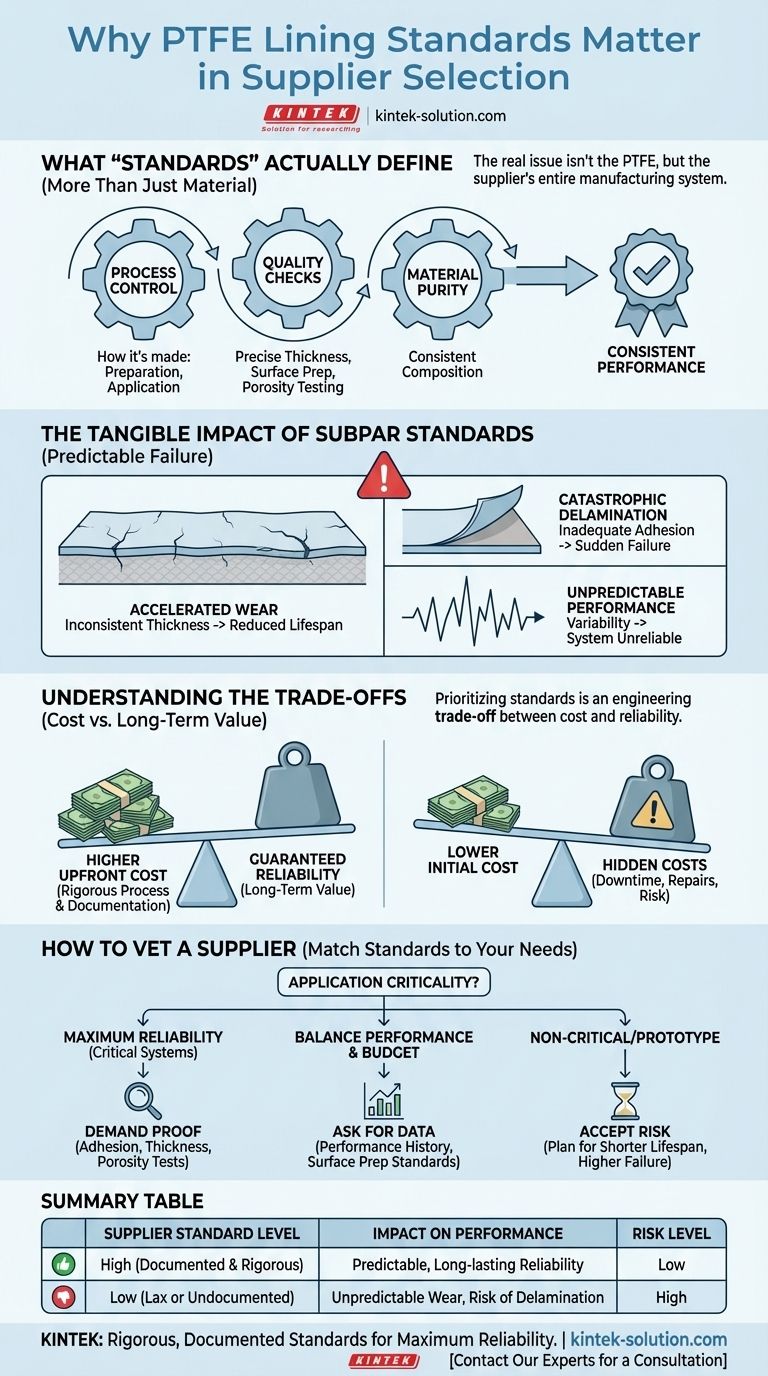
Visual Guide
Related Products
- High Purity PTFE Microwave Digestion Vessel for Soil and Food Analysis Acid Resistant Fluoropolymer Sample Preparation Liners
- High Purity PTFE Microwave Digestion Vessel Replacement Liner for Acid Sample Preparation and Trace Analysis
- Custom PTFE Sleeves and Hollow Rods for Advanced Applications
- PTFE Lined High Pressure Digestion Vessel 50ml High Temperature Hydrothermal Synthesis Tank
- High Purity TFM Microwave Digestion Vessels PTFE Acid Evaporation Liners Domestic GT-400 Equivalent Laboratory Reaction Containers
People Also Ask
- How does the dielectric property of PTFE benefit microwave-assisted digestion? Unlock Rapid and Uniform Sample Heating
- What are the advantages of using microwave digestion vessels? Optimize EG@MO synthesis with superior thermal control.
- What are the advantages of using microwave digestion vessels for environmental analysis? Boost speed and sample accuracy.
- What safety features are commonly integrated into microwave digestion vessels? Ensuring High-Pressure Laboratory Safety
- How do microwave digestion vessels support pharmaceutical elemental impurity testing? Achieve Precise USP Compliance