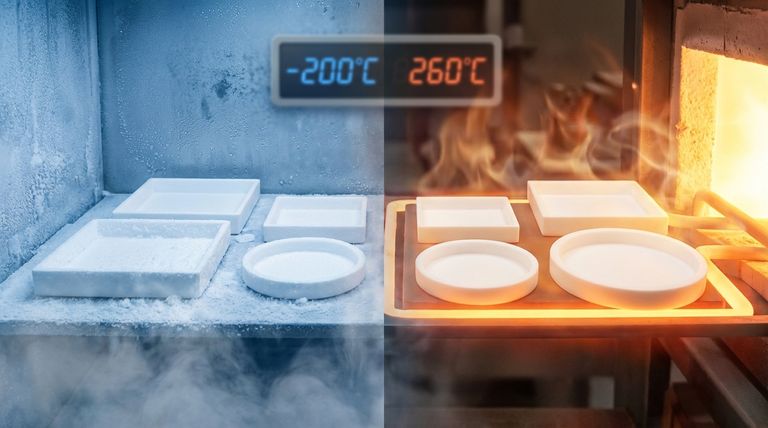
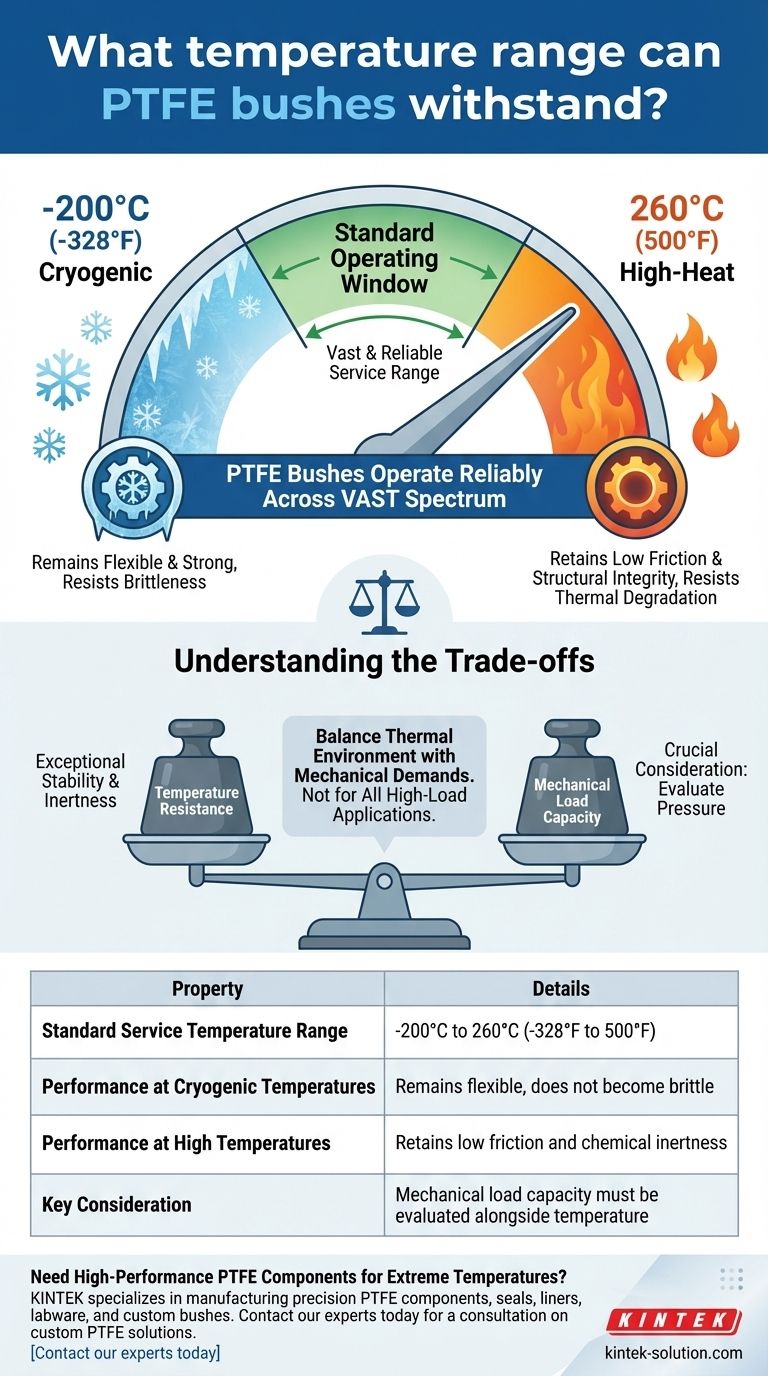
In short, PTFE bushes operate reliably within a vast temperature range. The generally accepted service temperature for Polytetrafluoroethylene (PTFE) is from -200°C (-328°F) up to 260°C (500°F). This remarkable thermal stability allows PTFE to maintain its key properties, such as low friction and chemical inertness, in both cryogenic and high-heat environments.
The critical takeaway is that while PTFE offers an exceptional temperature range, its suitability for a specific application depends equally on the mechanical load. Its thermal resilience must be considered alongside its limitations under high pressure.
The Basis of PTFE's Thermal Performance
The molecular structure of PTFE is responsible for its incredible thermal stability. It doesn't just survive extreme temperatures; it continues to perform its function reliably across the entire spectrum.
The Standard Operating Window
The established service temperature range for most PTFE components, including bushes, is -200°C to 260°C (-328°F to 500°F).
This range makes PTFE a premier choice for applications that experience significant temperature fluctuations or operate at constant extremes.
Performance in Cryogenic Conditions
At the low end of its range, PTFE does not become brittle like many other polymers. It maintains a useful degree of flexibility and strength, making it suitable for cryogenic applications where other materials would fail.
Performance in High-Heat Environments
At the upper limit of 260°C (500°F), PTFE resists thermal degradation. It retains its exceptionally low coefficient of friction and structural integrity, which is vital for bearing and bushing applications in industries like aerospace and automotive.
Understanding the Trade-offs
Selecting a material based on a single property can lead to design failure. While PTFE's thermal range is a key advantage, it is not a universal solution for every high-temperature application.
Temperature Resistance vs. Load Capacity
The primary trade-off with PTFE is its mechanical strength. It is a relatively soft material.
While it excels in low-friction scenarios, it may not be suitable for high-load or high-pressure applications where a metal bushing would be required. Always evaluate the specific load requirements of your design.
Variations in PTFE Grades
It's important to note that while the -200°C to 260°C range is standard for pure PTFE, slight variations can exist.
Different product types, such as O-rings, or filled grades of PTFE (e.g., glass-filled or carbon-filled) may have slightly different temperature ratings. Always consult the specific manufacturer's data sheet for the exact component you are considering.
Making the Right Choice for Your Goal
To select the right material, you must balance the thermal environment with the mechanical demands of the application.
- If your primary focus is thermal stability: PTFE is an excellent choice for applications with wide temperature swings, from cryogenic freezing to high operational heat.
- If your primary focus is high mechanical load: You must carefully verify that the load capacity of the PTFE bush is sufficient, and consider a metal or composite alternative if it is not.
- If your primary focus is both temperature and chemical resistance: PTFE's chemical inertness across its entire thermal range makes it an unparalleled choice for corrosive environments.
Ultimately, a successful design leverages PTFE's exceptional thermal properties while respecting its mechanical limitations.
Summary Table:
| Property | Details |
|---|---|
| Standard Service Temperature Range | -200°C to 260°C (-328°F to 500°F) |
| Performance at Cryogenic Temperatures | Remains flexible, does not become brittle |
| Performance at High Temperatures | Retains low friction and chemical inertness |
| Key Consideration | Mechanical load capacity must be evaluated alongside temperature |
Need High-Performance PTFE Components for Extreme Temperatures?
PTFE's remarkable thermal stability from -200°C to 260°C makes it ideal for demanding applications in the semiconductor, medical, laboratory, and industrial sectors. However, selecting the right component requires balancing temperature needs with mechanical load.
KINTEK specializes in manufacturing precision PTFE components—including seals, liners, labware, and custom bushes. We help you navigate these trade-offs to ensure optimal performance and longevity for your specific environment, whether you need prototypes or high-volume production.
Let's discuss your application requirements. Contact our experts today for a consultation on custom PTFE solutions that deliver reliability across the entire temperature spectrum.
Visual Guide
Related Products
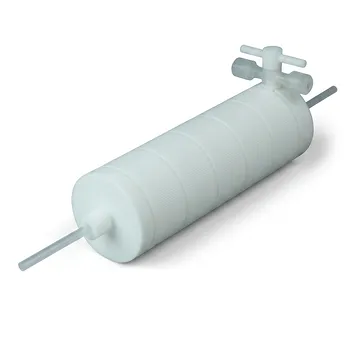
- High Corrosion Resistant PTFE Faucet Polytetrafluoroethylene Valve for Chemical Storage Drums and Fluid Transfer Systems Customizable Industrial Grade
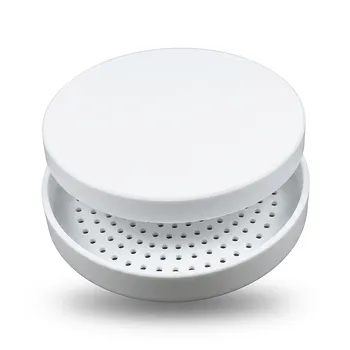
- Customizable PTFE Heat Insulation Plate High Temperature Corrosion Resistant Laboratory Support Layered Multi Tier Stand
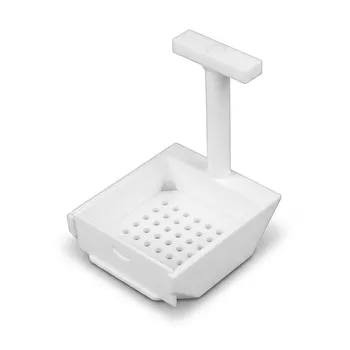
- PTFE Anti Scald Heat Insulation Sleeve Hot Plate Support Feet Laboratory Benchtop Protection Customizable Thermal Barrier
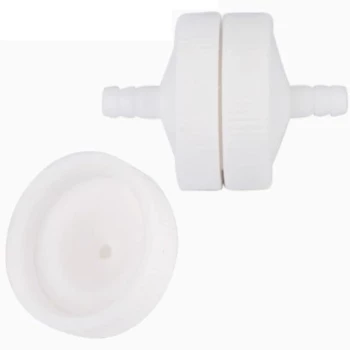
- PTFE PFA Vacuum Filtration System Corrosion Resistant Customizable Shatterproof Laboratory Device
- Custom PTFE Constant Pressure Separatory Funnel Corrosion Resistant Low Background Labware for PFA Flasks
People Also Ask
- What is the typical operating temperature and pressure range for PTFE valves? Key Specs for Optimal Performance
- What industries commonly use PTFE valves and components? Essential for Chemical & Purity Applications
- What specific advantages do PTFE valves offer? Unmatched Corrosion Resistance for Industrial Chemical Handling
- How do PTFE valves and components support high-purity liquid transfer? Ensure Product Integrity with Inert Materials
- What are the key properties of PTFE valves? Ensure Purity, Safety, and Reliability in Demanding Processes