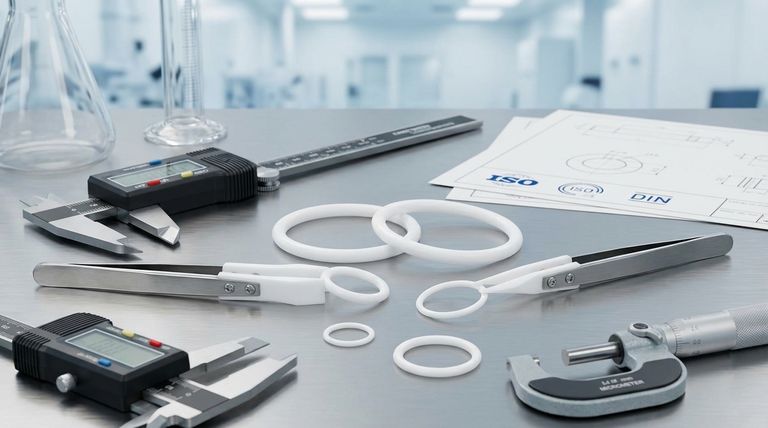
The primary standards referenced for PTFE O-rings are BS1806, ISO 3601, DIN 3771, and JIS B2401. These are international and regional dimensional standards that dictate the size, cross-section, and tolerances of an O-ring. This ensures that a part from one manufacturer can be reliably interchanged with another, fitting precisely into a standardized groove.
While dimensional standards guarantee a proper fit, the true reason for selecting a PTFE O-ring lies in its unique material properties. The standards ensure interchangeability, but the material's exceptional chemical resistance and low-friction nature are what dictate its performance and suitability for a specific application.
Decoding the O-Ring Standards
Understanding what these standards define is the first step in proper specification. They are primarily concerned with physical dimensions, not material performance.
What the Standards Define
These standards provide a common language for engineers and manufacturers. They specify the inside diameter (ID), the cross-section (CS), and the allowable tolerances for each dimension. This guarantees that an O-ring specified to a particular standard will fit correctly in a groove designed to that same standard.
A Guide to the Acronyms
Each standard originates from a different standards organization, though there is significant overlap.
- ISO 3601: The International Organization for Standardization, providing a global benchmark.
- BS1806: A British Standard, widely used in the UK and Commonwealth countries.
- DIN 3771: A German standard from the Deutsches Institut für Normung, common in Europe.
- JIS B2401: The Japanese Industrial Standard.
Why Standardization Matters
Using a recognized standard removes ambiguity in design and procurement. It ensures that components are predictable, reliable, and easily sourced from multiple suppliers, which is critical for both manufacturing and maintenance.
Beyond Dimensions: The Core Properties of PTFE
You choose PTFE not just for its size, but for its remarkable material characteristics. These properties are not governed by the dimensional standards but are inherent to the polymer itself.
Unmatched Chemical Resistance
PTFE is famous for being chemically inert. It is highly resistant to nearly all chemicals, including aggressive acids, bases, and solvents, making it ideal for harsh processing environments.
Wide Temperature Capability
PTFE O-rings perform reliably across a broad temperature range, typically from -73°C to 204°C (-100°F to 400°F). This allows them to be used in applications involving both cryogenic and high-temperature conditions.
Extremely Low Friction
With a very low coefficient of friction, PTFE has a slippery, non-stick surface. This is a significant advantage in applications where parts move against the O-ring, as it reduces wear and operating force.
The Role of Quality Manufacturing
Because PTFE has distinct material behaviors, consistent and precise manufacturing is critical. Reputable suppliers adhere to strict quality protocols, from sourcing raw PTFE resin to final inspection, to ensure every O-ring is reliable and consistent.
Understanding the Trade-offs and Limitations
No material is perfect. Acknowledging PTFE's limitations is essential for preventing seal failure and ensuring a successful design.
The Issue of Inelasticity
Unlike rubber elastomers, PTFE is not compressible or elastic. It does not "spring back" to its original shape after being compressed. This property, known as poor compression set, means it is generally unsuitable for dynamic sealing applications that rely on the seal's ability to respond to pressure changes.
Potential for Cold Flow (Creep)
Under a sustained load, PTFE can slowly and permanently deform over time, a phenomenon known as creep or "cold flow." This can eventually lead to a loss of sealing pressure and potential leakage, especially in high-pressure static applications.
Higher Seating Force Required
Because it is a rigid material, a PTFE O-ring requires more force to be compressed into its groove to achieve an effective seal compared to a flexible elastomer like nitrile or Viton™.
How to Specify the Right PTFE O-Ring
Choosing the correct O-ring involves matching the dimensional standard to your design and ensuring the material's inherent properties meet your operational demands.
- If your primary focus is interchangeability for a global product: Specify a widely recognized international standard like ISO 3601 to ensure broad sourcing options.
- If your primary focus is sealing aggressive chemicals in a static face seal: Confirm the PTFE compound provides the necessary chemical inertness and use a dimensional standard (like DIN 3771) that matches your groove design precisely.
- If your application involves dynamic movement or frequent pressure cycles: Exercise extreme caution. The poor compression set of pure PTFE makes it a high-risk choice; consider a filled PTFE variant or a different elastomeric material entirely.
Ultimately, selecting the right standard ensures the O-ring fits, but understanding PTFE's unique material characteristics is the key to a reliable, long-lasting seal.
Summary Table:
| Standard | Organization | Primary Use |
|---|---|---|
| ISO 3601 | International Organization for Standardization | Global benchmark for interchangeability |
| BS1806 | British Standards | Widely used in UK and Commonwealth countries |
| DIN 3771 | Deutsches Institut für Normung (German) | Common standard in Europe |
| JIS B2401 | Japanese Industrial Standards | Standard for applications in Japan and Asia |
Need a reliable PTFE sealing solution?
At KINTEK, we specialize in manufacturing high-precision PTFE components, including O-rings, seals, liners, and custom labware. Our expertise ensures your parts meet the exacting requirements of dimensional standards while delivering the superior chemical resistance and low-friction performance that PTFE is known for.
We serve the semiconductor, medical, laboratory, and industrial sectors with custom fabrication from prototypes to high-volume orders. Let us provide you with a sealing solution that fits perfectly and performs reliably in your most demanding applications.
Contact our experts today for a consultation on your specific needs!
Visual Guide

Related Products
- High Temperature Chemical Resistant 50ml PTFE Syringe Customized Teflon Injector with Threaded Seal for Trace Analysis
- Customizable PTFE Rods for Advanced Industrial Applications
- High Purity Laboratory Grade PTFE Syringe Chemical Resistant Fluoropolymer Injector for Trace Analysis
- Custom PTFE Corrosion Resistant White Syringe with Threaded Luer Connector Compatibility
- Virgin PTFE Precision Syringe for Chemical Dispensing and Syringe Pump Integration with FEP Tubing Compatibility
People Also Ask
- In what medical devices is PTFE commonly used? Essential Components for Safety and Reliability
- Is PTFE approved for food contact applications? Ensuring Food Safety with Compliant PTFE
- What is notable about the coefficient of friction of PTFE? Achieve Unmatched Low-Friction Performance
- Why is PTFE highly resistant to chemicals? Unmatched Inertness for Demanding Applications
- How does PTFE's flexibility affect its performance? Unlock Durability and Sealing Power