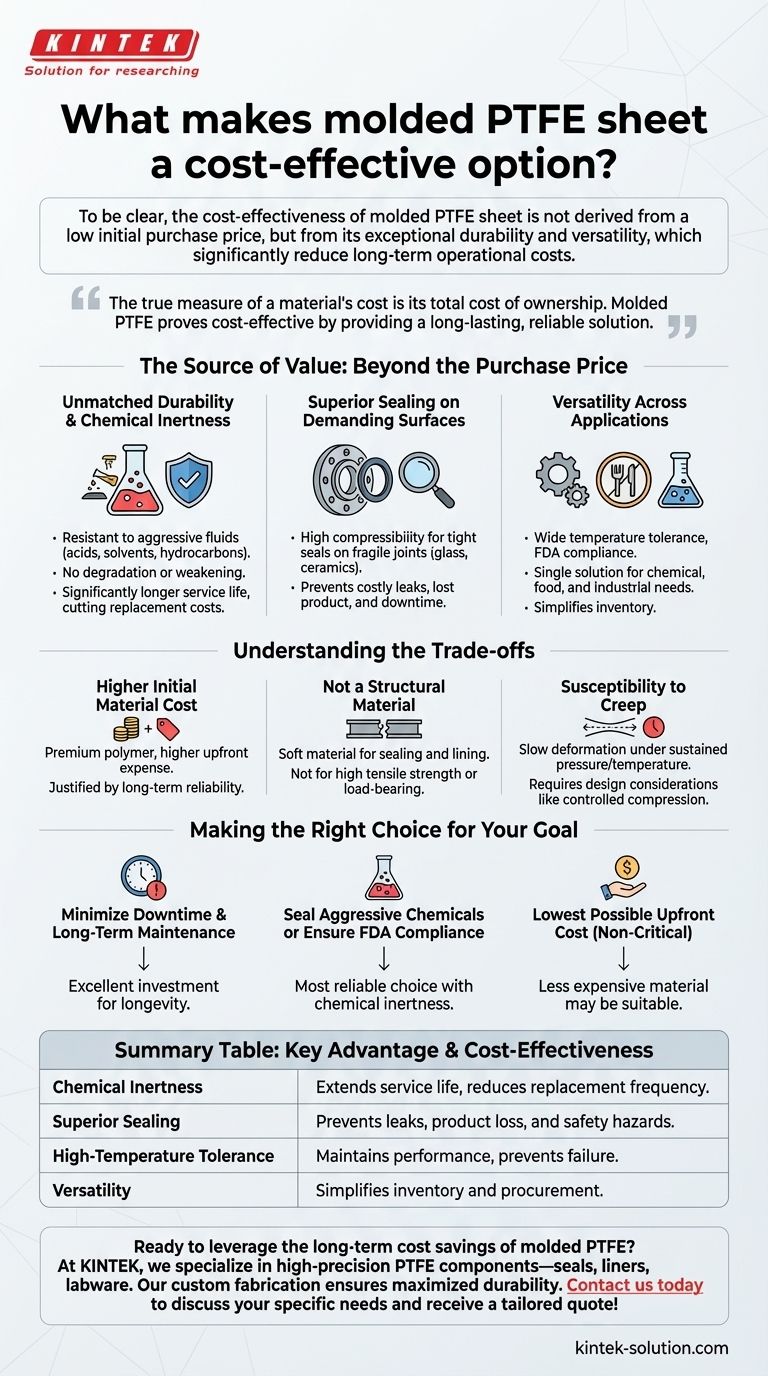
To be clear, the cost-effectiveness of molded PTFE sheet is not derived from a low initial purchase price, but from its exceptional durability and versatility, which significantly reduce long-term operational costs. Its ability to resist aggressive chemicals, withstand extreme temperatures, and create a reliable seal on imperfect surfaces minimizes the frequency of replacement, prevents costly leaks, and reduces downtime.
The true measure of a material's cost is its total cost of ownership. Molded PTFE proves cost-effective by providing a long-lasting, reliable solution that prevents expensive failures and maintenance cycles in demanding environments.
The Source of Value: Beyond the Purchase Price
The financial benefit of using molded PTFE sheet becomes clear when you look past the upfront material cost and consider the entire lifecycle of the application. Its unique properties translate directly into operational savings.
Unmatched Durability and Chemical Inertness
Molded PTFE is resistant to a vast range of aggressive fluids, including acids, solvents, and hydrocarbons.
This chemical inertness means the material does not degrade, swell, or weaken when exposed to harsh substances. This leads to a significantly longer service life compared to less resistant materials, drastically cutting down on replacement costs and associated labor.
Superior Sealing on Demanding Surfaces
Its high compressibility makes it an excellent choice for creating a tight seal on stress-sensitive or fragile flanged joints.
This is critical for equipment made of glass, ceramics, or plastic, where other materials might cause damage. More importantly, it ensures a reliable seal, preventing leaks that can lead to lost product, safety hazards, and expensive operational downtime.
Versatility Across a Wide Range of Applications
PTFE's combination of chemical resistance, wide temperature tolerance, and compliance with FDA food-grade requirements makes it a single solution for many different needs.
This versatility can simplify inventory management. Instead of stocking multiple specialized materials, a facility can use PTFE for chemical processing, food and beverage lines, and general utilities, reducing procurement complexity and costs.
Understanding the Trade-offs
While PTFE offers significant long-term value, it's essential to understand its specific limitations to use it effectively. It is not a universal solution for every problem.
Higher Initial Material Cost
The primary trade-off is the upfront expense. Molded PTFE is a premium polymer, and its initial cost is typically higher than that of common elastomers or fiber-based gasket materials.
This initial investment is justified only in applications where its longevity and reliability can be fully leveraged.
Not a Structural Material
PTFE is a relatively soft material with a primary function in sealing, lining, and low-friction applications.
It should not be used in applications requiring high tensile strength or structural load-bearing capabilities. Mistaking it for a structural plastic can lead to component failure.
Susceptibility to Creep
Under sustained pressure and temperature (a condition known as "creep" or "cold flow"), PTFE can slowly deform over time.
This characteristic must be accounted for in the design of flanged joints, often by using controlled compression or re-torquing bolts after installation to maintain a secure seal.
Making the Right Choice for Your Goal
Selecting the right material requires aligning its properties with your primary operational objective.
- If your primary focus is minimizing downtime and long-term maintenance: Molded PTFE is an excellent investment due to its longevity in harsh environments.
- If your primary focus is sealing aggressive chemicals or ensuring food-grade compliance: PTFE's chemical inertness and FDA compliance make it one of the most reliable choices available.
- If your primary focus is the lowest possible upfront cost for a non-critical application: A less expensive material may be a more suitable choice for your budget.
Ultimately, choosing molded PTFE is a strategic decision to prioritize long-term reliability over short-term material savings.
Summary Table:
| Key Advantage | How It Drives Cost-Effectiveness |
|---|---|
| Chemical Inertness | Resists degradation from acids, solvents, and hydrocarbons, extending service life and reducing replacement frequency. |
| Superior Sealing | Compresses well on fragile surfaces, preventing leaks that cause product loss, safety hazards, and downtime. |
| High-Temperature Tolerance | Withstands extreme temperatures, maintaining performance in demanding environments without failure. |
| Versatility | One material for multiple applications (chemical, food-grade, industrial), simplifying inventory and procurement. |
Ready to leverage the long-term cost savings of molded PTFE?
At KINTEK, we specialize in manufacturing high-precision PTFE components—including seals, liners, and labware—for the semiconductor, medical, laboratory, and industrial sectors. Our custom fabrication services, from prototypes to high-volume orders, ensure you get a PTFE solution that maximizes durability and minimizes your total cost of ownership.
Contact us today to discuss your specific needs and receive a tailored quote!
Visual Guide
Related Products
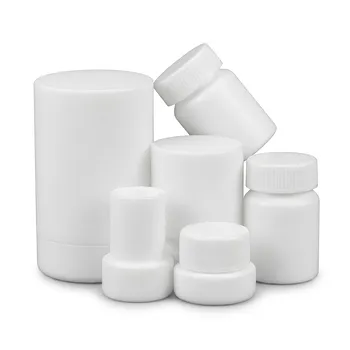
- Corrosion Resistant PTFE Small Reaction Bottle One Piece Molded Teflon Sample Storage Tank
- PTFE Anti Scald Heat Insulation Sleeve Hot Plate Support Feet Laboratory Benchtop Protection Customizable Thermal Barrier
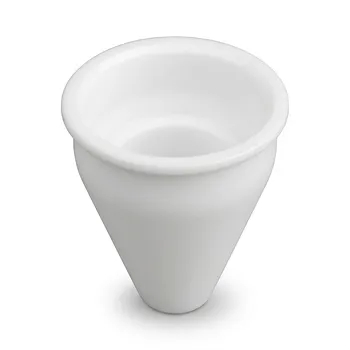
- Custom Machined PTFE Conical Sample Cell Corrosion Resistant Triangular Fluoropolymer Container for Trace Analysis
- Custom PTFE Sleeves and Hollow Rods for Advanced Applications
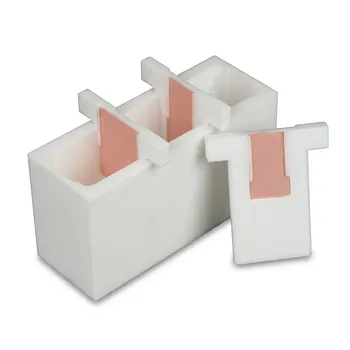
- White PTFE Electrolytic Cell with Movable Slider and Insulated Lid for Fluorine Corrosion Resistance
People Also Ask
- What are the temperature limits for the PTFE bottle? Ensure Safety from -200°C to 260°C
- What are the advantages of the PTFE bottle's non-stick surface? Ensure Purity and Efficiency in Your Lab
- What are the key features of PTFE reagent bottles? Superior Chemical Resistance and Durability
- What are the key applications of the PTFE bottle? Ensure Chemical Safety and Sample Purity
- What material is the PTFE bottle made from? Discover the Benefits of 100% Virgin PTFE