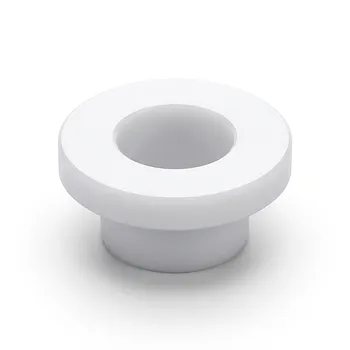
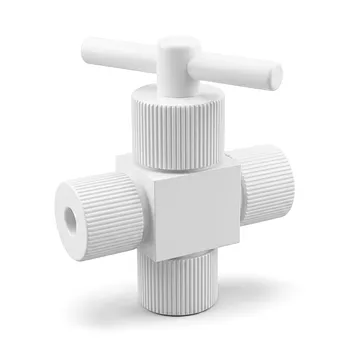
At its core, Polytetrafluoroethylene (PTFE) is one of the most lubricious solid materials known. This gives PTFE O-rings an exceptionally low coefficient of friction, allowing them to function as self-lubricating seals in applications where reducing drag and wear is critical. Their inherent slipperiness minimizes energy loss and prevents damage to moving parts.
While PTFE's defining characteristic is its extremely low friction, the most important takeaway is that it is a rigid plastic, not a flexible elastomer. This fundamental difference dictates its ideal use cases and introduces critical trade-offs in sealing performance compared to traditional rubber O-rings.

The Source of PTFE's Lubricity
PTFE's unique molecular structure is responsible for its remarkable non-stick and low-friction properties. This makes it a standout choice for dynamic sealing applications where parts are in constant motion.
The Lowest Coefficient of Friction
PTFE has one of the lowest coefficients of friction of any solid material. This means surfaces slide against it with minimal resistance.
This property is so pronounced that PTFE itself is used as a lubricant additive to reduce friction in machinery and other mechanical systems.
A Naturally Non-Stick Surface
The same properties that make PTFE non-stick in cookware also benefit its sealing performance.
Its surface is inherently slippery, which prevents material transfer and reduces the force needed to move components that are in contact with the O-ring.
How This Reduces Wear and Energy
In a dynamic system, high friction generates heat and leads to abrasion and wear on moving parts.
By dramatically lowering friction, PTFE O-rings protect equipment, extend service life, and reduce the overall energy required to operate the system.
Key Properties Beyond Lubrication
While low friction is a primary benefit, PTFE's value as a sealing material is amplified by a combination of other powerful characteristics.
Unmatched Chemical Resistance
PTFE O-rings are virtually impervious to all industrial chemicals, including aggressive acids, bases, and solvents.
They are only degraded by a very small number of substances, such as molten alkaline metals and specific halogenated compounds.
Wide Operational Temperature Range
This material maintains its integrity across an exceptionally broad temperature spectrum, typically performing reliably from -73°C to +260°C (-100°F to +500°F).
This makes it suitable for applications involving cryogenic fluids or high-temperature processes.
Excellent Insulating Capabilities
PTFE is an outstanding electrical and thermal insulator, which is a critical property in applications where electrical isolation or thermal management is required.
Understanding the Trade-offs: Plastic vs. Elastomer
The most common mistake is to treat a PTFE O-ring like a direct replacement for a rubber O-ring. Its nature as a rigid plastic introduces significant limitations.
Lack of Elasticity and Memory
Unlike rubber O-rings that seal by being compressed, PTFE is non-compressible and has very poor elastic memory.
Once deformed, it does not readily return to its original shape. This means it cannot effectively compensate for surface imperfections or pressure fluctuations in the same way an elastomer can.
The Risk of Leakage in Static Seals
Because it doesn't compress and "spring back," pure PTFE is often a poor choice for high-pressure static sealing applications.
Without the constant outward force provided by an elastomer, it is more susceptible to developing leak paths, especially if thermal cycling occurs.
Hardness and Installation Challenges
PTFE has a high hardness (typically 60-65 Shore D), making it stiff and difficult to install compared to flexible rubber O-rings.
Stretching it over a shaft can permanently deform it, compromising its sealing ability from the start. Specialized installation techniques are often required.
Making the Right Choice for Your Application
Selecting the right material requires balancing PTFE's benefits against its fundamental limitations.
- If your primary focus is minimizing friction in a dynamic application: PTFE is an excellent choice, provided the hardware design accommodates its rigidity and lack of elasticity.
- If your primary focus is sealing against aggressive chemicals or extreme temperatures: PTFE's inertness and thermal stability are nearly unmatched, making it a premier material.
- If your primary focus is a reliable, high-pressure static seal: A traditional elastomeric O-ring is almost always a more robust and forgiving choice.
By understanding PTFE not just as a lubricant but as a unique sealing material, you can leverage its strengths while mitigating its inherent trade-offs.
Summary Table:
| Property | Description | Key Benefit |
|---|---|---|
| Low Coefficient of Friction | One of the lowest of any solid material | Self-lubricating, reduces wear and energy loss |
| Chemical Resistance | Resistant to nearly all industrial chemicals | Ideal for aggressive chemical environments |
| Temperature Range | Performs from -73°C to +260°C | Suitable for cryogenic and high-temperature applications |
| Material Type | Rigid plastic (not an elastomer) | Excellent for dynamic seals, poor for high-pressure static seals |
Need a high-performance seal for a demanding application?
At KINTEK, we specialize in manufacturing precision PTFE components, including O-rings, seals, liners, and custom labware. Our expertise is crucial for industries like semiconductor, medical, and laboratory, where material properties like low friction, chemical inertness, and thermal stability are non-negotiable.
We provide custom fabrication from prototypes to high-volume orders, ensuring you get the exact seal you need without compromise.
Let's discuss your specific requirements. Contact our engineering team today for a consultation.
Visual Guide

Related Products
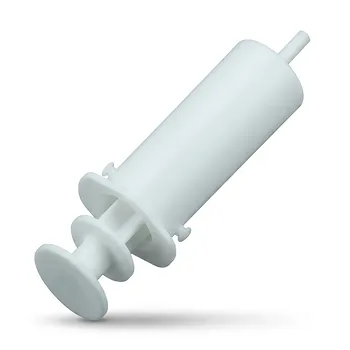
- High Temperature Chemical Resistant 50ml PTFE Syringe Customized Teflon Injector with Threaded Seal for Trace Analysis
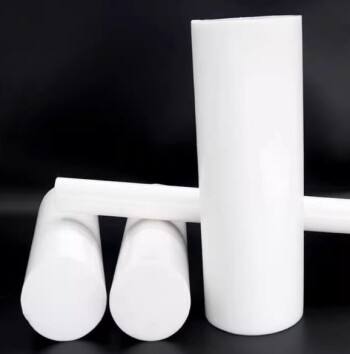
- Customizable PTFE Rods for Advanced Industrial Applications
- High Purity Laboratory Grade PTFE Syringe Chemical Resistant Fluoropolymer Injector for Trace Analysis
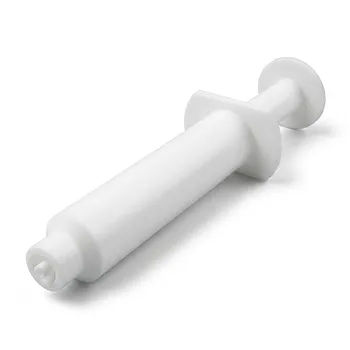
- Custom PTFE Corrosion Resistant White Syringe with Threaded Luer Connector Compatibility
- Virgin PTFE Precision Syringe for Chemical Dispensing and Syringe Pump Integration with FEP Tubing Compatibility
People Also Ask
- In what medical devices is PTFE commonly used? Essential Components for Safety and Reliability
- Is PTFE approved for food contact applications? Ensuring Food Safety with Compliant PTFE
- Why is PTFE highly resistant to chemicals? Unmatched Inertness for Demanding Applications
- How does PTFE's flexibility affect its performance? Unlock Durability and Sealing Power
- What is notable about the coefficient of friction of PTFE? Achieve Unmatched Low-Friction Performance