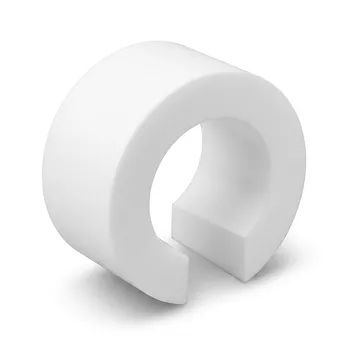
The primary machining concerns for PTFE wear plates are its high rate of thermal expansion, its inherent softness, and its tendency to cause rapid tool wear. These properties combine to make achieving and holding tight dimensional tolerances the central challenge, requiring specific strategies for tooling, speeds, and workholding that differ significantly from those used for metals.
The key to successfully machining PTFE is not to fight its nature but to adapt your process to it. Understanding that PTFE will expand with heat and deform under pressure allows you to use specific tooling and techniques to manage these properties and achieve precise, reliable results.

The Core Challenge: PTFE's Unique Material Properties
To effectively machine PTFE wear plates, one must first respect the material's fundamental characteristics. Unlike rigid metals, PTFE is a soft polymer with distinct behaviors under thermal and mechanical stress.
High Coefficient of Thermal Expansion
PTFE expands and contracts significantly with even minor temperature changes. Heat generated from cutting friction can cause the material to expand during the machining process, leading to a part that is undersized once it cools to ambient temperature.
This property is the single most critical factor affecting dimensional accuracy.
Low Strength and Material Softness
PTFE is a soft material that can easily be compressed or deformed. Excessive clamping pressure in a vise or fixture can distort the wear plate, leading to inaccurate cuts.
Likewise, dull tools or improper tool geometry can push the material away rather than cutting it cleanly, resulting in dimensional errors and poor surface finish.
Tendency for Rapid Tool Wear
While seemingly soft, PTFE can be abrasive to cutting tools, especially when machined with incorrect speeds or feed rates. Dull tools exacerbate the problem by generating more friction and heat, further complicating the issue of thermal expansion.
Achieving Precision in Practice
Managing PTFE's properties requires a deliberate and controlled approach. The right combination of tooling, parameters, and techniques is essential for a successful outcome.
Critical Tooling Requirements
Your cutting tools are the most important variable. They must be extremely sharp with smooth, polished cutting faces to minimize friction.
HSS (High-Speed Steel) or carbide tools are recommended. Proper tool geometry, including sufficient clearance and a cutting angle of less than 90 degrees, is crucial to ensure the tool shears the material cleanly instead of deforming it.
Optimizing Speeds and Feeds
The goal is to remove material efficiently without generating excessive heat. This is achieved with moderate cutting speeds paired with high feed rates.
A high feed rate moves the tool through the material quickly, which helps prevent heat buildup in one spot and promotes effective chip evacuation.
The Role of Coolant and Chip Removal
For any heat-intensive operations, a high-pressure coolant is highly beneficial. It serves two purposes: reducing friction at the cutting edge and actively clearing chips (swarf) away from the work area.
Effective swarf removal is vital to prevent chips from being recut, which can mar the surface finish.
Careful Workholding and Clamping
Secure the PTFE wear plate with just enough pressure to hold it firmly without causing it to compress or bulge. Distributing the clamping force over a larger surface area can help prevent localized distortion.
Understanding the Trade-offs
Machining PTFE is an exercise in balancing competing factors. Recognizing these trade-offs is key to avoiding common frustrations and achieving your design intent.
The Myth of Ultra-Tight Tolerances
While skilled machinists can achieve tolerances within 50 microns (+/- 0.002 inches), it's often unnecessary. PTFE's natural resilience and flexibility allow it to conform to mating surfaces.
Forcing unnecessarily tight tolerances onto a PTFE part fights its inherent nature and can dramatically increase manufacturing complexity and cost.
Designing for the Material
The most successful PTFE applications are designed from the start with the material's properties in mind. This means allowing for thermal expansion in the design and leveraging its low-friction, conforming nature rather than treating it like a rigid block of aluminum.
Features like groove patterns and mounting holes are easily machined with standard CNC equipment, but their final dimensions must account for the material's behavior.
Making the Right Choice for Your Goal
Your specific objective for the wear plate should guide your machining strategy.
- If your primary focus is dimensional accuracy: Prioritize thermal management with coolant and avoid dwelling in one spot. Use exceptionally sharp tools and measure the part only after it has returned to a stable ambient temperature.
- If your primary focus is groove precision and surface finish: Use tools with highly polished cutting faces and a high-pressure coolant stream to ensure clean shearing and efficient chip evacuation.
- If your primary focus is process efficiency: Emphasize high feed rates and sharp tooling to minimize cycle time and reduce heat buildup, which allows for more consistent production.
By adapting your approach to these core principles, you can transform PTFE's unique challenges into predictable and successful manufacturing outcomes.
Summary Table:
| Machining Concern | Key Impact | Recommended Strategy |
|---|---|---|
| High Thermal Expansion | Parts shrink after cooling, causing dimensional inaccuracy. | Use coolant; measure parts at ambient temperature. |
| Material Softness | Clamping pressure or dull tools can deform the plate. | Use sharp tools; apply minimal, distributed clamping force. |
| Rapid Tool Wear | Abrasive nature dulls tools, increasing heat and friction. | Use sharp HSS/carbide tools; employ high feed rates. |
Need precision-machined PTFE wear plates that meet your exact specifications?
At KINTEK, we specialize in manufacturing high-quality PTFE components like seals, liners, and custom labware. Our expertise in managing PTFE's unique properties—such as thermal expansion and softness—ensures your wear plates are machined to the precise tolerances required for reliability and performance in demanding semiconductor, medical, laboratory, and industrial applications.
We offer custom fabrication from prototypes to high-volume orders, prioritizing precision and material integrity. Let us handle the complexities of PTFE machining for you.
Contact us today to discuss your project requirements and get a quote!
Visual Guide

Related Products
- Customizable PTFE Heat Insulation Plate High Temperature Corrosion Resistant Laboratory Support Layered Multi Tier Stand
- PTFE Anti Scald Heat Insulation Sleeve Hot Plate Support Feet Laboratory Benchtop Protection Customizable Thermal Barrier
- Corrosion Resistant PTFE Stirring Disk Chemical Dispersion Plate 350mm Diameter Fluoropolymer Mixer Accessory
- High Temperature Resistant Insulating TFM Separator and Ultra Clean Laboratory PTFE Baffle Plate with Customizable Pore Size and Hole Configuration
- Custom PTFE Multi Layer Filtration Plates Corrosion Resistant Low Background Lab Grade Filter Assemblies
People Also Ask
- What customization options are available for PTFE materials? Tailor Performance for Your Application
- What are the limitations of pure PTFE in high temperature applications? Understanding the 200°C Ceiling
- What is a disadvantage of PTFE in terms of mechanical strength? Overcome Its Weakness with Reinforced Solutions
- What are the limitations of PTFE materials? Understand the Key Trade-Offs Before You Spec
- What are the main ingredients used in the production of PTFE? Unlocking its High-Performance Properties