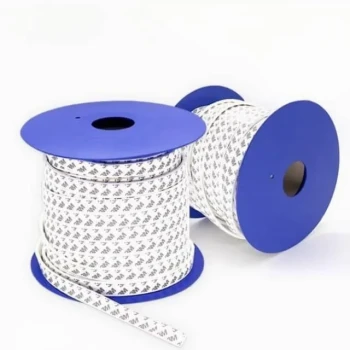
In short, the primary benefits of EPTFE joint sealant are its exceptional durability and versatility. It creates a robust, reliable seal capable of withstanding extreme mechanical stress, high pressure, and even vacuum conditions on virtually any type of joint.
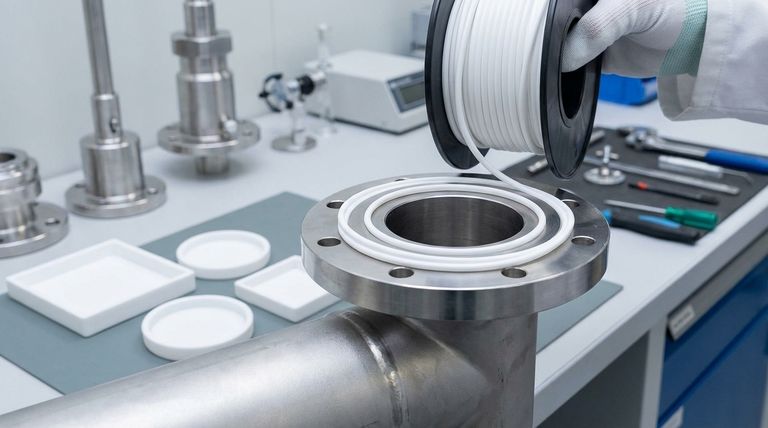
The core advantage of EPTFE joint sealant is its ability to function as a high-performance, form-in-place gasket. This eliminates the need for a vast inventory of pre-cut gaskets and ensures a perfect, durable seal on even irregular or damaged surfaces where traditional options would fail.
Why EPTFE Excels in Demanding Environments
Expanded Polytetrafluoroethylene (EPTFE) sealant is not a simple paste or liquid; it's a soft, flexible cord of specialized material. Its unique properties solve common and critical industrial sealing challenges.
Unmatched Adaptability
The most immediate benefit of EPTFE is its ability to conform to any shape.
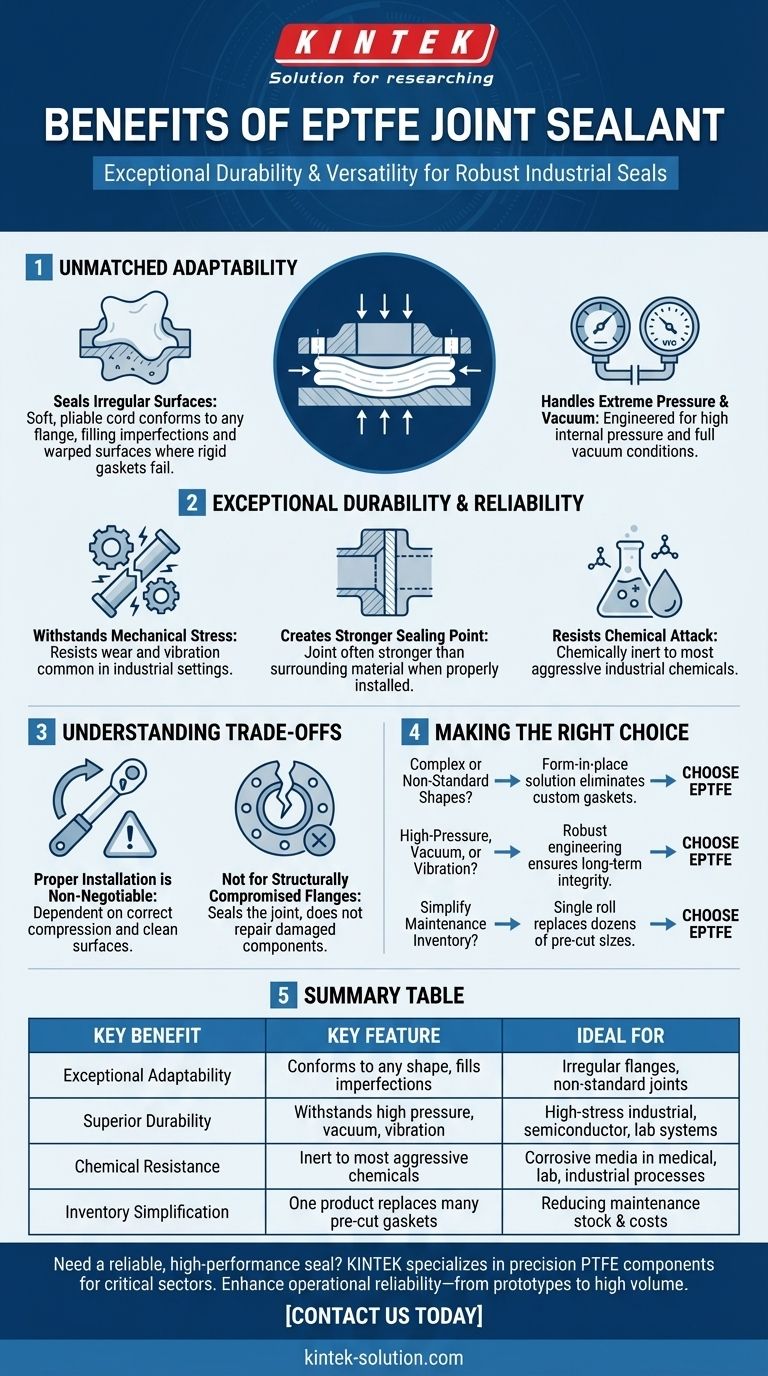
Seals Irregular Surfaces Because it's a soft, pliable cord, you can apply it to any flange shape—round, square, or highly irregular. It crushes down under pressure to fill imperfections, scratches, and warped surfaces, creating a tight seal where rigid gaskets cannot.
Handles Extreme Pressure Differentials EPTFE sealant is engineered to perform under both high internal pressure and a full vacuum. This dual capability makes it a reliable choice for a wide range of processing and conveyance systems.
Exceptional Durability and Reliability
In critical applications, the seal cannot be the weak point. EPTFE is designed to ensure it isn't.
Withstands Mechanical Stress
The material is specifically designed to handle the mechanical wear and vibration common in industrial settings, such as high-pressure water lines or heavy machinery.
Creates a Stronger Sealing Point
When properly installed and compressed, the EPTFE sealant creates a joint that is often stronger and more reliable than the surrounding pipe or flange material. This ensures the seal will not fail under operational abuse or pressure spikes.
Resists Chemical Attack
As a form of PTFE, the material is chemically inert to most industrial chemicals. This makes it an ideal choice for aggressive or corrosive media where other sealing materials would degrade quickly.
Understanding the Trade-offs
While highly effective, EPTFE is not a universal solution. Understanding its limitations is key to successful application.
Proper Installation is Non-Negotiable
The performance of EPTFE sealant is entirely dependent on correct installation. The surfaces must be clean, and the material must be compressed to the manufacturer's specification to create a stable, long-lasting seal. Over- or under-tightening can lead to failure.
Not a Cure for Damaged Flanges
While EPTFE can compensate for minor surface imperfections, it cannot fix a structurally compromised or severely damaged flange. It seals the joint; it does not repair the components.
Making the Right Choice for Your Goal
Use these guidelines to determine if EPTFE joint sealant fits your specific needs.
- If your primary focus is sealing complex or non-standard shapes: EPTFE's form-in-place nature makes it the ideal solution, eliminating the need for custom-cut gaskets.
- If your primary focus is reliability in high-pressure, vacuum, or high-vibration systems: Its robust engineering ensures the integrity of the sealed joint under significant mechanical stress.
- If your primary focus is simplifying maintenance inventory: A single roll of EPTFE sealant can replace dozens of different pre-cut gasket sizes, reducing complexity and cost.
Ultimately, choosing EPTFE is a decision to prioritize long-term joint integrity and operational reliability.
Summary Table:
| Key Benefit | Key Feature | Ideal For |
|---|---|---|
| Exceptional Adaptability | Conforms to any shape, fills imperfections | Irregular or damaged flanges, non-standard joints |
| Superior Durability | Withstands high pressure, vacuum, and vibration | High-stress industrial, semiconductor, and laboratory systems |
| Chemical Resistance | Inert to most aggressive chemicals | Corrosive media in medical, lab, and industrial processes |
| Inventory Simplification | One product replaces many pre-cut gaskets | Reducing maintenance stock and costs |
Need a reliable, high-performance seal for your critical application?
At KINTEK, we specialize in manufacturing precision PTFE components, including EPTFE joint sealants, for the semiconductor, medical, laboratory, and industrial sectors. Our expertise ensures you get a sealing solution that withstands extreme conditions, simplifies your inventory, and enhances operational reliability—from custom prototypes to high-volume orders.
Contact us today to discuss your specific sealing challenges and discover how KINTEK can provide a durable, tailored solution for your needs.
Visual Guide
Related Products
- Custom PTFE Sealing Tapes for Industrial and High Tech Applications
- Custom PTFE Sealing Caps and Corrosion Resistant Low Background Teflon Adapters
- Custom PTFE Insulating Gaskets and Corrosion Resistant Fluoropolymer Seals for Industrial Electrical Applications
- Customizable High Temperature Resistant Anti Static PTFE Insulating Gaskets Flame Retardant Corrosion Proof Industrial Seals
- Customizable PTFE Seals Filter Holders for Versatile Applications
People Also Ask
- How are custom PTFE parts used in the automotive sector? Enhance Vehicle Performance & Durability
- Why is PTFE's temperature stability important for sealing applications? Ensure Leak-Proof Performance from -200°C to 260°C
- Why is PTFE popular in the oil and gas industry? Withstand Extreme Heat, Pressure & Corrosion
- What is PTFE and why is it used for seals? The Ultimate Guide to High-Performance Sealing
- What are the key benefits of using PTFE for seals? Unlock Superior Performance in Extreme Conditions