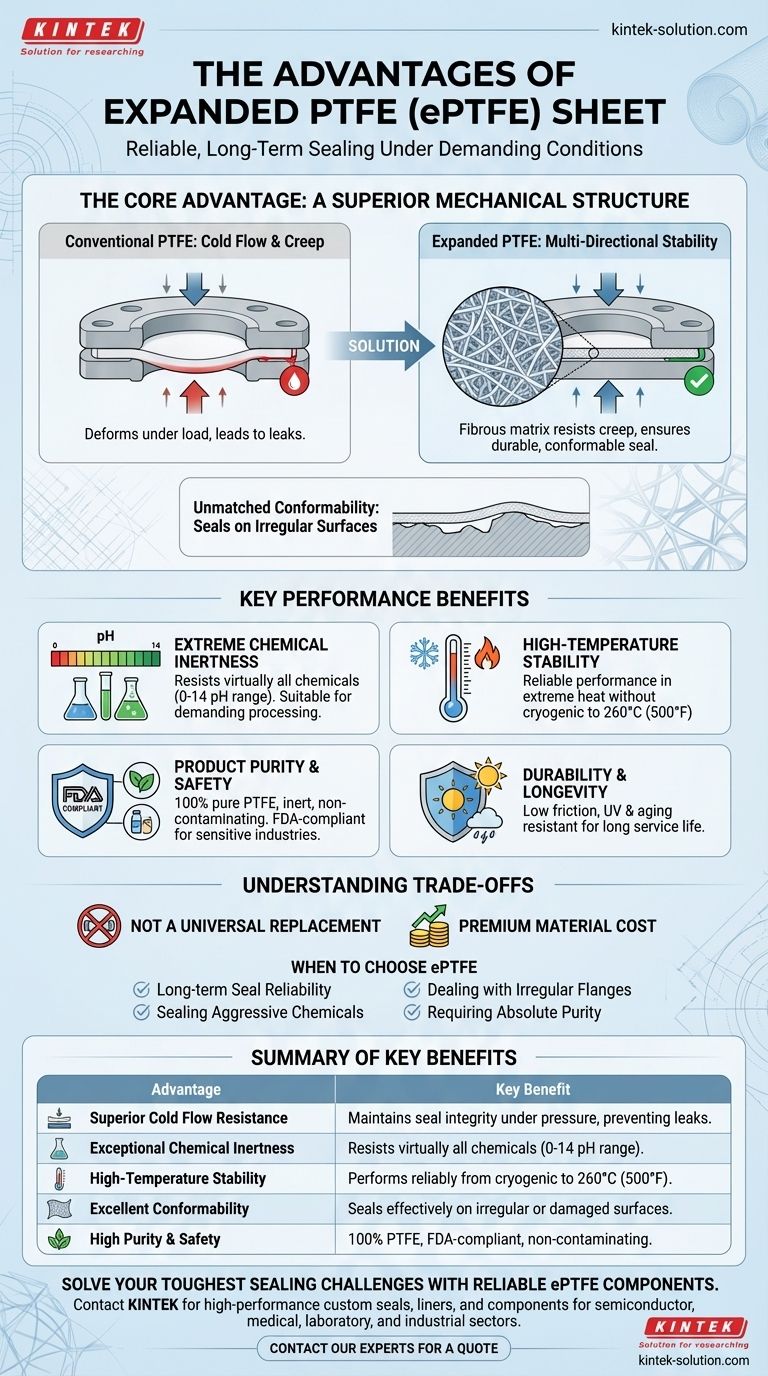
The primary advantages of expanded PTFE (ePTFE) sheet are its ability to create a highly reliable, long-term seal under demanding chemical and thermal conditions. It combines the exceptional chemical inertness of standard PTFE with a unique structural stability that overcomes PTFE's inherent weakness of cold flow, or creep, under pressure.
The core problem with conventional PTFE gaskets is their tendency to "creep" or deform under load, eventually leading to leaks. Expanded PTFE solves this by transforming the material into a strong, fibrous, multi-directional structure that maintains its shape, ensuring a durable and highly conformable seal.
The Core Advantage: A Superior Mechanical Structure
The most significant benefit of ePTFE is not a chemical property but a mechanical one, derived directly from its manufacturing process.
The Problem with Conventional PTFE: Cold Flow
Standard PTFE is a soft material. When compressed in a flange, it can slowly deform and flow away from the point of pressure over time, especially at elevated temperatures. This phenomenon, known as cold flow or creep, reduces the sealing pressure and can ultimately cause a leak.
The Solution: Multi-Directional Expansion
Expanded PTFE is made from 100% pure PTFE that has been stretched in multiple directions. This process creates a micro-fibrous structure, similar to a web, which gives the material immense dimensional stability and strength.
This fibrous matrix physically resists the tendency to creep, allowing the gasket to maintain a consistent seal even under high bolt loads and prolonged service.
Unmatched Conformability and Tightness
The soft, flexible nature of this expanded structure allows it to conform exceptionally well to irregular or damaged flange surfaces. It effectively fills in minor pits, scratches, and imperfections, ensuring an extremely tight and reliable seal where a more rigid gasket might fail.
Key Performance Benefits in Application
Beyond its structural superiority, ePTFE retains all the well-known advantages of the base polymer.
Extreme Chemical Inertness
ePTFE sheet can handle a vast range of aggressive chemicals across the entire 0-14 pH range. The only notable exceptions are molten alkali metals and elemental fluorine, making it suitable for the most demanding chemical processing applications.
High-Temperature Stability
This material performs reliably across a wide operational temperature range, from cryogenic levels up to 260°C (500°F). This high thermal stability ensures it does not degrade or become brittle in extreme process conditions.
Product Purity and Safety
Because it is 100% pure PTFE, the material is chemically inert and non-contaminating. It will not discolor or leach into the end product, making it FDA-compliant and ideal for high-purity applications in the food, beverage, and pharmaceutical industries.
Durability and Longevity
ePTFE inherits PTFE's extremely low coefficient of friction, which reduces wear. It is also completely resistant to aging and degradation from UV light or weathering, ensuring a long and predictable service life.
Understanding the Trade-offs
While highly effective, ePTFE is a specialized material, and its selection requires understanding its context.
Not a Universal Replacement
Expanded PTFE is a "soft" gasket material. While it excels at sealing flanges on equipment like glass-lined steel vessels, it is not intended to replace spiral-wound or other metal gaskets in extremely high-pressure piping applications where gasket blowout is a primary concern.
Cost Consideration
The complex manufacturing process makes expanded PTFE a premium material. Its cost is higher than conventional PTFE or many other common gasketing materials. This investment is justified by its superior performance, reduced maintenance, and enhanced safety in critical applications.
When to Choose Expanded PTFE Sheet
Use this guide to determine if ePTFE is the right solution for your specific needs.
- If your primary focus is long-term seal reliability: Choose ePTFE for its unmatched resistance to cold flow, which prevents leaks and reduces the need for re-torquing bolts.
- If you are sealing aggressive chemicals: ePTFE provides a nearly universal solution, ensuring compatibility and safety across the full pH spectrum.
- If you are dealing with irregular or imperfect flange surfaces: The material's exceptional conformability creates a tight seal where more rigid gaskets would likely fail.
- If your application requires absolute purity: ePTFE's inert, non-contaminating properties are essential for food, pharmaceutical, and sensitive chemical processes.
Ultimately, choosing expanded PTFE is an investment in reliability and safety for your most critical sealing applications.
Summary Table:
| Advantage | Key Benefit |
|---|---|
| Superior Cold Flow Resistance | Maintains seal integrity under pressure, preventing leaks. |
| Exceptional Chemical Inertness | Resists virtually all chemicals across the 0-14 pH range. |
| High-Temperature Stability | Performs reliably from cryogenic temperatures up to 260°C (500°F). |
| Excellent Conformability | Seals effectively on irregular or damaged flange surfaces. |
| High Purity & Safety | 100% PTFE, FDA-compliant, non-contaminating for sensitive industries. |
Ready to solve your toughest sealing challenges with reliable ePTFE components?
At KINTEK, we specialize in manufacturing high-performance expanded PTFE seals, liners, and custom components for the semiconductor, medical, laboratory, and industrial sectors. Our precision production ensures you get a durable, long-lasting seal that resists cold flow and harsh chemicals, reducing maintenance and enhancing safety.
Whether you need a prototype or a high-volume order, we deliver custom solutions tailored to your exact requirements.
Contact our experts today to discuss your application and get a quote!
Visual Guide
Related Products
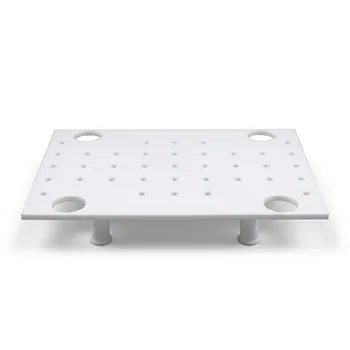
- Customizable PTFE Heat Insulation Plate High Temperature Corrosion Resistant Laboratory Support Layered Multi Tier Stand
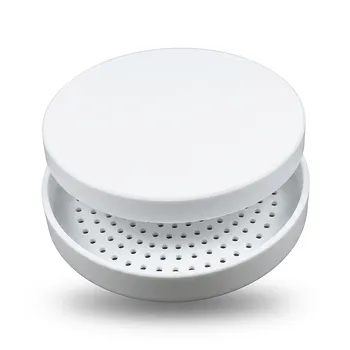
- Custom Virgin Polytetrafluoroethylene Sieve Mesh Solid Waste Analysis Round Square Customizable PTFE Screens
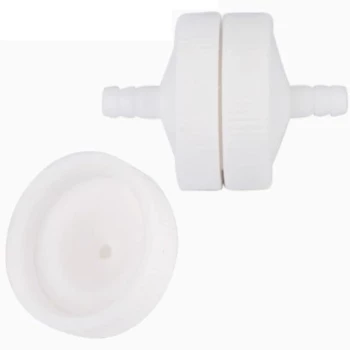
- Customizable PTFE Seals Filter Holders for Versatile Applications
- PTFE Anti Scald Heat Insulation Sleeve Hot Plate Support Feet Laboratory Benchtop Protection Customizable Thermal Barrier
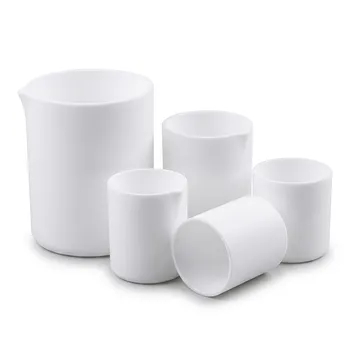
- Large Scale PTFE Beakers and Flasks for High Temperature Corrosion Resistant Laboratory Applications with Custom CNC Fabrication
People Also Ask
- What customization options are available for PTFE materials? Tailor Performance for Your Application
- What are the limitations of pure PTFE in high temperature applications? Understanding the 200°C Ceiling
- What were the unexpected properties of the newly discovered PTFE? Unveiling the Game-Changing Material
- How does PTFE behave in terms of chemical inertness? Unmatched Resistance for Demanding Applications
- Why is PTFE considered an ideal substitute for other plastics in high-temperature applications? Superior Thermal Stability & Performance