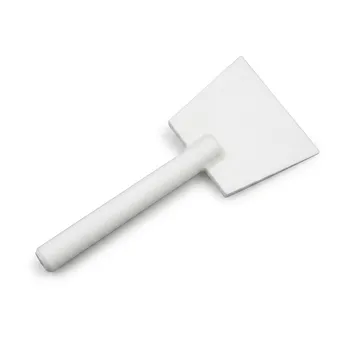
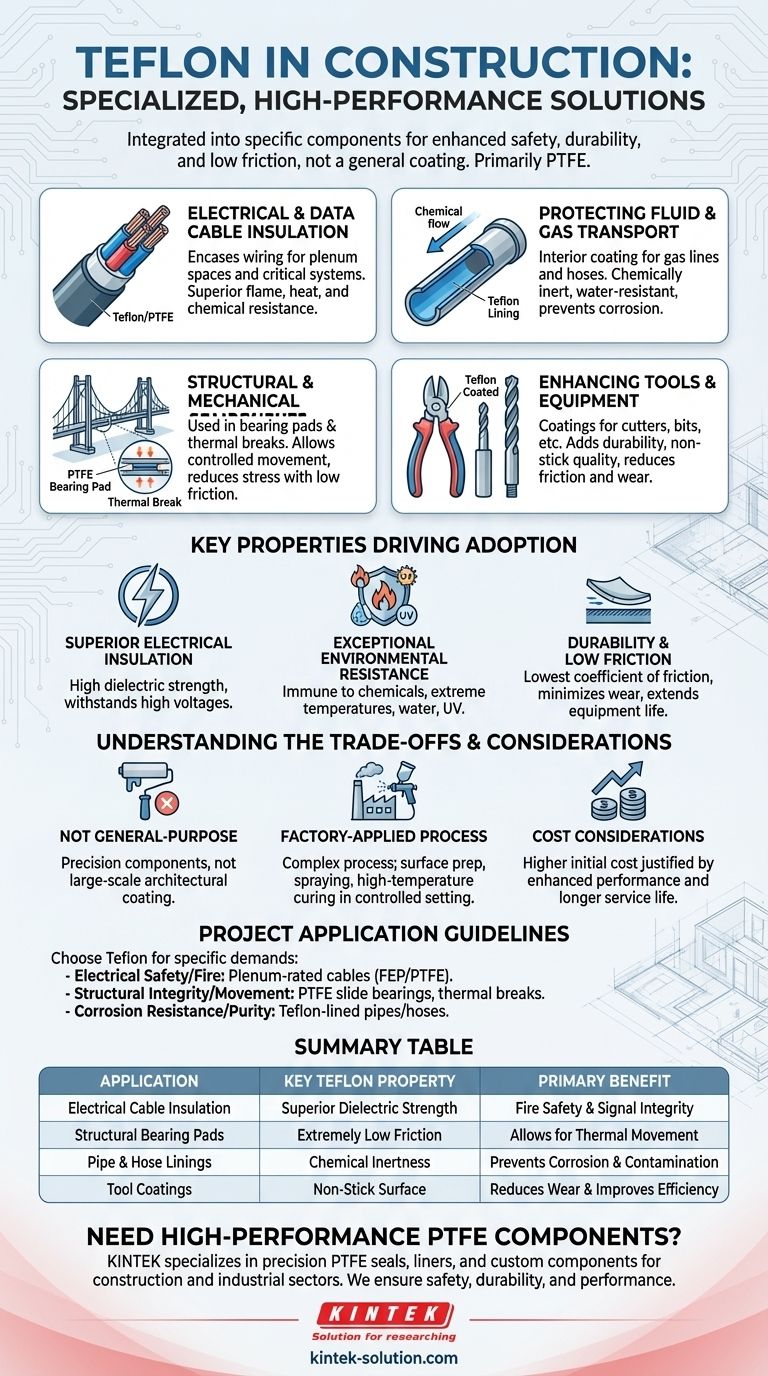
In the construction industry, Teflon coating is not applied broadly like paint but is instead integrated into specific, high-performance components where its unique properties are essential. It serves primarily as a protective sheathing for wiring and a durable, low-friction surface for structural and mechanical parts.
The core function of Teflon in construction is not as a general-purpose coating, but as a specialized material engineered into key components to enhance safety, reduce maintenance, and ensure long-term durability against heat, chemicals, and electricity.
Core Applications of Teflon in Construction
Teflon, most commonly Polytetrafluoroethylene (PTFE), is specified for components that must withstand harsh operating conditions. Its use is targeted and strategic, focused on solving specific engineering challenges.
Electrical and Data Cable Insulation
The most critical use of Teflon in construction is for encasing and insulating electrical wiring.
Its properties make it ideal for plenum spaces and critical systems where fire safety and signal integrity are paramount. It offers superior resistance to flames, heat, and chemicals compared to standard insulators.
Protecting Fluid and Gas Transport
Teflon coatings are applied to the interior of gas line pipes and industrial hoses.
Because it is chemically inert and water-resistant, it prevents corrosion and ensures the purity of the substances being transported, contributing to the system's longevity and safety.
Structural and Mechanical Components
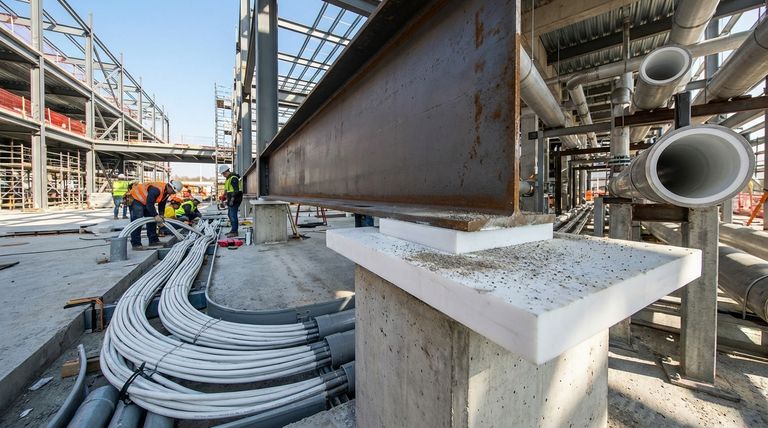
PTFE is used to manufacture structural bearing pads and thermal breaks.
These components are placed between structural elements, like steel beams and concrete supports, to allow for controlled movement from thermal expansion and contraction. The extremely low friction of Teflon prevents stress buildup in the structure.
Enhancing Tools and Equipment
Teflon is also used to coat professional tools like wire cutters, scissors, and drill bits.
This application adds durability and a non-stick quality, reducing friction and wear during use and making the tools last longer and perform more efficiently.
The Key Properties Driving Adoption
The selection of Teflon-based materials is driven by a combination of properties that are difficult to achieve with other polymers. Understanding these foundational benefits clarifies why it is chosen for such demanding roles.
Superior Electrical Insulation
Teflon has an exceptionally high dielectric strength, meaning it can withstand high voltages without breaking down. This makes it one of the most reliable insulators for wiring in sensitive and high-stakes environments.
Exceptional Environmental Resistance
This material is virtually immune to chemical attack and is highly resistant to extreme temperatures, water, and UV radiation. This ensures that components do not degrade when exposed to harsh construction site conditions or industrial environments.
Durability and Low Friction
Teflon possesses the lowest coefficient of friction of any known solid material. This "slipperiness" is essential for bearing pads and coated tools, minimizing wear and tear on moving parts and extending the operational life of the equipment.
Understanding the Trade-offs
While highly effective, Teflon is a specialized material, not a universal solution. Its application comes with important considerations that professionals must weigh.
Not a General-Purpose Coating
Teflon is not used as a large-scale architectural or protective coating for surfaces like walls or structural steel. Its value is in precision-engineered components, not broad application.
Factory-Applied Process
The application of industrial Teflon coatings is a complex, multi-stage process involving surface preparation, spraying, and high-temperature curing (sintering). This is performed in a controlled factory setting, not on a construction site.
Cost Considerations
As a high-performance polymer, components made with or coated in Teflon are typically more expensive than those using conventional materials. The cost is justified by enhanced safety, reduced maintenance needs, and a longer service life.
How to Apply This to Your Project
Your choice to specify Teflon-based components should be driven by the specific performance demands of your project.
- If your primary focus is electrical safety and fire resistance: Specify plenum-rated cables and wiring with FEP or PTFE insulation.
- If your primary focus is structural integrity and movement: Utilize PTFE slide bearings or thermal break pads in your structural designs.
- If your primary focus is corrosion resistance in piping: Consider Teflon-lined pipes and hoses for aggressive chemical or high-purity applications.
Ultimately, Teflon serves as a critical problem-solver in modern construction, engineered for the precise points where performance cannot be compromised.
Summary Table:
| Application | Key Teflon Property | Primary Benefit |
|---|---|---|
| Electrical Cable Insulation | Superior Dielectric Strength | Fire Safety & Signal Integrity |
| Structural Bearing Pads | Extremely Low Friction | Allows for Thermal Movement |
| Pipe & Hose Linings | Chemical Inertness | Prevents Corrosion & Contamination |
| Tool Coatings | Non-Stick Surface | Reduces Wear & Improves Efficiency |
Need high-performance PTFE components for your construction project? KINTEK specializes in manufacturing precision PTFE seals, liners, and custom components for the construction, industrial, and specialized sectors. We ensure your critical systems meet the highest standards for safety, durability, and performance.
Contact our experts today to discuss your custom fabrication needs, from prototypes to high-volume orders.
Visual Guide
Related Products
- Corrosion Resistant Heating Plate with Modified PTFE Coating 400x300mm Acid Resistant Laboratory Hot Plate Customizable Heating Solution
- Custom PTFE Insulating Gaskets and Corrosion Resistant Fluoropolymer Seals for Industrial Electrical Applications
- PTFE Anti Scald Heat Insulation Sleeve Hot Plate Support Feet Laboratory Benchtop Protection Customizable Thermal Barrier
- Custom PTFE Insulating Gaskets Corrosion Resistant Teflon Seals Tailored Engineering Plastic Components
- High Temperature Resistant PTFE Thermal Insulation Board Corrosion Resistant Metal Free Fluoropolymer Stand for Ultra Clean Laboratories
People Also Ask
- How does the low friction coefficient of PTFE coatings affect tightening torque? Achieve Accurate Clamping Force Safely
- How is Teflon used in the textile industry? Creating Stain-Resistant, Water-Repellent Fabrics
- What advantages do PTFE coatings offer in terms of durability and maintenance? Maximize Component Lifespan
- What makes PTFE coatings non-stick? The Science Behind the Ultimate Slippery Surface
- Why is the curing process important in PTFE coating manufacturing? It's the Key to Performance