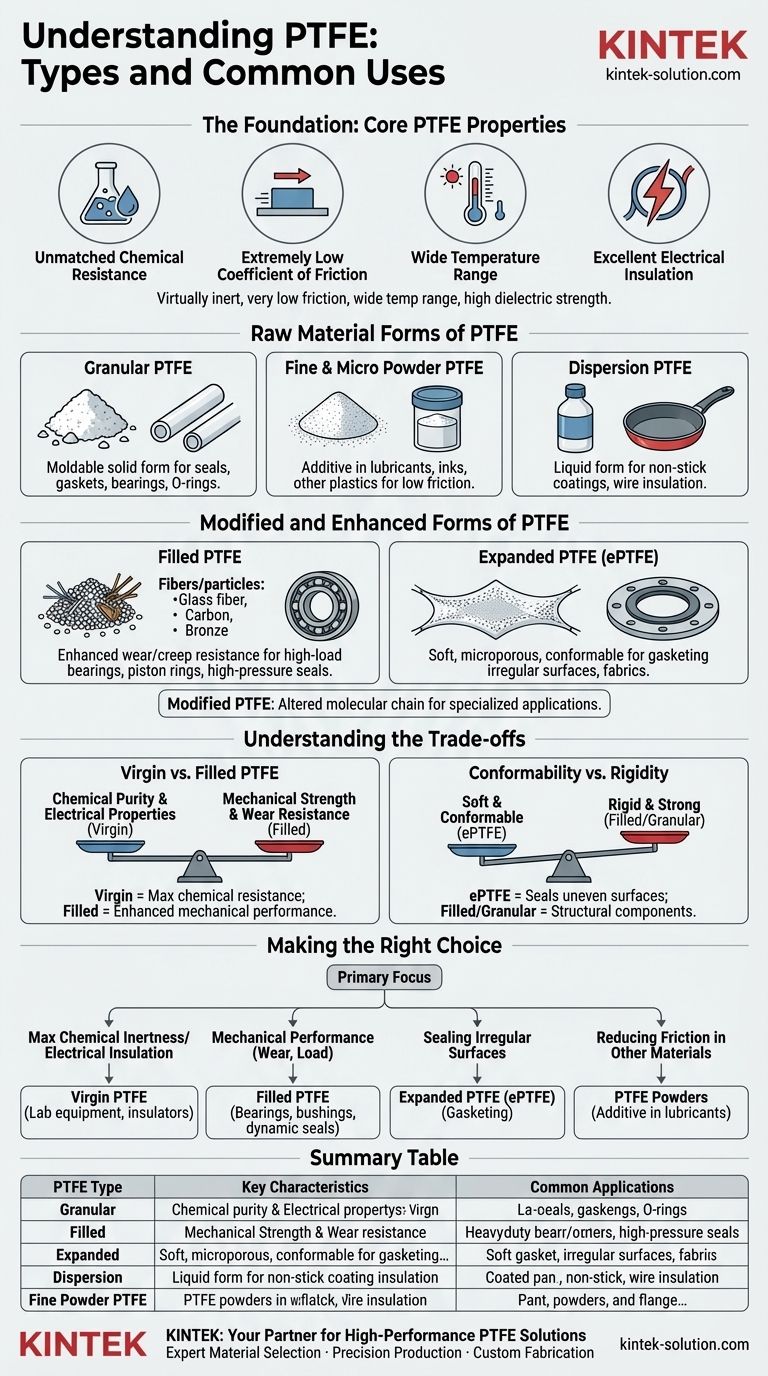
At its core, Polytetrafluoroethylene (PTFE) is not a single material but a family of polymers. The primary types are distinguished by their physical form and whether they have been modified with fillers. These include granular PTFE for molding solid parts, fine powders for use as additives, dispersions for creating non-stick coatings, filled PTFE for enhanced mechanical strength, and expanded PTFE for gasketing.
The key is to understand that while all PTFE variants share core properties like extreme chemical resistance and low friction, the specific form or modification you choose is what tailors the material for a specific engineering challenge—from a simple O-ring to a high-wear industrial bearing.

The Foundation: Core PTFE Properties
Before examining the different types, it's essential to understand the properties that make PTFE a unique and valuable engineering material.
### Unmatched Chemical Resistance
PTFE is virtually inert and resistant to almost all industrial chemicals and solvents. This makes it an ideal choice for seals, linings, and components used in aggressive chemical processing.
### Extremely Low Coefficient of Friction
With a coefficient of friction around 0.05, PTFE is one of the slipperiest solid materials known. This property is the reason it is used for non-stick coatings and self-lubricating bearings.
### Wide Temperature Range
PTFE maintains its properties over a very wide temperature range, making it suitable for both cryogenic applications and high-temperature environments.
### Excellent Electrical Insulation
It is an excellent electrical insulator with high dielectric strength, making it valuable in electronics and electrical wiring.
Raw Material Forms of PTFE
The most fundamental way to categorize PTFE is by its unprocessed, raw form. This form dictates how it can be turned into a final product.
### Granular PTFE
This is the workhorse of the PTFE family. Produced as a powder with larger particles, it is the primary raw material for molding solid shapes like rods, sheets, and tubes.
These basic shapes are then machined into finished components such as seals, gaskets, bearings, bushings, and O-rings.
### Fine & Micro Powder PTFE
These powders have much smaller particles and are not typically molded on their own. Instead, they are used as an additive.
They are blended into other materials like lubricants, greases, inks, and even other plastics to impart PTFE's low-friction characteristics to the host material.
### Dispersion PTFE
This is a milky-white aqueous dispersion of tiny PTFE particles. This liquid form is used to create coatings.
The most well-known application is for non-stick surfaces on cookware, but it is also used for industrial coatings on wires, fabrics, and other components requiring a thin, low-friction layer.
Modified and Enhanced Forms of PTFE
To overcome some of the inherent weaknesses of pure PTFE, it is often modified or processed in special ways to enhance its performance.
### Filled PTFE
This is one of the most common and important modifications. Fillers are blended with granular PTFE before molding to dramatically improve its mechanical properties.
Common fillers include glass fiber, carbon, graphite, bronze, and PEEK. These additives increase wear resistance, reduce creep (cold flow under pressure), and improve thermal conductivity. This makes filled PTFE ideal for demanding applications like bearings, piston rings, and high-pressure seals.
### Expanded PTFE (ePTFE)
Expanded PTFE is created by rapidly stretching pure PTFE under specific conditions. This process creates a strong, microporous material that is soft and highly conformable.
Its primary use is in gasketing and sealing, especially on irregular, damaged, or fragile flange surfaces where a standard rigid gasket would fail. It is also used in medical implants and high-performance fabrics.
### Modified PTFE
This refers to a PTFE polymer where the molecular chain has been slightly altered. These modifications can result in a material with reduced porosity, better weldability, and improved resistance to permeation, suiting it for specialized chemical and semiconductor applications.
Understanding the Trade-offs
Choosing the right PTFE type involves balancing its inherent strengths against its weaknesses and the specific demands of your application.
### Virgin vs. Filled PTFE
The primary trade-off is between chemical purity and mechanical strength. Virgin (unfilled) PTFE offers the highest chemical resistance and best electrical properties.
However, it suffers from poor mechanical performance, particularly creep, where it deforms under a sustained load. Filled PTFE solves this mechanical weakness but may have slightly reduced chemical resistance and will lose the exceptional electrical insulation properties of virgin PTFE.
### Conformability vs. Rigidity
Expanded PTFE is exceptionally soft and conformable, making it a superior sealant for uneven surfaces. However, it lacks the rigidity and strength for use as a structural or load-bearing component.
Conversely, a solid gasket made from filled PTFE is rigid and strong but will not seal effectively on a damaged flange.
### Cost and Complexity
As you move from standard granular PTFE to filled, expanded, or modified versions, the cost and complexity of manufacturing increase. The performance gains must justify the added expense.
Making the Right Choice for Your Goal
Your final selection depends entirely on the most critical performance requirement for your component.
- If your primary focus is maximum chemical inertness or electrical insulation: Virgin (unfilled) PTFE is the correct choice for applications like lab equipment or high-frequency insulators.
- If your primary focus is mechanical performance (wear, load, or creep resistance): Filled PTFE is essential for demanding components like bearings, bushings, and dynamic seals.
- If your primary focus is sealing irregular or fragile surfaces: Expanded PTFE (ePTFE) provides the necessary conformability for creating a reliable gasket.
- If your primary focus is reducing friction in another material: PTFE powders (fine or micro) are the right option to use as an additive in lubricants or other polymers.
Ultimately, selecting the correct PTFE means matching the specific material type to the unique mechanical and environmental demands of your application.
Summary Table:
| PTFE Type | Key Characteristics | Common Applications |
|---|---|---|
| Granular PTFE | Moldable solid form | Seals, gaskets, O-rings, bushings |
| Filled PTFE | Enhanced wear/creep resistance | High-load bearings, piston rings, seals |
| Expanded PTFE (ePTFE) | Soft, microporous, conformable | Gasketing for irregular surfaces, fabrics |
| Dispersion PTFE | Liquid form for coatings | Non-stick surfaces, wire insulation |
| Fine Powder PTFE | Additive for friction reduction | Lubricants, inks, plastics |
Need a Custom PTFE Component?
Understanding the different types of PTFE is the first step. The next is finding a partner who can precisely manufacture the component you need. At KINTEK, we specialize in fabricating high-performance PTFE parts—from seals and liners to complex labware—for the semiconductor, medical, laboratory, and industrial sectors.
We offer:
- Expert Material Selection: Guidance on choosing virgin, filled, or expanded PTFE for your specific mechanical, chemical, and thermal requirements.
- Precision Production: Machining and molding of components that meet exact specifications for critical applications.
- Custom Fabrication: Support from initial prototypes to high-volume production runs.
Let us help you solve your engineering challenge with the right PTFE solution. Contact our team today for a consultation.
Visual Guide
Related Products
- Customizable PTFE Rods for Advanced Industrial Applications
- High Purity PTFE Filter with PFA Valve Connections and Integrated Sieve Plate for Corrosive Fluid Processing
- Custom PTFE Teflon Balls for Advanced Industrial Applications
- PTFE Corrosion Resistant Filter with PFA Valve Connections and Integrated Sieve Plate
- Custom PTFE Filtration System Acid Resistant High Purity Semiconductor Grade Chemical Processing Filter
People Also Ask
- How do PTFE rods contribute to energy efficiency in industrial applications? Reduce Friction & Power Consumption
- What are the different types of PTFE rods available based on manufacturing technology? Choose the Right Type for Your Project
- What are PTFE rods and how are they manufactured? A Guide to Their Properties and Production
- Why are PTFE rods suitable for medical applications? Unmatched Safety and Sterilization Performance
- How are Teflon rods applied in the automotive and aerospace industries? Solve Friction, Heat, and Chemical Challenges