The primary advantages of Teflon lip seals are their exceptional performance in conditions that would cause standard elastomeric seals to fail. They offer superior resistance to aggressive chemicals, stability across extreme temperature ranges, and reliable sealing in high-speed and high-pressure applications, all while minimizing friction and wear.
While standard rubber lip seals are effective for general use, Teflon (PTFE) lip seals are a specialized engineering solution. They are designed to provide unmatched reliability and longevity in the most demanding operational environments.
The Engineering Case for Teflon (PTFE) Seals
Choosing a sealing component is a critical design decision. While standard nitrile or viton seals are common, certain conditions demand the advanced properties of Polytetrafluoroethylene (PTFE), commonly known by its brand name, Teflon.
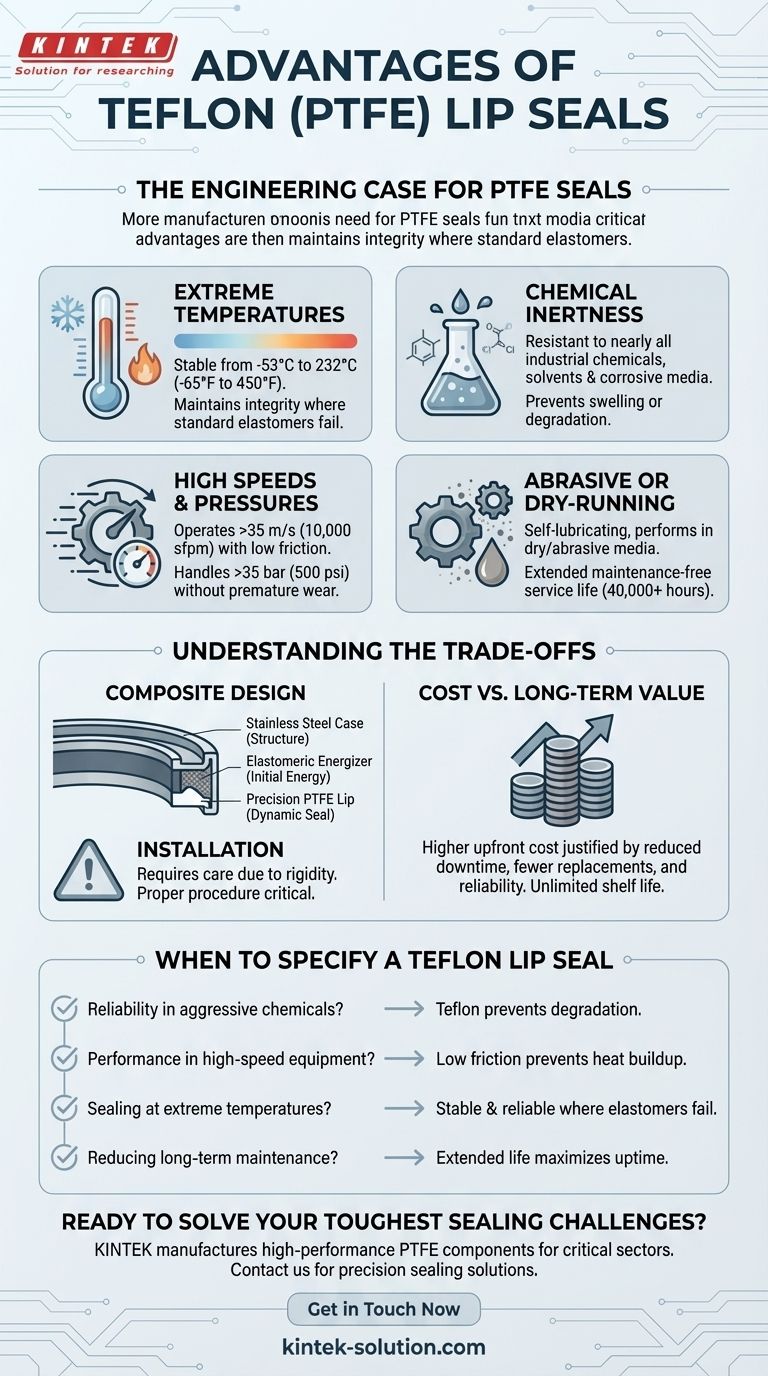
Surviving Extreme Temperatures
PTFE seals operate effectively across an exceptionally wide temperature range, typically from -53°C to 232°C (-65°F to 450°F).
Unlike standard elastomers that can become brittle at low temperatures or degrade at high temperatures, PTFE maintains its integrity and sealing capability.
Unmatched Chemical Inertness
PTFE is famously chemically inert, meaning it is resistant to nearly all industrial chemicals, solvents, and corrosive media.
This property prevents the seal from swelling, degrading, or failing when exposed to aggressive fluids, a common failure point for conventional seals.
Excelling at High Speeds and Pressures
These seals are engineered for dynamic applications involving high rotational speeds, often exceeding 35 m/s (or 10,000 sfpm).
The inherently low friction of PTFE minimizes heat generation at the contact point, preventing premature wear and failure at high speeds. This same durability allows them to handle high pressures, often in excess of 35 bar (500 psi).
Performance in Abrasive or Dry-Running Conditions
A key advantage of PTFE is its ability to perform in dry or abrasive media.
Because the material is self-lubricating, it does not require a consistent fluid film to prevent wear, making it ideal for applications where lubrication is minimal or contaminants are present. This leads to a significantly longer, maintenance-free service life, with some applications exceeding 40,000 hours.
Understanding the Trade-offs
While their advantages are significant, it's crucial to understand that PTFE seals are a specialized component, not a universal replacement for all seal types.
The Role of Composite Design
A "Teflon seal" is rarely just a piece of PTFE. It is typically a composite seal featuring a stainless steel case for structure, an elastomeric element (an o-ring or spring) to provide initial energy, and the precision-made PTFE lip that creates the dynamic seal.
This design combines the rigidity of metal, the elasticity of an energizer, and the unique properties of PTFE.
Installation Considerations
PTFE is a more rigid material than rubber. This means installation requires more care to avoid damaging the sealing lip.
Some designs incorporate an outer elastomer coating to simplify fitting, but proper procedure remains critical to ensure a perfect seal.
Cost vs. Long-Term Value
PTFE lip seals typically have a higher upfront cost than their standard elastomeric counterparts.
However, this cost is often justified in critical applications by reducing equipment downtime, eliminating frequent seal replacements, and ensuring operational reliability in harsh environments. Another subtle benefit is their unlimited shelf life, as the material does not degrade over time like rubber.
When to Specify a Teflon Lip Seal
Your choice of seal should be dictated by the specific demands of your application.
- If your primary focus is reliability in aggressive chemical environments: Teflon's chemical inertness makes it the definitive choice to prevent seal degradation and failure.
- If your primary focus is performance in high-speed rotating equipment: Teflon's low-friction properties are essential for preventing heat buildup and ensuring long life.
- If your primary focus is sealing at extreme temperatures (hot or cold): Teflon provides a stable and reliable seal where conventional elastomers would fail.
- If your primary focus is reducing long-term maintenance in critical systems: The extended, maintenance-free service life of a Teflon seal justifies the initial investment by maximizing uptime.
Choosing a Teflon lip seal is an engineering decision to prioritize long-term reliability in the most demanding operational environments.
Summary Table:
| Key Advantage | Performance Benefit |
|---|---|
| Chemical Resistance | Inert to nearly all industrial chemicals and solvents. |
| Temperature Range | Stable performance from -65°F to 450°F (-53°C to 232°C). |
| High-Speed/Low Friction | Operates at speeds >35 m/s with minimal heat generation. |
| High-Pressure/Dry-Running | Handles pressures >35 bar and performs without lubrication. |
| Service Life | Offers extended, maintenance-free operation (up to 40,000+ hours). |
Ready to Solve Your Toughest Sealing Challenges?
When your application demands reliability in extreme temperatures, aggressive chemicals, or high-speed operations, standard seals are not enough. You need a precision-engineered solution.
KINTEK manufactures high-performance PTFE components—including seals, liners, and labware—for the semiconductor, medical, laboratory, and industrial sectors. We combine precision production with custom fabrication, from prototypes to high-volume orders, to deliver the durability and performance your critical systems require.
Contact us today to discuss your specific requirements and let our experts help you select or design the perfect sealing solution.
Visual Guide
Related Products
- Custom PTFE Insulating Gaskets Corrosion Resistant Teflon Seals Tailored Engineering Plastic Components
- Custom PTFE Sealing Caps and Corrosion Resistant Low Background Teflon Adapters
- High Temperature Chemical Resistant 50ml PTFE Syringe Customized Teflon Injector with Threaded Seal for Trace Analysis
- Customizable High Temperature Resistant Anti Static PTFE Insulating Gaskets Flame Retardant Corrosion Proof Industrial Seals
- Custom PTFE Insulating Gaskets and Corrosion Resistant Fluoropolymer Seals for Industrial Electrical Applications
People Also Ask
- How are custom PTFE parts used in the automotive sector? Enhance Vehicle Performance & Durability
- Why is PTFE an ideal material choice for sealing gaskets, valves, and fluid transfer tubing exposed to extremely aggressive chemicals? Discover Its Superior Chemical Resistance and Reliability
- What are the key benefits of PTFE (Teflon) gaskets? Superior Chemical & Temperature Resistance
- How do PTFE gaskets prevent the transfer of grit into gearboxes? Create an Impermeable Barrier Against Contaminants
- How do fillers improve the mechanical performance of PTFE gaskets compared to virgin PTFE? Boost Strength & Reliability