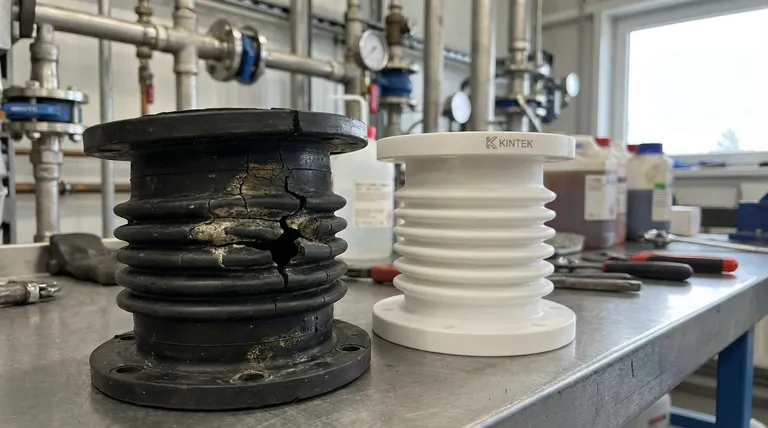
It’s a scenario that’s all too familiar in high-stakes industries. Your team has just commissioned a new processing line. Everything is calibrated, tested, and running smoothly. Then, weeks or months later, an alarm sounds. A critical flexible connector—a bellow designed to absorb movement in a pipe or protect a pump—has failed. The result is a costly shutdown, a hazardous leak, or a contaminated batch. You check the maintenance logs; the part was well within its pressure and cycle-life ratings. So why did it fail?
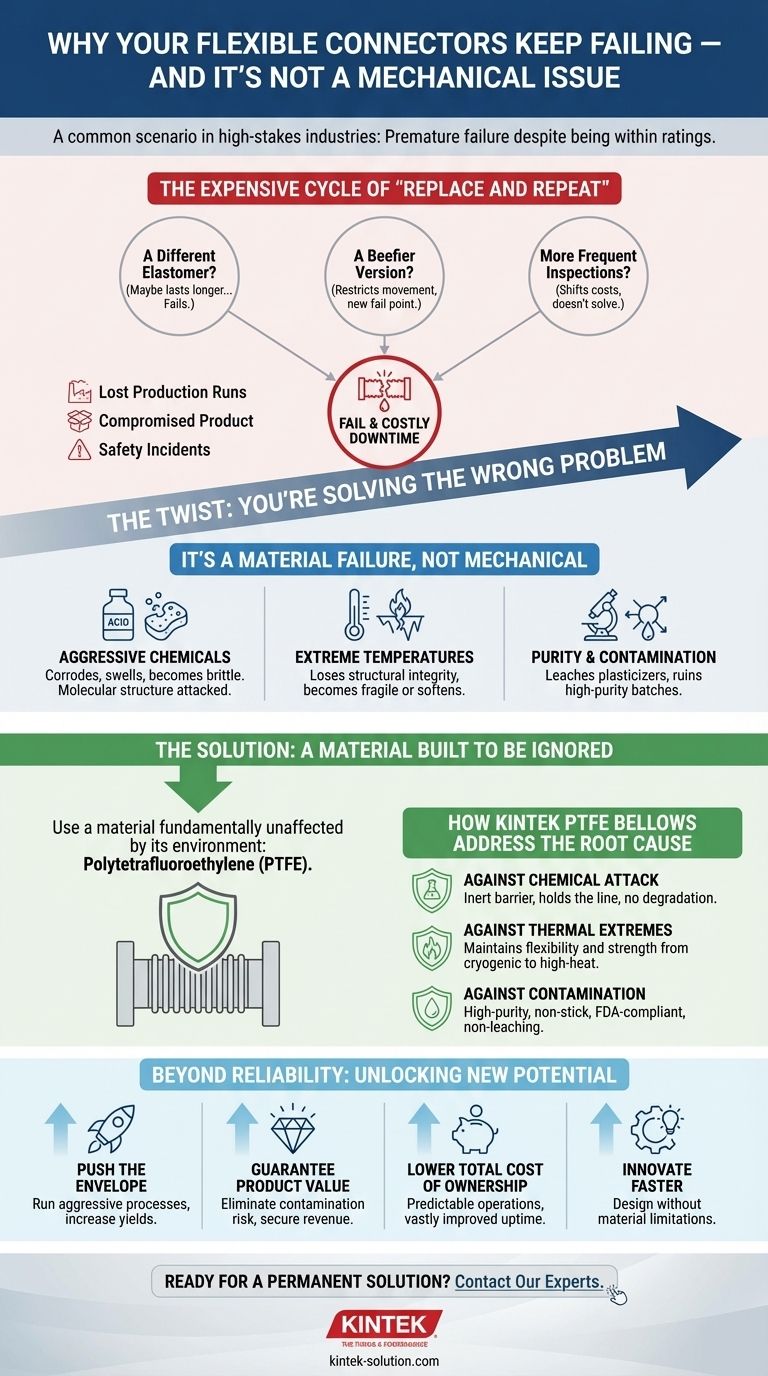
The Expensive Cycle of 'Replace and Repeat'
This isn't a one-off incident; it's a chronic problem that plagues engineers in chemical processing, semiconductor manufacturing, and pharmaceutical production. When a flexible joint fails prematurely, the typical response is a frantic search for a "stronger" replacement.
You might try:
- A different elastomer: "The last one was EPDM, let's try Viton this time." It might last a little longer, but eventually, it fails too.
- A beefier, thicker version: This can restrict necessary movement, transferring stress elsewhere in the system and creating a new failure point.
- More frequent inspections and replacements: This shifts the cost from unplanned downtime to planned downtime and increased labor, without ever solving the underlying issue.
Each attempt is a shot in the dark, a guess aimed at treating a symptom. The business consequences are painfully concrete: lost production runs costing tens of thousands per hour, compromised product purity that ruins entire batches, and the constant risk of safety incidents from chemical leaks. You're stuck in a reactive, expensive cycle of "replace and repeat," all while the root cause remains hidden in plain sight.
The Twist: You're Solving the Wrong Problem
Here is the fundamental truth that is often missed: The failure is almost never due to the mechanical flexing the bellow was designed for. You're looking at a material science problem, not a mechanical one.
It's Not a Mechanical Failure; It's a Material Failure
Standard elastomers like rubber or silicone are excellent at providing flexibility in benign environments. But in the demanding world of industrial processing, they are constantly under attack from an invisible enemy: the process media itself.
- Aggressive Chemicals: Think of a standard elastomer as a dense sponge. When exposed to corrosive acids, solvents, or reactants, its molecular structure is slowly but surely compromised. It might swell, become brittle, or soften over time. The constant flexing simply accelerates its inevitable disintegration.
- Extreme Temperatures: High heat can cause materials to lose their structural integrity, while cryogenic temperatures can make them as fragile as glass. A bellow that works perfectly at room temperature can fail catastrophically at the system's operational limits.
- Purity and Contamination: The material itself can become the contaminant. Over time, elastomers can leach plasticizers or other chemicals into the process stream, a disaster for high-purity applications in semiconductor or pharmaceutical manufacturing.
This is why your "stronger" replacements keep failing. You're swapping one vulnerable material for another, treating a chemical or thermal wound with a mechanical bandage. To win this fight, you don't need a stronger material; you need an indifferent one.
The Solution: A Material Built to Be Ignored by Its Environment
The only way to permanently solve this problem is to use a material that is fundamentally unaffected by the hostile environment it operates in. That material is Polytetrafluoroethylene (PTFE).
A bellow made from PTFE isn't just a flexible part; it's an engineered shield. It creates an inert barrier that isolates your critical systems from chemical attack, thermal extremes, and contamination risks. It is a solution born from a deep understanding of the true cause of failure.
How KINTEK PTFE Bellows Address the Root Cause
At KINTEK, we don't just make PTFE parts; we engineer solutions to these exact failure modes. Our components are designed to directly counter the root causes of failure that plague other materials.
- Against Chemical Attack: KINTEK PTFE is resistant to nearly all industrial chemicals. It simply doesn't react. Where an elastomer degrades, PTFE holds the line, ensuring long-term system integrity without leaking or breaking down.
- Against Thermal Extremes: Our PTFE components maintain their flexibility and strength across an exceptionally wide temperature range, providing reliable performance from cryogenic conditions to high-heat processes.
- Against Contamination: We use high-purity and FDA-compliant PTFE. Its non-stick surface resists buildup and is easy to clean, and the material itself is non-leaching, guaranteeing the purity of your product. For sensitive electronics, we can fabricate components from specialized anti-static PTFE grades that prevent destructive static discharge.
Choosing a KINTEK PTFE bellow isn't just another replacement. It's a strategic decision to eliminate the root cause of the problem.
Beyond Reliability: Unlocking New Operational Potential
When you're no longer fighting the fires of unexpected downtime, what becomes possible? Solving this chronic component failure does more than just lower your maintenance budget; it unlocks new potential for your entire operation.
With a system fortified by chemically inert and thermally stable components, you can:
- Push the Envelope: Run more aggressive chemical processes or operate at higher temperatures to increase yields and efficiency, confident that your equipment is protected.
- Guarantee Product Value: Eliminate the risk of contamination in high-value semiconductor wafers or pharmaceutical batches, securing revenue and reputation.
- Lower Total Cost of Ownership: Move from a costly, reactive maintenance schedule to a predictable, long-term operational model with vastly improved uptime.
- Innovate Faster: Design and build next-generation equipment without being constrained by the chemical and thermal limitations of lesser materials.
This isn't just about fixing a leak. It's about building a more robust, capable, and profitable operation from the ground up.
Your toughest operational challenges often trace back to a single point of weakness. We specialize in turning those weaknesses into strengths. If you're tired of the "replace and repeat" cycle and ready to implement a permanent solution, our team of specialists is here to help you analyze your system and design the precise component for your needs. Let's discuss your project and how precision-engineered PTFE can safeguard your operations. Contact Our Experts
Visual Guide
Related Products
- Customizable PTFE Scrapers and Shovels for Demanding Applications
- High Purity PTFE PM2.5 Filter Sample Splitter for Environmental Monitoring Customizable Square Filter Divider for CDC Analysis
- High Temperature PTFE Reaction Sieve with Customizable Layers and Precision Pore Sizes for Threaded Sample Separation Devices
- High Purity PFA Acid Purifier Maintenance and Refurbishment System with Silicone Heating Jacket and Digital Temperature Control Box
- High Purity PFA Coiled Tubing Custom PTFE Machining PFA Welding and Precision Bending Solutions
Related Articles
- The PTFE Paradox: Why the 'Perfect' Material Fails—And How to Make It Work
- Why Your High-Performance PTFE Parts Fail—And Why It's Not the Material's Fault
- Beyond the Bolt: The Physics and Psychology of Choosing the Right PTFE Washer
- Beyond "Non-Stick": Why Your PTFE Components Fail and How to Fix It for Good
- Beyond Friction: Why Your PTFE Components Fail and How to Engineer for Reliability