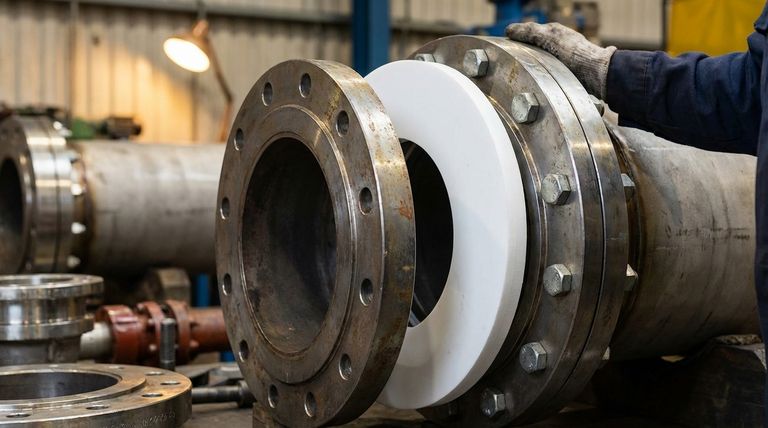
At their core, extra-thick PTFE washers (5mm – 6mm) are specified for applications demanding significant structural support, high-pressure sealing, or robust electrical insulation. Their primary uses include serving as load-bearing components in heavy machinery, sealing critical joints in oil and gas pipelines, and providing structural insulation in high-power industrial equipment.
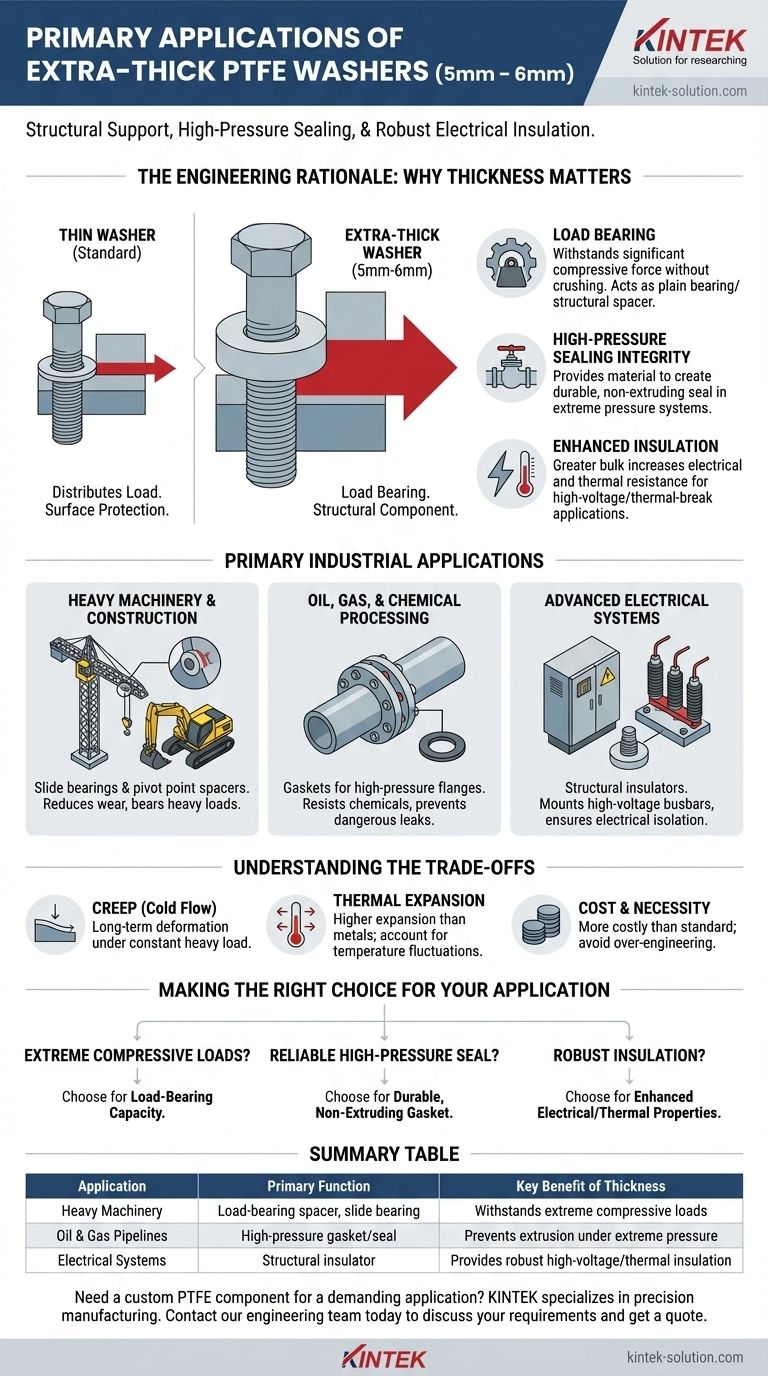
The critical distinction for an extra-thick PTFE washer is its function: it transitions from a simple surface-protecting spacer to a robust structural component. Its thickness provides the necessary bulk to withstand high compressive loads, seal against extreme pressures, and maintain integrity as a durable insulator.
The Engineering Rationale: Why Thickness Matters
The decision to use a 5mm or 6mm PTFE washer is driven by engineering demands that a standard, thinner washer cannot meet. The added thickness fundamentally changes the component's mechanical and insulative properties.
From Load Distribution to Load Bearing
A thin washer primarily distributes the load from a screw or bolt head across a wider surface area to prevent damage.
An extra-thick washer, however, acts as a load-bearing element. It can withstand significant compressive force without being crushed, making it suitable as a plain bearing or a structural spacer between major components.
High-Pressure Sealing Integrity
In high-pressure systems, like oil and gas pipelines, a seal must be able to deform slightly to fill imperfections in flange surfaces without being destroyed.
The substantial thickness provides the necessary material to create a durable, resilient seal that resists being extruded out of the joint under extreme pressure.
Enhanced Electrical and Thermal Insulation
Insulation capability is directly related to the thickness of the insulating material.
For high-voltage electrical applications or where a thermal break is required, the added bulk of a 5mm-6mm washer provides significantly greater electrical and thermal resistance than a standard washer.
Primary Industrial Applications in Detail
The unique properties of thick PTFE washers make them essential in several demanding fields.
Heavy Machinery and Construction
In equipment like cranes, excavators, and industrial presses, these washers are used as slide bearings and pivot point spacers. Their low friction reduces wear on moving metal parts, while their durability allows them to bear heavy, continuous loads.
Oil, Gas, and Chemical Processing
Thick PTFE washers are frequently used as gaskets for flange connections in high-pressure pipelines.
PTFE's exceptional chemical resistance ensures it will not degrade when exposed to corrosive fluids, and its thickness provides the robust seal needed to prevent dangerous leaks.
Advanced Electrical Systems
In power distribution units or large industrial electronics, these washers serve as structural insulators. They can be used to mount high-voltage busbars or other large components, ensuring they remain electrically isolated from the chassis.
Understanding the Trade-offs
While powerful, extra-thick PTFE washers are not a universal solution. Their material properties introduce specific design considerations.
Potential for Creep (Cold Flow)
PTFE can slowly deform over time when subjected to a constant, heavy load—a phenomenon known as creep or cold flow. While thickness improves resistance, this must be calculated for in long-term, high-stress structural applications.
Higher Thermal Expansion
PTFE has a significantly higher coefficient of thermal expansion than metals. In assemblies that experience wide temperature fluctuations, the expansion and contraction of the washer must be accounted for to avoid stressing other components.
Cost and Necessity
These are specialized components that are more costly than standard thin washers. Using one where it is not required represents over-engineering and unnecessary expense.
Making the Right Choice for Your Application
Selecting the correct component requires matching its capabilities to your primary engineering goal.
- If your primary focus is managing extreme compressive loads: Choose an extra-thick washer for its load-bearing capacity, especially in heavy equipment pivot points or as a structural spacer.
- If your primary focus is creating a reliable high-pressure seal: The thickness provides the necessary material to form a durable, non-extruding gasket in chemical or gas pipelines.
- If your primary focus is robust electrical or thermal isolation: The added thickness directly enhances the washer's insulative properties for high-voltage or thermal-break applications.
Ultimately, choosing an extra-thick PTFE washer is a deliberate engineering decision for when standard components simply cannot provide the required structural or sealing integrity.
Summary Table:
| Application | Primary Function | Key Benefit of Thickness |
|---|---|---|
| Heavy Machinery | Load-bearing spacer, slide bearing | Withstands extreme compressive loads |
| Oil & Gas Pipelines | High-pressure gasket/seal | Prevents extrusion under extreme pressure |
| Electrical Systems | Structural insulator | Provides robust high-voltage/thermal insulation |
Need a custom PTFE component for a demanding application?
Your high-pressure sealing, structural support, or critical insulation challenge requires a component built for the task. KINTEK specializes in precision manufacturing of custom PTFE components—including extra-thick washers, seals, liners, and labware—for the semiconductor, medical, laboratory, and industrial sectors.
We deliver the durability and performance you need, from rapid prototypes to high-volume production runs.
Contact our engineering team today to discuss your specific requirements and get a quote.
Visual Guide
Related Products
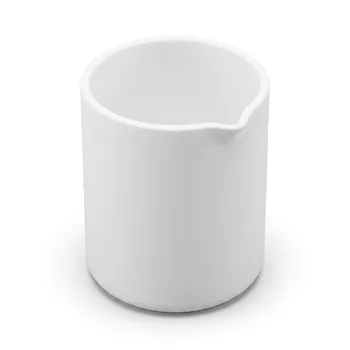
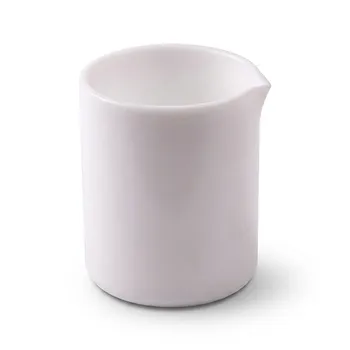
- Custom Thickened PTFE Laboratory Beaker for High Temperature Hot Plate Applications
- 6 Inch Circular PTFE Wafer Carrier Acid and Alkali Resistant Semiconductor Cleaning Flower Basket Customizable
- PTFE Circular Wafer Carrier 6 Inch Acid Alkali Resistant Semiconductor Cleaning Basket Customizable
- Custom Thickened PTFE Beaker High Temperature Hot Plate Heating Resistant Precision Laboratory Labware Customizable Fluoropolymer Vessel
- Custom Thickened PTFE Beaker 3000ml Hotplate Heating High Temperature Deformation Resistant Fluoropolymer Labware
People Also Ask
- Why is the material of the reaction vessel critical for tribocatalytic degradation? Boost Your Catalytic Yield!
- How does thermal stability and fluoride evolution impact the performance of high-temperature PTFE laboratory vessels? Uncover the key factors for reliable operation.
- What are the limitations of pure PTFE in high temperature applications? Understanding the 200°C Ceiling
- In what high-temperature applications is PTFE used? The Ultimate Polymer for Extreme Heat & Corrosion
- Are Teflon parts capable of withstanding high temperatures? Understanding the 260°C Limit for Performance