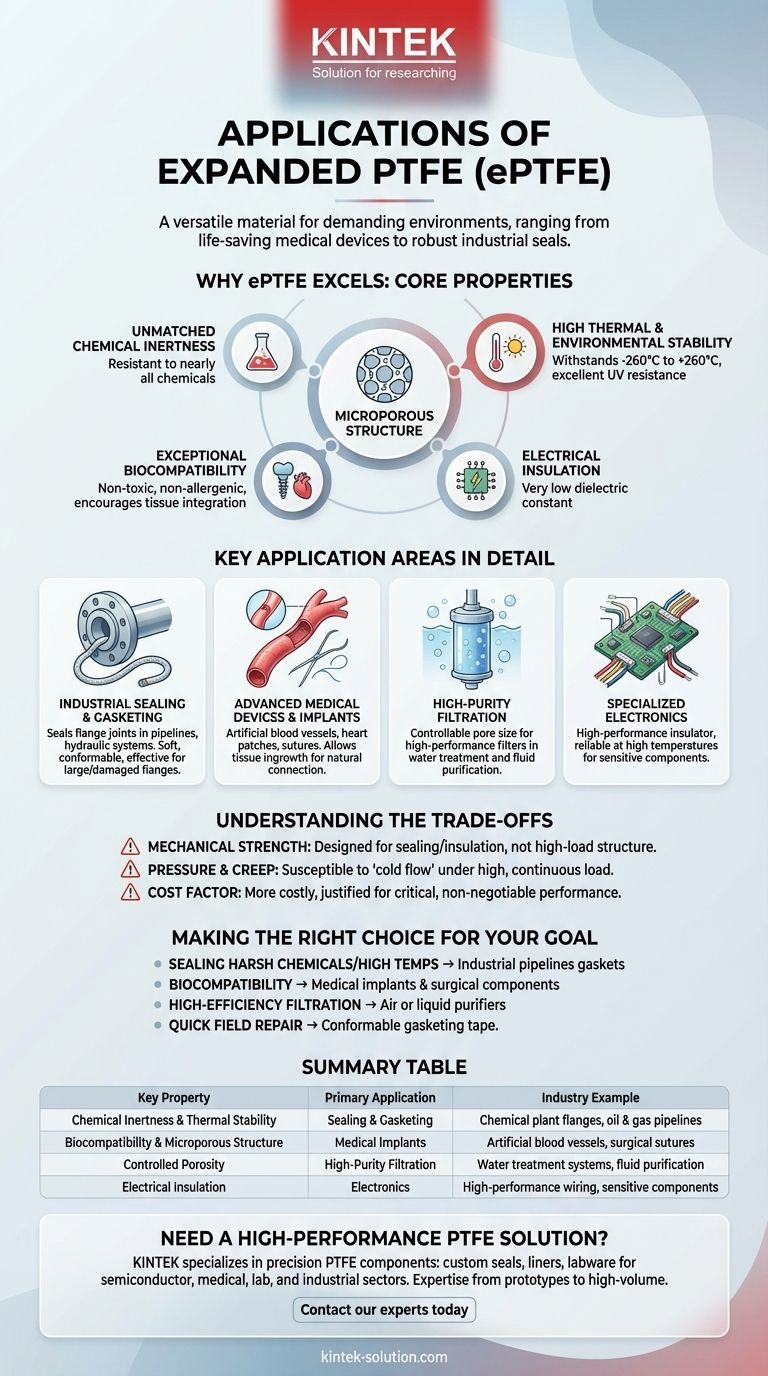
Expanded PTFE (ePTFE) is a uniquely versatile material prized for its performance in demanding environments. Its applications range from creating life-saving medical devices and high-purity filters to providing robust industrial seals in chemical plants and insulating sensitive electronics.
The core reason for ePTFE's wide adoption lies in its unique microporous structure. This structure enhances the already excellent properties of standard PTFE—like chemical inertness and temperature resistance—by adding softness, conformability, and controlled porosity, making it adaptable to problems that other materials cannot solve.
Why ePTFE Excels: The Core Properties
The value of ePTFE is not based on a single feature, but on the combination of several powerful characteristics. Understanding these properties explains its role in so many critical applications.
The Microporous Structure
The expansion process creates a network of interconnected voids within the material, resulting in a structure that is both strong and porous. This porosity can be precisely controlled to create low, medium, or high-density variants.
This structure is the key to its dual-purpose capability: it is impermeable to liquids at low pressure, making it an excellent sealant, yet it allows for controlled ingrowth, as seen with human tissue in medical implants.
Unmatched Chemical Inertness
Like standard PTFE, ePTFE is chemically inert and resistant to nearly all industrial chemicals and solvents. This makes it an ideal material for sealing flanges and pipes in the oil and gas, chemical, and pharmaceutical industries where corrosive substances are common.
High Thermal and Environmental Stability
ePTFE performs reliably across a wide temperature range, withstanding continuous service temperatures up to 260°C (500°F). It also exhibits excellent UV resistance, preventing degradation in outdoor applications.
Exceptional Biocompatibility
The material is non-toxic, non-allergenic, and hygienic. This outstanding biocompatibility, combined with its porous structure that encourages cellular integration, makes it a first-choice material for medical implants like surgical sutures, artificial blood vessels, and cardiac patches.
Electrical Insulation
ePTFE possesses a very low dielectric constant, meaning it does not conduct electricity well. This property makes it a highly effective insulator for specialized electronic components and high-performance wiring.
Key Application Areas in Detail
These core properties translate directly into solutions for specific industries.
Industrial Sealing and Gasketing
ePTFE is widely used to seal flange joints in pipelines, hydraulic and pneumatic systems, and pressure vessels. It is often supplied as a flexible cord or tape that is easy to cut and install in the field.
Because it is soft and conformable, it is exceptionally effective for sealing large, complex, or damaged flanges, including those made of plastic or glass that cannot tolerate high compressive loads.
Advanced Medical Devices and Implants
The medical field relies on ePTFE for its purity and ability to coexist with the human body. Its microporous structure allows a patient's own tissue to grow into the material, creating a strong, natural connection.
This makes it invaluable for creating artificial blood vessels, repairing heart defects, and as a component in advanced surgical sutures.
High-Purity Filtration
The controllable pore size of ePTFE membranes allows for the creation of high-performance filters. These are used in environmental applications for fluid purification, such as water treatment systems where it helps diffuse ozone to remove impurities.
Specialized Electronics
In electronics, ePTFE serves as a high-performance insulator. Its ability to resist electrical current while withstanding high temperatures ensures the reliability of sensitive components.
Understanding the Trade-offs
While ePTFE is a high-performance material, it's essential to understand its limitations to apply it correctly.
Mechanical Strength
ePTFE is a soft, conformable material designed primarily for sealing and insulation, not for high-load structural applications. Its strength lies in its flexibility and resilience, not its rigidity.
Pressure and Creep
While excellent for sealing, all PTFE materials can be susceptible to "creep" or "cold flow" under high, continuous mechanical loads. This must be a consideration in the design of high-pressure sealed joints to ensure long-term reliability.
Cost Factor
As a specialized material, ePTFE is typically more costly than conventional gasket or sealing materials. Its use is justified in critical applications where performance, purity, and long-term reliability are non-negotiable.
Making the Right Choice for Your Goal
To apply ePTFE effectively, align your choice with the primary demand of your application.
- If your primary focus is sealing harsh chemicals or high temperatures: ePTFE's chemical inertness and thermal stability make it a superior choice for gaskets and seals in demanding industrial pipelines.
- If your primary focus is biocompatibility for medical devices: Its non-toxic nature and porous structure for tissue integration make it an ideal material for implants and surgical components.
- If your primary focus is high-efficiency filtration: The controlled microporosity of ePTFE allows for the creation of highly effective filters for purifying air or liquids.
- If your primary focus is a quick and reliable field repair on a flange: ePTFE gasketing tape offers an easy-to-install, highly conformable solution for large, complex, or even damaged sealing surfaces.
Ultimately, leveraging ePTFE is about choosing a material engineered for superior reliability where performance cannot be compromised.
Summary Table:
| Key Property | Primary Application | Industry Example |
|---|---|---|
| Chemical Inertness & Thermal Stability | Sealing & Gasketing | Chemical plant flanges, oil & gas pipelines |
| Biocompatibility & Microporous Structure | Medical Implants | Artificial blood vessels, surgical sutures |
| Controlled Porosity | High-Purity Filtration | Water treatment systems, fluid purification |
| Electrical Insulation | Electronics | High-performance wiring, sensitive components |
Need a high-performance PTFE solution tailored to your specific challenge?
At KINTEK, we specialize in manufacturing precision PTFE components, including custom ePTFE seals, liners, and labware. Whether you're in the semiconductor, medical, laboratory, or industrial sector, our expertise in custom fabrication—from prototypes to high-volume orders—ensures you get a component that delivers superior reliability where performance cannot be compromised.
Contact our experts today to discuss your project requirements and discover the right PTFE solution for you.
Visual Guide
Related Products
- Large Capacity PTFE Reaction Bottle 2L Wide Mouth Fluoropolymer Extraction Vessel Compatible with Rotary Agitators
- Large Scale PTFE Beakers and Flasks for High Temperature Corrosion Resistant Laboratory Applications with Custom CNC Fabrication
- Custom Graphite Filled PTFE Rods for Advanced Industrial Applications
- Customizable PTFE Heat Insulation Plate High Temperature Corrosion Resistant Laboratory Support Layered Multi Tier Stand
- Custom PTFE Wide Mouth Reagent Reaction Bottle Corrosion Resistant High Temperature Large Capacity Straight Body Laboratory Vessel
People Also Ask
- Ion Activation Reaction Vessel Requirements: Why PTFE is Critical for Membrane Performance
- Why is a PTFE reaction vessel required for Ti3C2Tx MXene synthesis? Ensure Safe HF Etching & High Purity
- Why are fluoroplastic (PTFE) reaction vessels recommended for Methylene Blue (MB) adsorption kinetic experiments?
- What reaction vessel and fluid handling considerations are necessary for living cationic polymerization of fluorinated monomers involving Lewis acid catalysts? Key design and safety tips
- Why are high-purity PTFE or PFA reaction vessels recommended for the synthesis of PANI-TiC hybrid materials? - Guide