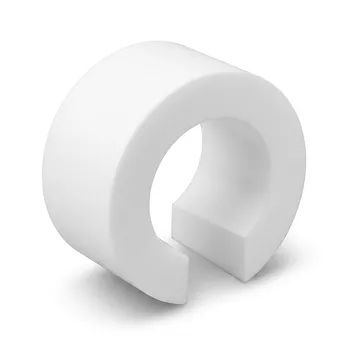
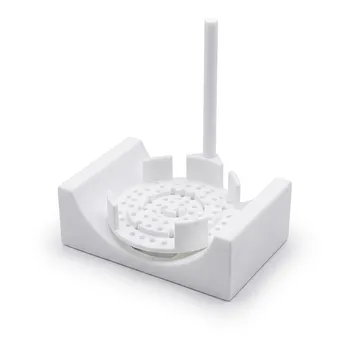
In practice, Polytetrafluoroethylene (PTFE) is a material of choice for bearings and bushings in applications where traditional lubrication is impossible or undesirable. Its key applications include machinery for chemical processing, food and beverage production, and automotive components, as well as uses in pharmaceutical manufacturing and as electrical insulation.
The core reason for using PTFE is not just its low friction, but its unique ability to deliver self-lubricating, maintenance-free performance in environments—defined by extreme temperatures, corrosive chemicals, or purity requirements—where conventional metal bearings would quickly fail.
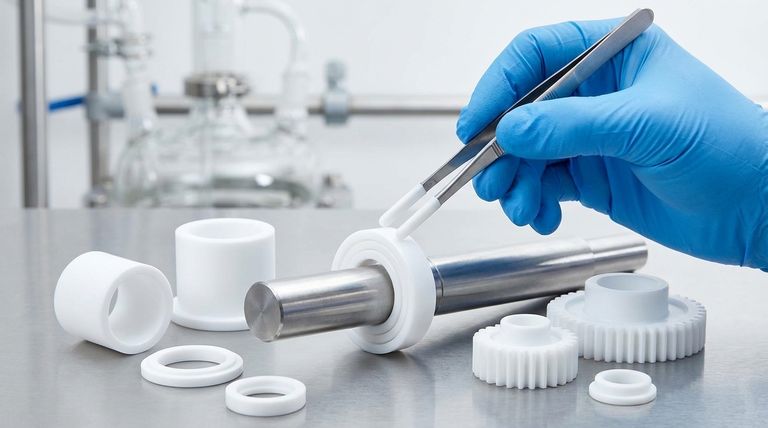
The Core Properties Driving PTFE Adoption
To understand where to apply PTFE, we must first understand the fundamental properties that set it apart from other bearing materials. These characteristics work in concert to solve specific engineering challenges.
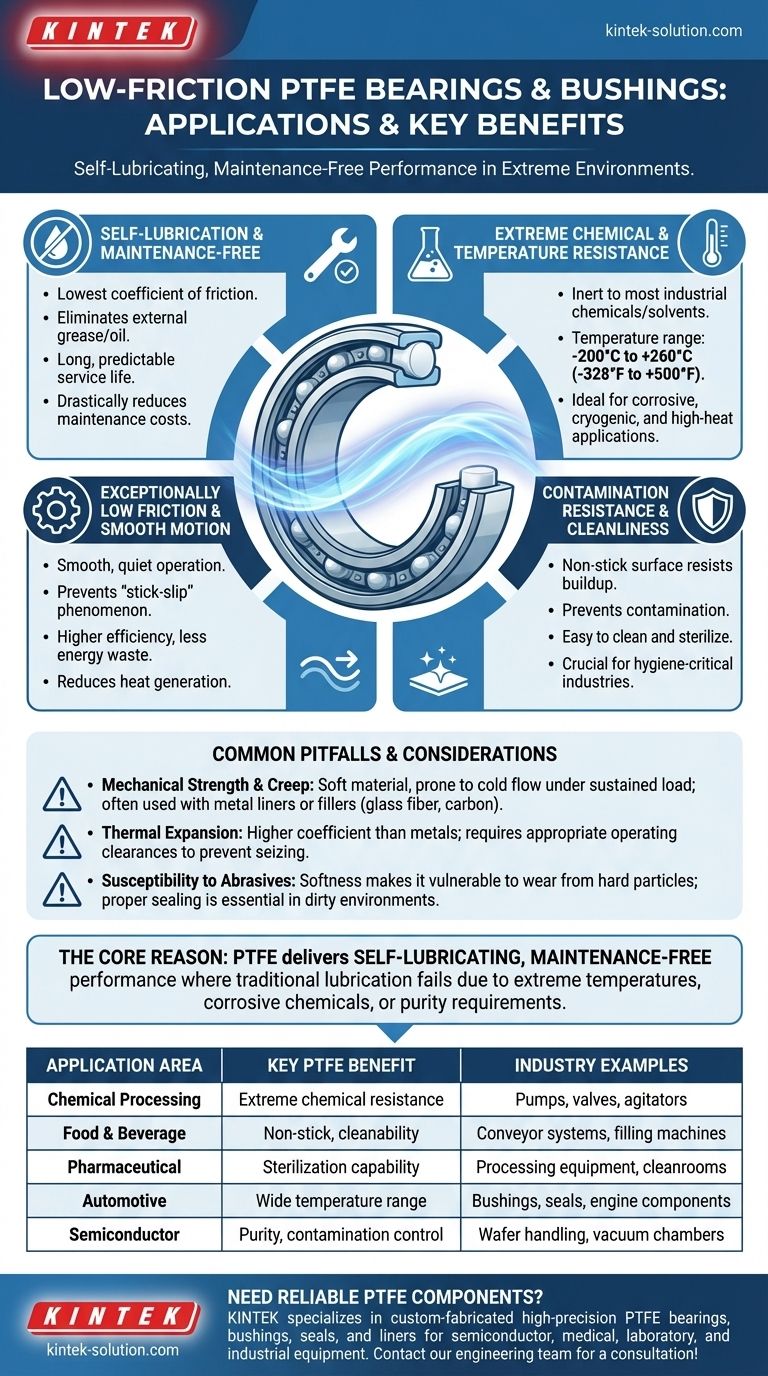
Self-Lubrication and Maintenance-Free Operation
PTFE has one of the lowest coefficients of friction of any solid material, which allows it to function as a self-lubricating surface.
This eliminates the need for external grease or oil, drastically reducing maintenance costs and complexity. The result is a clean, dry-running component with a long and predictable service life.
Extreme Chemical and Temperature Resistance
This material is nearly completely inert, resisting almost all industrial chemicals and solvents. This makes it ideal for equipment that handles corrosive substances.
Furthermore, PTFE maintains its integrity across an exceptionally wide temperature range, from -200°C to +260°C (-328°F to +500°F), enabling its use in cryogenic and high-heat applications.
Exceptionally Low Friction and Smooth Motion
The low-friction surface provides smooth, quiet operation and prevents the "stick-slip" phenomenon, where motion starts and stops abruptly at low speeds.
This consistent performance allows for higher efficiency, as less energy is wasted overcoming friction. This, in turn, reduces heat generation, especially under high loads or at high sliding velocities.
Contamination Resistance and Cleanliness
PTFE features a non-stick surface that resists the buildup of process materials. This is a critical advantage in industries where hygiene is paramount.
This property prevents contamination and makes equipment significantly easier to clean and sterilize, a non-negotiable requirement in food, beverage, and pharmaceutical manufacturing.
Common Pitfalls and Considerations
While PTFE offers significant advantages, it is not a universal solution. Understanding its limitations is critical for successful implementation and avoiding premature failure.
Mechanical Strength and Creep
Pure PTFE is a relatively soft material and can be prone to "cold flow" or creep, where it deforms permanently under a sustained load.
For high-load applications, PTFE is often used as a liner within a more rigid metal housing or blended with fillers like glass fiber, carbon, or bronze to improve its mechanical strength and wear resistance.
Thermal Expansion
PTFE has a higher coefficient of thermal expansion than metals. This means it expands and contracts more significantly with temperature changes.
Designers must account for this by engineering appropriate operating clearances to prevent the bearing from seizing or becoming too loose within its housing.
Susceptibility to Abrasives
While excellent in clean environments, PTFE's relative softness makes it susceptible to wear from hard, abrasive particles.
In environments with significant contamination (like dirt or grit), proper sealing is essential to protect the bearing surface and ensure a long service life.
Making the Right Choice for Your Application
Selecting the correct bearing material depends entirely on the primary challenge you need to solve.
- If your primary focus is purity or chemical compatibility: PTFE is the definitive choice for food-grade, pharmaceutical, or corrosive chemical applications where lubricant contamination is unacceptable.
- If your primary focus is eliminating maintenance: Use PTFE in inaccessible locations or in machinery where downtime for lubrication is costly and disruptive.
- If your primary focus is smooth motion under load: PTFE bearings excel at providing consistent, stick-slip-free movement at both high and low speeds.
- If your primary focus is extreme temperature resilience: PTFE is one of the few materials that can provide reliable bearing performance in both cryogenic and high-temperature environments.
Ultimately, choosing PTFE is a decision to prioritize clean, consistent, and maintenance-free performance in challenging operational conditions.
Summary Table:
| Application Area | Key PTFE Benefit | Industry Examples |
|---|---|---|
| Chemical Processing | Extreme chemical resistance | Pumps, valves, agitators |
| Food & Beverage | Non-stick, cleanability | Conveyor systems, filling machines |
| Pharmaceutical | Sterilization capability | Processing equipment, cleanrooms |
| Automotive | Wide temperature range | Bushings, seals, engine components |
| Semiconductor | Purity, contamination control | Wafer handling, vacuum chambers |
Need reliable PTFE components for your demanding applications?
At KINTEK, we specialize in manufacturing high-precision PTFE components—including custom bearings, bushings, seals, and liners—for semiconductor, medical, laboratory, and industrial equipment. Our expertise ensures you get maintenance-free, chemically resistant solutions that withstand extreme temperatures and purity requirements.
Let us help you solve your most challenging bearing problems with custom-fabricated PTFE components, from prototypes to high-volume production. Contact our engineering team today for a consultation!
Visual Guide
Related Products
- Custom PTFE Sleeves and Hollow Rods for Advanced Applications
- Customizable PTFE Rods for Advanced Industrial Applications
- Custom PTFE Insulating Gaskets and Corrosion Resistant Fluoropolymer Seals for Industrial Electrical Applications
- PTFE Circular Wafer Carrier 6 Inch Acid Alkali Resistant Semiconductor Cleaning Basket Customizable
- Custom PTFE Acid Resistant Support Rack for PFA Hydrogen Absorption Systems Multi Hole Configurations
People Also Ask
- What industries benefit most from custom PTFE parts? Solve Extreme Environment Challenges
- What advantages do custom PTFE parts offer for industrial efficiency? Boost Uptime & Cut Costs
- What design considerations are important for custom PTFE parts? Design for Performance & Reliability
- What industries use custom PTFE parts and for what purposes? Solve Critical Challenges with High-Performance Materials
- What are the key properties of Teflon (PTFE) used in custom parts? | Achieve Peak Performance