Knowledge Resources How do fillers improve the properties of PTFE? Boost Wear Resistance, Creep Resistance & Thermal Conductivity
Author avatar

Tech Team · Kintek

Updated 1 day ago

How do fillers improve the properties of PTFE? Boost Wear Resistance, Creep Resistance & Thermal Conductivity


In short, fillers are added to Polytetrafluoroethylene (PTFE) to overcome its inherent mechanical weaknesses. While virgin PTFE offers remarkable chemical resistance and a low coefficient of friction, it suffers from poor resistance to wear and deformation under load. Adding fillers like glass, carbon, or bronze fundamentally enhances its mechanical properties, creating a tougher, more durable material for demanding applications.

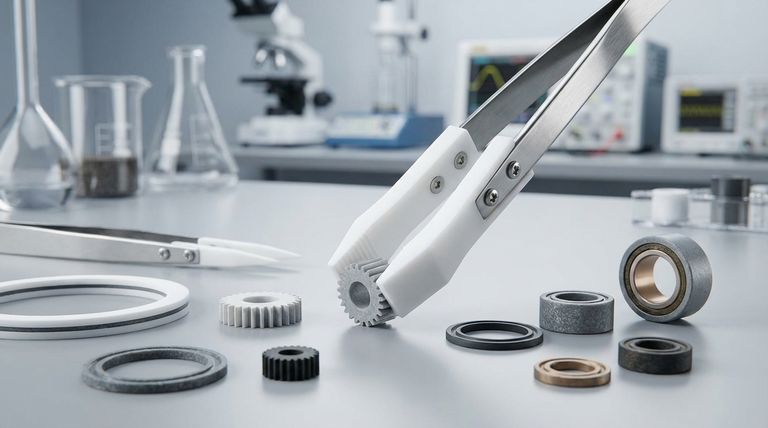
The core purpose of adding fillers to PTFE is to transform it from a soft, compliant material into a high-performance engineering plastic. This is achieved by drastically improving its wear resistance, creep resistance (deformation under load), and thermal conductivity, making it suitable for mechanical components like seals, bearings, and gaskets.
How do fillers improve the properties of PTFE? Boost Wear Resistance, Creep Resistance & Thermal Conductivity

The Foundation: Understanding Virgin PTFE's Limitations

To appreciate what fillers bring to PTFE, we must first understand the base material's unique profile of strengths and weaknesses.

Exceptional Chemical and Thermal Resistance

Virgin PTFE is renowned for its properties. It is almost universally chemically inert, meaning it resists corrosion and degradation from nearly all chemicals.

It also boasts an extremely low coefficient of friction, making it one of the most slippery materials known. Combined with its ability to withstand a wide range of temperatures (up to 260°C / 500°F), it's a premier choice for non-stick surfaces and low-friction environments.

The Core Weakness: Low Mechanical Strength

Despite its advantages, virgin PTFE is mechanically soft. Its primary limitations are poor abrasion resistance and low creep resistance.

This means it wears down quickly under friction and can slowly deform or "flow" out of shape when subjected to a constant load, especially at elevated temperatures.

Poor Thermal Conductivity

PTFE is an excellent thermal insulator. While this is an advantage in some applications, it can be a significant drawback in high-speed or high-load mechanical systems.

Friction generates heat, and without a way to dissipate it, the PTFE component can overheat, expand, and fail prematurely.

How Fillers Fundamentally Change PTFE

Fillers act as a reinforcing matrix within the PTFE, directly addressing its core mechanical and thermal deficiencies.

A Dramatic Boost in Wear Resistance

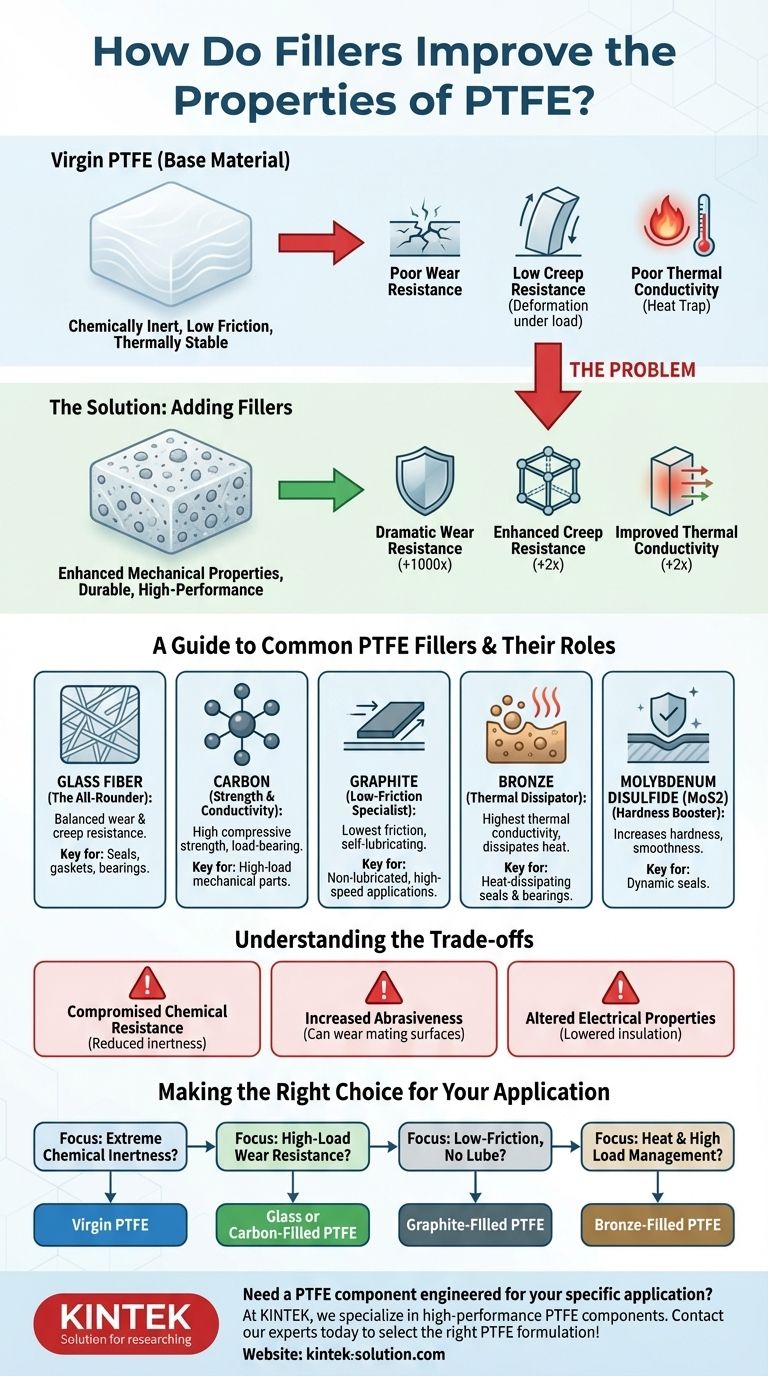
The single most significant improvement is in durability. Research shows that filled PTFE compounds can offer up to 1000 times greater abrasion resistance than virgin PTFE.

The filler particles bear the brunt of the frictional forces, protecting the softer PTFE matrix from being worn away.

Enhanced Creep Resistance

Fillers provide a rigid skeleton that helps the material resist deformation. A properly filled PTFE can have twice the creep resistance of its unfilled counterpart.

This makes it far more suitable for components like seals and gaskets that are under constant compressive force.

Improved Thermal Conductivity

Fillers like bronze or carbon create a pathway for heat to escape. Filled PTFE can have twice the thermal conductivity, allowing it to run cooler in dynamic applications.

This enhanced heat dissipation reduces thermal expansion and significantly increases the operational limits of bearings and seals.

A Guide to Common PTFE Fillers and Their Roles

The choice of filler depends entirely on the specific problem you need to solve. Each one imparts a different set of properties.

Glass Fiber: The All-Rounder

Glass fiber is one of the most common fillers. It provides an excellent balance of improved wear and creep resistance while maintaining good chemical and electrical properties.

Carbon: For Strength and Conductivity

Carbon enhances compressive strength and hardness, making PTFE more rigid and load-bearing. It also improves thermal conductivity and provides some electrical conductivity.

Graphite: The Low-Friction Specialist

While all PTFE is low-friction, adding graphite creates a self-lubricating compound. It is ideal for non-lubricated, high-speed applications where the lowest possible coefficient of friction is critical.

Bronze: The Thermal Dissipator

Bronze provides the highest thermal conductivity of all common fillers, making it the best choice for dissipating heat. It also offers excellent wear and creep resistance but has lower chemical resistance than other options.

Molybdenum Disulfide (MoS2): The Hardness Booster

Often used in combination with other fillers, MoS2 increases the hardness and smoothness of the material. It reduces the coefficient of friction and is excellent for dynamic seals.

Understanding the Trade-offs

Adding fillers is not a universal upgrade. You are always trading one property for another, and it's critical to understand these compromises.

Compromised Chemical Resistance

The primary trade-off is a reduction in chemical inertness. Fillers like bronze can be attacked by chemicals that would not affect virgin PTFE, limiting the applications where they can be used.

Increased Abrasiveness

Some fillers, particularly glass fiber, can be abrasive to softer mating surfaces like aluminum or other plastics. This must be considered in the overall system design.

Altered Electrical Properties

Virgin PTFE is an outstanding electrical insulator. Adding conductive fillers like carbon or bronze will dramatically lower its electrical resistance, making it unsuitable for applications requiring high dielectric strength.

Making the Right Choice for Your Application

Selecting the correct PTFE formulation requires matching the material's properties to the demands of your environment.

  • If your primary focus is extreme chemical inertness or FDA compliance: Virgin PTFE is the only suitable choice.
  • If your primary focus is wear resistance in a high-load mechanical application: A glass or carbon-filled PTFE provides the necessary durability.
  • If your primary focus is low friction in a non-lubricated, dynamic environment: Graphite-filled PTFE offers superior self-lubricating performance.
  • If your primary focus is managing heat and high compressive loads: Bronze-filled PTFE provides the best thermal conductivity and strength.

By understanding the role of each filler, you can specify a PTFE compound perfectly engineered to your specific performance requirements.

Summary Table:

Filler Type Primary Benefits Key Applications
Glass Fiber Excellent wear & creep resistance, good chemical properties Seals, gaskets, bearings
Carbon High compressive strength, improved thermal & electrical conductivity High-load mechanical parts
Graphite Lowest coefficient of friction, self-lubricating Non-lubricated, high-speed applications
Bronze Highest thermal conductivity, excellent wear resistance Heat-dissipating seals and bearings
Molybdenum Disulfide (MoS2) Increased hardness, reduced friction Dynamic seals

Need a PTFE component engineered for your specific application?

At KINTEK, we specialize in manufacturing high-performance PTFE components—from custom seals and liners to specialized labware—for the semiconductor, medical, laboratory, and industrial sectors. Whether you require virgin PTFE for unmatched chemical resistance or a filled compound for superior mechanical strength, our precision production and custom fabrication services ensure you get the exact solution, from prototypes to high-volume orders.

Let us help you select the right PTFE formulation to maximize performance and durability. Contact our experts today to discuss your project requirements!

Visual Guide
How do fillers improve the properties of PTFE? Boost Wear Resistance, Creep Resistance & Thermal Conductivity Visual Guide

Related Products

People Also Ask

Related Products

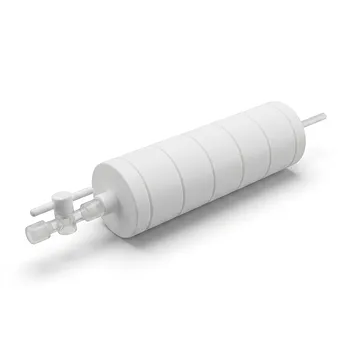
Custom PTFE Filtration System Acid Resistant High Purity Semiconductor Grade Chemical Processing Filter

Custom PTFE Filtration System Acid Resistant High Purity Semiconductor Grade Chemical Processing Filter

Optimized for semiconductor and chemical processing, this customizable PTFE filtration system offers unparalleled acid resistance and high-purity performance. Engineered for demanding industrial environments, our bespoke solutions ensure zero contamination and exceptional long-term durability in highly corrosive media.

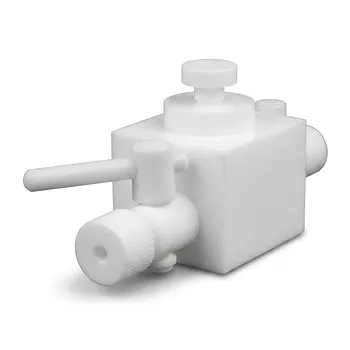
High Corrosion Resistant PTFE Faucet Polytetrafluoroethylene Valve for Chemical Storage Drums and Fluid Transfer Systems Customizable Industrial Grade

High Corrosion Resistant PTFE Faucet Polytetrafluoroethylene Valve for Chemical Storage Drums and Fluid Transfer Systems Customizable Industrial Grade

Engineered for extreme chemical environments, this customizable PTFE faucet provides universal corrosion resistance for plastic drums and fluid systems. Experience leak-proof performance and high-purity fluid transfer with our bespoke polytetrafluoroethylene valve solutions tailored to your unique industrial specifications and requirements.

PTFE PFA Vacuum Filtration System Corrosion Resistant Customizable Shatterproof Laboratory Device

PTFE PFA Vacuum Filtration System Corrosion Resistant Customizable Shatterproof Laboratory Device

High-performance PTFE and PFA vacuum filtration systems designed for extreme chemical resistance. This customizable, shatterproof unit ensures trace-level purity and exceptional thermal stability for demanding laboratory processes and hazardous fluid transfers in industrial and research applications.

PTFE Corrosion Resistant Filter with PFA Valve Connections and Integrated Sieve Plate

PTFE Corrosion Resistant Filter with PFA Valve Connections and Integrated Sieve Plate

High-performance PTFE filtration system featuring PFA valve connections and customizable sieve plates for extreme chemical resistance. Ideal for pharmaceutical and semiconductor processes requiring absolute purity, durability, and bespoke engineering solutions for aggressive fluid handling.

High Temperature Chemical Resistant 50ml PTFE Syringe Customized Teflon Injector with Threaded Seal for Trace Analysis

High Temperature Chemical Resistant 50ml PTFE Syringe Customized Teflon Injector with Threaded Seal for Trace Analysis

Engineered from virgin PTFE, this 50ml high-purity injector offers exceptional chemical resistance and thermal stability from -200°C to +250°C. Perfect for trace analysis, aggressive solvent handling, and precision dispensing in demanding laboratory environments.

PTFE Anti Scald Heat Insulation Sleeve Hot Plate Support Feet Laboratory Benchtop Protection Customizable Thermal Barrier

PTFE Anti Scald Heat Insulation Sleeve Hot Plate Support Feet Laboratory Benchtop Protection Customizable Thermal Barrier

Protect laboratory benchtops with customizable PTFE anti-scald insulation sleeves and support feet. Engineered for high-temperature stability and chemical resistance, these bespoke components ensure safe thermal isolation for hot plates and sensitive equipment in modern high-performance research environments.

Custom PTFE Laboratory Apparatus Corrosion Resistant Low Background Reaction Cells Precision CNC Fabrication

Custom PTFE Laboratory Apparatus Corrosion Resistant Low Background Reaction Cells Precision CNC Fabrication

Precision-engineered custom PTFE laboratory apparatus designed for extreme chemical resistance and low-background trace analysis. Our bespoke reaction cells and labware provide unbreakable, high-purity solutions for demanding industrial and research environments through specialized precision CNC fabrication and performance engineering.

High Purity PTFE Filter with PFA Valve Connections and Integrated Sieve Plate for Corrosive Fluid Processing

High Purity PTFE Filter with PFA Valve Connections and Integrated Sieve Plate for Corrosive Fluid Processing

Optimize laboratory workflows with our high-purity PTFE filtration equipment featuring PFA valve connections and customizable sieve plates. Engineered for absolute chemical resistance and zero-contaminant trace analysis in demanding industrial and research environments. High performance guaranteed for every critical application process.

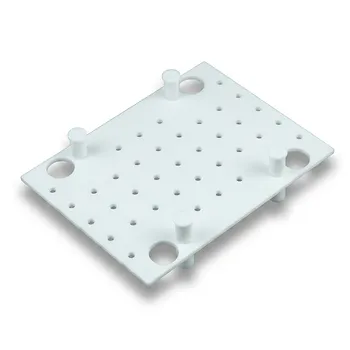
Customizable PTFE Heat Insulation Plate High Temperature Corrosion Resistant Laboratory Support Layered Multi Tier Stand

Customizable PTFE Heat Insulation Plate High Temperature Corrosion Resistant Laboratory Support Layered Multi Tier Stand

High-performance customizable PTFE heat insulation plates offer superior 250°C thermal stability and chemical resistance. Expertly engineered for laboratory environments, these bespoke layered supports ensure maximum durability and precision for demanding industrial fluid or chemical processing applications in modern facilities.

High Temperature PTFE Reaction Sieve with Customizable Layers and Precision Pore Sizes for Threaded Sample Separation Devices

High Temperature PTFE Reaction Sieve with Customizable Layers and Precision Pore Sizes for Threaded Sample Separation Devices

Engineered for extreme chemical environments, this customizable PTFE reaction sieve features adjustable layers and pore counts. Designed with secure threaded connections, it ensures reliable sample separation and high-temperature performance for demanding laboratory and industrial chemical reaction processes.

Custom PTFE Constant Pressure Separatory Funnel Corrosion Resistant Low Background Labware for PFA Flasks

Custom PTFE Constant Pressure Separatory Funnel Corrosion Resistant Low Background Labware for PFA Flasks

Engineered for high-purity trace analysis, this custom PTFE constant pressure separatory funnel offers unmatched chemical resistance and low-background performance. The unit ensures precise fluid transfer and fits PFA flasks, delivering zero-contamination results for demanding industrial, chemical, and laboratory applications.

Custom Virgin Polytetrafluoroethylene Sieve Mesh Solid Waste Analysis Round Square Customizable PTFE Screens

Custom Virgin Polytetrafluoroethylene Sieve Mesh Solid Waste Analysis Round Square Customizable PTFE Screens

Optimize your laboratory filtration with custom virgin PTFE sieve mesh designed for solid waste analysis. Available in 100 mesh or bespoke specifications, these chemically resistant round and square screens deliver unmatched durability and precision for critical industrial testing applications today.

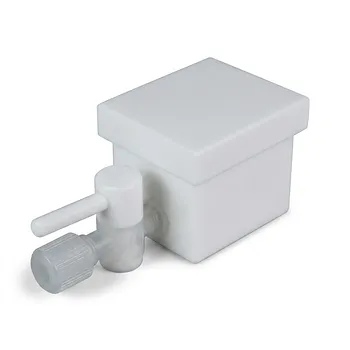
Custom PTFE Corrosion Resistant Insulating Electrophoresis Reaction Cell with Septum and Valves for Low Background Trace Analysis

Custom PTFE Corrosion Resistant Insulating Electrophoresis Reaction Cell with Septum and Valves for Low Background Trace Analysis

Optimize trace analysis with our custom PTFE corrosion-resistant reaction cells. Featuring insulating electrophoresis designs with integrated septums and valves, these high-purity systems ensure low background and zero metal precipitation for demanding industrial laboratory and chemical research applications today.

High Purity Laboratory Grade PTFE Syringe Chemical Resistant Fluoropolymer Injector for Trace Analysis

High Purity Laboratory Grade PTFE Syringe Chemical Resistant Fluoropolymer Injector for Trace Analysis

Engineered for superior chemical resistance, this experimental grade PTFE syringe ensures zero contamination in trace analysis. With a wide operating temperature range and precision-machined graduations, it provides a reliable, unbreakable alternative to glass units.

Corrosion Resistant PTFE Dispersing Disc and High Temperature Propeller Stirring Paddle for Laboratory Chemical Mixing

Corrosion Resistant PTFE Dispersing Disc and High Temperature Propeller Stirring Paddle for Laboratory Chemical Mixing

Optimize laboratory mixing with corrosion-resistant PTFE dispersing discs and propeller stirrers. Engineered for high-temperature stability and ultra-pure trace analysis, these custom-fabricated stirring paddles ensure maximum chemical compatibility and long-term durability in demanding industrial and research environments.

Custom PTFE Petri Dishes Corrosion Resistant High Purity Low Background Labware

Custom PTFE Petri Dishes Corrosion Resistant High Purity Low Background Labware

High-purity custom PTFE petri dishes designed for trace analysis and membrane casting. These vessels offer exceptional chemical resistance, zero leaching, and a non-stick surface, ensuring the highest integrity for sensitive laboratory processes and demanding industrial applications.

Customizable PTFE Reaction Vessel with Electric Stirring Paddle and Buchner Funnel Vacuum Filtration System

Customizable PTFE Reaction Vessel with Electric Stirring Paddle and Buchner Funnel Vacuum Filtration System

High-performance customizable PTFE reaction vessel system featuring integrated electric stirring paddles and Buchner funnel vacuum filtration components designed for demanding laboratory environments requiring absolute chemical inertness, high-purity trace analysis, and bespoke engineering solutions for complex industrial applications.

Custom PTFE Parts Manufacturer for Teflon Parts and PTFE Tweezers

Custom PTFE Parts Manufacturer for Teflon Parts and PTFE Tweezers

KINTEK prioritizes precision production and offers custom fabrication from prototypes to high-volume orders.

Custom PTFE Parts Manufacturer for Teflon Containers and Components

Custom PTFE Parts Manufacturer for Teflon Containers and Components

High-precision PTFE containers for labs & industry. Chemical-resistant, customizable sizes. Ideal for semiconductor, medical & lab applications. Get a quote!

Customizable PTFE Rods for Advanced Industrial Applications

Customizable PTFE Rods for Advanced Industrial Applications

High-performance PTFE solid rods for chemical-resistant, low-friction components. Ideal for lab, medical & industrial applications. Custom machining available.


Leave Your Message